Stormwind - Taken by Storm (1984, Germany) Wishbone Records 12" Vinyl LP Album

- dystopian desert fantasy meets mid-80s german steel

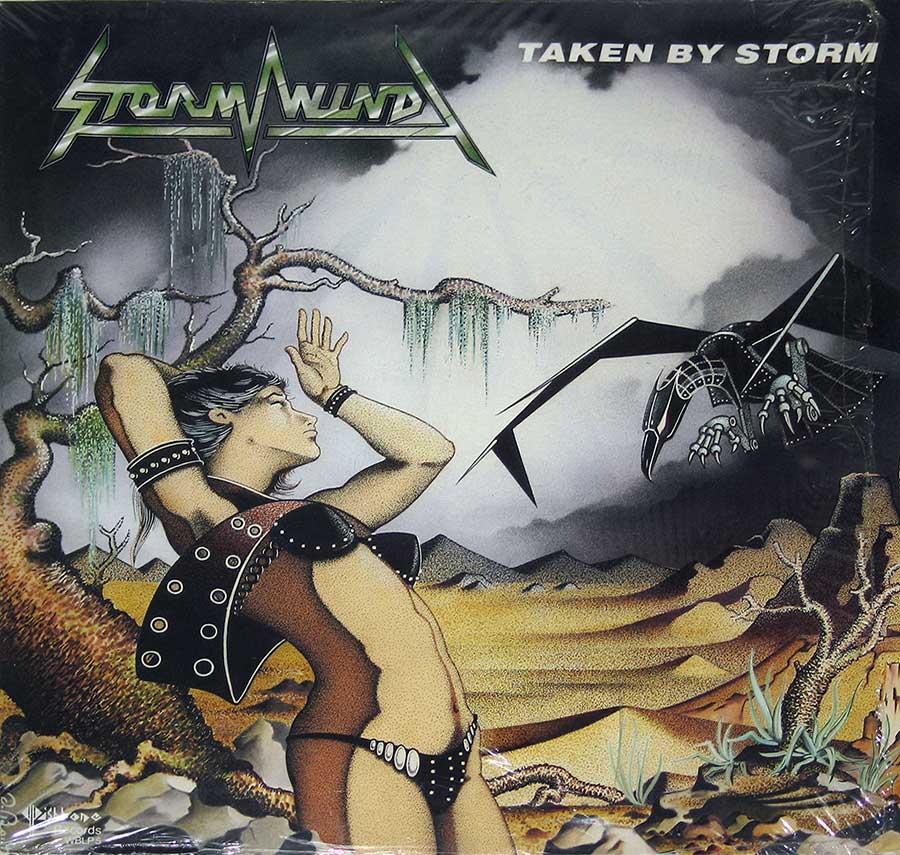
Album Front cover Photo of Stormwind - Taken by Storm (1984, Germany) Wishbone Records 12" Vinyl LP Album https://vinyl-records.nl/

A windswept desert scene unfolds under a grey, storm-heavy sky: a leather-clad warrior looks up in defiance while a mechanical, bird-like predator swoops in from jagged black shapes. Twisted trees, cracked earth, and distant mountains frame the tension, rendered in sharp, airbrushed 80s metal drama.

Stormwind's "Taken by Storm" (1985) never had chart muscle - it had word-of-mouth, battered cassettes, and that stubborn West German scene pride. In the mid-80s German speed-metal churn, this debut sits between classic heavy metal and the faster, tighter edge that was creeping in. Recorded at Sound-Partner in late 1984 and issued on Wishbone, it hits like cold air (and no, nobody asked it to be polite): twin guitars clipped and bright, drums kept on a short leash, vocals snapping commands. "Hard Sins" and "Chaos" sprint, "Warlord" broods a little longer, and Detlef Braun's cover art sells the menace before the needle drops. It still resurfaces on reissues because the riffs refuse to die quietly.

"Taken by Storm" (1985) Album Description:

Stormwind’s "Taken by Storm" doesn’t walk in politely. It barges in, shakes the rain off its jacket, and starts throwing tight, clipped riffs around like it’s late for work. Recorded at Sound-Partner Studio in Kirchhellen between September and November 1984, then landing in March 1985, it has that North Rhine-Westphalia steel to it: clean bite, no fog, no dreamy excuses. "Hard Sins" and "Chaos" hit fast and straight; "Warlord" hangs around longer, not because the band got philosophical, but because they finally had room to breathe.

West Germany, 1984–85: what was in the air

Düsseldorf in the mid-’80s wasn’t built for softness. Concrete, tramlines, rehearsal rooms that smelled like stale cigarettes and warm amplifiers, and a metal scene that learned to move with its elbows out. Big names were already proving you could sound precise and still be dangerous; smaller bands were trying to get on tape before the lineup changed again.

Even the date has that underground messiness: plenty of people file it under 1984 because that’s when the tape rolled, while the release lands in March 1985 on paper. Both years cling to it like mud on boots. Fine.

Genre context: where it sits by contrast

This is heavy metal with speed in the legs and melody kept on a short rope. The closest neighborhood in 1984–85, without pretending Stormwind were alone on the street:

  • Accept for the punch and discipline, though Stormwind carry less arena gloss and more backroom urgency.
  • Warlock for the street-level drive; "Thunder & Lightning" even throws a dedication at Doro Pesch, which says a lot about who mattered in the local conversation.
  • Running Wild and Grave Digger for that German habit of keeping songs lean and moving, like the clock is always running.
  • Sodom and Destruction were sharpening thrash nearby, but Stormwind stay planted in classic heavy metal muscle rather than sprinting into full-on abrasion.
Musical exploration: the sound in the speakers

Two guitars come in like clipped wire—tight, bright, and rehearsed until the corners stop flapping. Drums don’t showboat; they drive. Bass does the unglamorous job, thickening the floor so the riffs don’t skid out.

Most tracks hover around three minutes, because indulgence costs money and this record doesn’t sound rich. "Striker" snaps and disappears before it can get cute. "Thunder & Lightning" swings classic-metal drama without tipping into theatre. "Warlord" is the long one, and it earns the extra real estate by leaning into tension instead of padding.

How the band got to this record (cause/effect, not a scrapbook)

Stormwind formed in February 1980, schoolmates Niko Arvanitis and Rudy Kronenberger starting the thing and dragging it forward until it resembled a real band. Another schoolmate, drummer Olly Kliem, comes in early, and it still takes until 1983 to get a stable lineup and cut a demo. That struggle shows up here as discipline: songs that don’t wander, arrangements that don’t collapse, performances that sound like everyone agreed on the same ending.

Vocals arrive as a turning point: Klaus Lemm joins in 1984, and suddenly the band has a front end that can take the speed and still land a chorus. The album’s tightness isn’t an aesthetic choice; it’s the sound of finally getting the right people in the room before time runs out.

Key people behind the curtain (what they actually did)

Nothing mystical here. Just people doing the work.

  • Ferdinand Köther (producer) keeps the sessions pointed in the same direction, picks takes that hit, and gets the whole thing out the door on Wishbone (catalog WBLP 5) instead of leaving it as another “almost” in a rehearsal space.
  • Ralph Hubert (engineering) captures the attack cleanly: guitars stay defined, drums stay tight, and the record avoids that mushy underground blur that kills fast songs.
  • Sound-Partner Studio, Kirchhellen gives the album its hard edges; the room doesn’t smear the band, it pins them down.
  • Detlef Braun (artwork) paints the threat on the front; Claus Werner Dieck (design) does the back-end reality, the part you actually read with the needle still humming.
  • Jürgen Schweikert (photography) supplies the human proof, the faces and posture that keep the whole package rooted in its time.

A printed inner sleeve comes with the original LP too, which matters because this band wanted the record to feel like a proper statement, not a flimsy flyer with grooves.

Controversy, or the lack of it

No famous scandal hangs off this release. No courtroom drama, no label war, no headline-friendly stupidity. The only real “controversy” is the usual underground argument: which year counts, the recording year or the release date. People will fight about it with straight faces, because that’s what humans do when the amps are turned off.

One quiet personal anchor

Late-night radio is the right habitat for this record: dial half between stations, static chewing at the edges, and then a riff cuts through like headlights on wet asphalt. Sleep can wait.

References

This isn’t a record that asks to be worshipped. It asks to be played loud and judged honestly, which is a much rarer kind of confidence.
Album Key Details: Genre, Label & Format & Release Info

Music Genre:

Heavy Metal

Heavy Metal

Label & Catalognr:

Wishbone Records – Cat#: WBLP 5

Album Packaging

This album "Taken by Storm" includes the original custom inner sleeve with album details, complete lyrics of all songs and photos.

Media Format:

Record Format: 12" LP Vinyl Stereo Gramophone Record
Total Weight: 230g

Release Details:

Release Date: 1984

Release Country: Germany

Production & Recording Information:

Producers:
  • Ferdinand Köther – Producer

    The kind of hands-on local label boss who could turn ambition into an actual finished LP.

    Ferdinand Köther, a no-nonsense producer with the smell of fresh tape and deadlines on his jacket, steered "Taken by Storm" from rehearsal-room chaos to a proper 1984 heavy metal statement. His job here was the unglamorous magic: keeping performances tight, choosing the takes that actually hit, and pushing the record over the finish line on Wishbone Records without sanding off the bite.

Sound & Recording Engineers:
  • Ralph "Ralf" Hubert – Sound / Recording Engineer
  • Ralph "Ralf" Hubert – Record Producer, Sound Engineer, Musician

    He is the guy who can make a mid-budget German metal band sound like it had a plan all along.

    Ralph "Ralf" Hubert is the kind of German studio hawk who makes a band sound sharper than they actually are (a compliment). Back in Sep-Nov 1984 I can place him behind the desk at Sound-Partner Studio in Kirchhellen, engineering Stormwind sessions with that clean, metallic bite. From 1985 onward he stepped out from the control room as bassist, writer and guiding hand in Mekong Delta, where precision riffing and surgical low-end are the whole religion. Across the late 1980s and beyond, his name keeps popping up in metal credits-usually where the drums are tight and the guitars stop flapping. Producer, engineer, musician: the link between sweaty rehearsal rooms and the cold, exacting final mix.

Recording Location:
  • Sound-Partner Studios – Recording Studio (Kirchhellen, Germany)

    A proper working studio where mid-80s German metal could sound sharp instead of small.

    Sound-Partner Studios, a Kirchhellen workhorse with the kind of room that tells the truth, hosted the recording of "Taken by Storm" between September and November 1984. This place is where the band’s attack got pinned to tape: tight guitars, a firm low-end, and drums that don’t smear into fog. The studio’s clean capture is a big reason the record feels disciplined, not demo-ish.

Album Cover Design & Artwork:
  • Detlef Braun – Sleeve Art
  • Detlef Braun – Illustrator, Album Cover Artwork

    I have grabbed LPs just because his painted chaos looked expensive.

    Detlef Braun is a German graphic artist and album-sleeve illustrator who, in the mid-1980s, gave the West German metal underground its painted fangs. From roughly 1984 to 1986 his name turns up on covers for Atlain ("Living in the Dark"), Living Death ("Vengeance of Hell"), Avenger ("Prayers of Steel"), Breaker ("Dead Rider"), Brainfever ("Face to Face", sometimes credited as "Detlev Braun"), and Steeltower ("Night of the Dog"). His calling card is bold, airbrushed drama: reapers, monsters, and steel-on-steel attitude.

  • Claus Werner – Back Cover Design

    The quiet craftsman of the back panel—credits, layout, and all the “real record” signals.

    Claus Werner, a practical-minded designer who understands that metal needs legibility as much as attitude, handled the back cover design for "Taken by Storm." His work is the album’s utility belt: presenting the credits, production notes, and contact/label info in a way that reads clean on an actual sleeve. That structure matters—because collectors and fans live on the back cover almost as much as the music.

Photography:
  • Jürgen Schweikert – Photography

    A lens that makes a band look like a band, not five guys waiting for the bus.

    Jürgen Schweikert, a photographer with a straightforward eye for how metal should present itself, supplied the photography used on "Taken by Storm." His images feed the inner-sleeve vibe and the overall package: faces, attitude, and that mid-80s German scene reality—less fantasy, more sweaty rehearsal-room truth. The photos anchor the album in its time and place, which is exactly what a good sleeve should do.

Additional Notes:

For booking and information write to:

Wishbone Records, F. Köther, Graf-Imma-Str. 48,

4630 Bochum 1, Germany, 0234 / 79 79 92, Telex 8 25 735

Thanks to:

Udo Dirkschneider (Accept) for helping us to complete band,

Warlock for their help, being our friends and believing in us, the metal magazine

Desaster for having open eyes and ears for good new bands,

Andy and Nicky for helping us with the lyrics,

Anke for hairstyling, our roadies Ralf, Uar and Minka,

Ralf, Monika, Monty and Dieter of Café Litas for keeping metal alive,

Everybody who helped us make this record and all our friends and fans for their support and believing in us.

Band Members / Musicians:

Band Line-up:
  • Klaus Klemm – Vocals

    A metal frontman with a street-level bite, built to sell hooks without polishing the edges off.

    Klaus Klemm, the vocalist who gives Stormwind its human grit, drives "Taken by Storm" with phrasing that’s more punch than poetry. This record lives on his ability to sound urgent over fast riffs—snarling through "Hard Sins" and leaning into the drama when the tempos open up. The choruses land because he commits like the tape is expensive (because it was).

  • Niko Arvanitis – Guitars

    A Düsseldorf riff-carpenter who treats twin-guitar metal like a job you show up for, not a hobby you drift through.

    Niko Arvanitis is a Düsseldorf guitarist who learned early that riffs don't survive on charm - they survive on discipline. He co-founded Stormwind in February 1980 and played guitars through 1986, cutting the band's debut "Taken by Storm" and the 1985 "Warbringer" EP. In 1985-1989 he stepped into Warlock, tightening the bite on "Fight for Rock" (1986) and helping carry "True as Steel" (1986) into "Triumph and Agony" (1987). After that, he popped up in What? (1989-1990), then later as a guest with Powergod (2001) and on Doro's 2010 anniversary release, plus a songwriting credit for Mad Max (2012). Rock Classic Allstars and Jeff Brown gigs show up later too - proof he never fully left the stage.

  • Wolla Bohm – Guitars

    A German heavy metal lifer with road-grit in his hands, giving the record extra bite and confidence.

    Wolla Bohm, a guitarist who’s done time in the German metal trenches, adds the second blade to Stormwind’s attack on "Taken by Storm." The album’s stingy, cutting twin leads and the tougher rhythm push—especially in "Thunder & Lightning" and "Warlord"—come from that two-guitar pressure. His presence helps the band sound like a unit, not a rehearsal tape with ambition.

  • Wolfgang "Wolla" Bohm, a guitarist from Germany, has played in several leading German Heavy Metal bands including Darxon, Snakebite, Stormwind and U.D.O.
 
  • Rudy Kay – Bass

    The low-end anchor who keeps the riffs from floating off into thin air, especially when the tempos sprint.

    Rudy Kay, the bassist holding the floor steady, gives "Taken by Storm" its weight and forward shove. The lines mostly ride the guitars—because that’s how 1984 metal survives on vinyl—but the real contribution is glue: locking the kick drum, thickening the choruses, and making fast cuts like "Breaker" hit like a single machine instead of five separate ideas.

  • Olly Kliem – Drums

    A drummer with a tight right foot and no patience for wobble, driving the album like it owes him money.

    Olly Kliem, the engine room of this lineup, pushes "Taken by Storm" with brisk, no-frills heavy metal momentum. The tempos stay crisp, fills are functional rather than flashy, and the grooves keep the riffs honest—especially on the straight-ahead chargers like "Striker." The album’s “tight but hungry” feel starts with him keeping everyone on the same rail.

Complete Track-listing:

Tracklisting Side One:
  1. Hard Sins (03:09)
  2. Chaos (03:39)
  3. The Next Could Be You (03:17)
  4. Striker (02:42)
  5. Thunder & Lightning (03:36)
Video: Stormwind - hard sins - 1984
Tracklisting Side Two:
  1. Evil's Child (03:02)
  2. She-Devil (03:20)
  3. Fairy of Dreams (03:53)
  4. Breaker (02:54)
  5. Warlord (04:46)
Video: Stormwind - warlord - 1984

Disclaimer: Track durations shown are approximate and may vary slightly between different country editions or reissues. Variations can result from alternate masterings, pressing plant differences, or regional production adjustments.

Album Front Cover Photo
Stormwind – Taken by Storm front cover, Wishbone Records WBLP 5, mid-1980s German heavy metal LP. Airbrushed fantasy scene with leather-clad woman in desert confronting mechanical bird under storm sky; metallic green Stormwind logo top left, TAKEN BY STORM top right. Gloss-laminated sleeve shows edge stress, light corner dings, shrink-wrap reflections and pressure marks typical of handled original pressings.

Held at arm’s length first, because the gloss catches light like a cheap mirror and throws it back at you. The Stormwind logo sits sharp and metallic green in the upper left, the kind of chrome-tipped lettering every mid-80s German band flirted with. “TAKEN BY STORM” is shoved to the top right in plain block type, almost apologetic. That imbalance feels deliberate, like the band name matters more than the concept. Fair enough.

Closer up, the airbrush work gets busy. A leather-clad woman arches back against a twisted tree, hands raised, staring down a mechanical bird that looks half hawk, half Cold War scrap metal. The desert behind her isn’t romantic; it’s cracked and yellowed, dotted with scrub that feels more Ruhrgebiet imagination than actual Sahara. The storm cloud swallowing the sky has that grey-white fade artists loved in ’84—dramatic, maybe a bit overcooked. Still, it sells the threat.

The gloss lamination is thick and slightly uneven at the edges. Along the bottom lip there’s the faint ripple you only notice when you tilt it—pressure from decades of being shelved tight. Corners show soft rounding, especially lower right, where fingers always grab. The shrink wrap in this copy is still clinging at the top edge, wrinkled, catching reflections in diagonal streaks. That plastic glare annoys me, but it also proves the sleeve hasn’t been abused.

Ink density is solid; blacks in the storm cloud haven’t browned out. No sun fade on the spine side, which tells me it didn’t sit in a shop window too long. Wishbone Records credit sits small and practical near the lower edge—no drama, just business. The whole design screams mid-budget ambition. Not subtle, not pretending to be subtle. It wants to look dangerous. And honestly, after flipping through too many polite press sleeves from the same era, that bluntness is refreshing.

Album Back Cover Photo
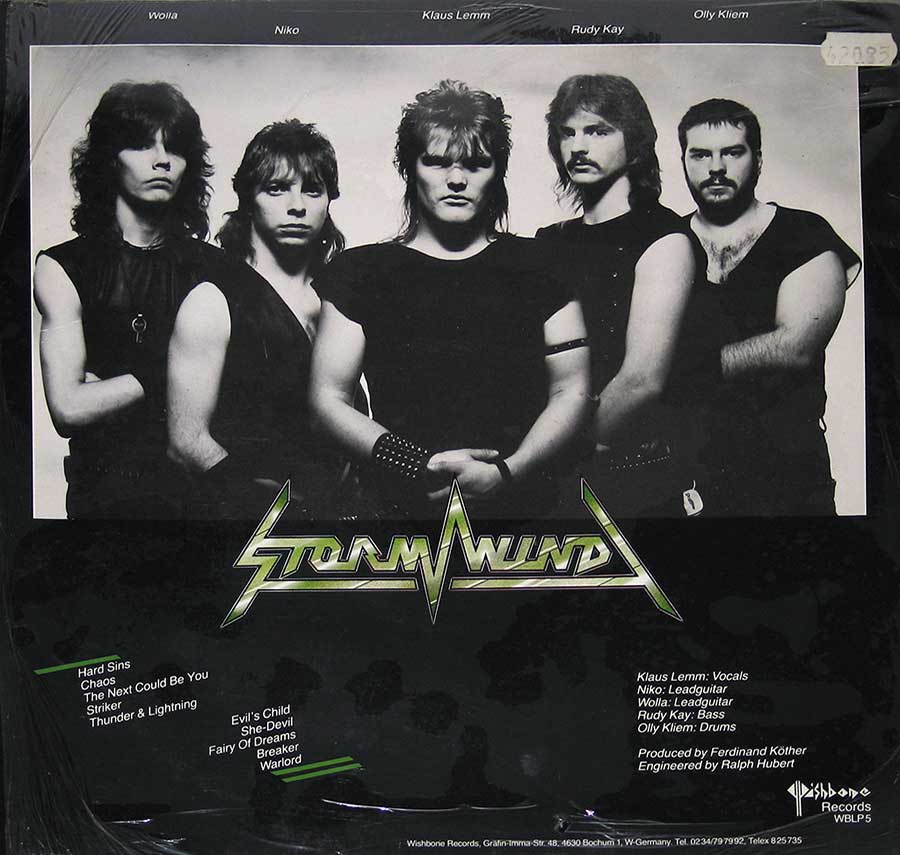
Stormwind – Taken by Storm back cover, Wishbone Records WBLP 5, German 1984/85 LP. Black and white band photo across top with members identified above heads; green Stormwind logo centered below; tracklist split left and right; production credits to Ferdinand Köther and Ralph Hubert; Wishbone Records logo and Bochum address at bottom. Gloss sleeve shows corner wear, price sticker residue and shrink-wrap creasing.

Flip the sleeve over and the fantasy evaporates. Now it’s five young Stormwind band-members in black shirts, arms folded, staring down the camera like the photographer told them to look serious and nobody dared blink. The photo runs wide across the top half, clean black-and-white, high contrast, no background distractions. Names float above their heads—Wolla, Niko, Klaus Lemm, Rudy Kay, Olly Kliem—printed small and practical, almost like school portraits. No mysticism here. Just faces.

The lower half turns utilitarian fast. A large metallic-green Stormwind logo sits centered, sharper than it has any right to be on a mid-budget sleeve. Track titles split left and right in angled columns, with those thin green slashes underlining certain songs. That graphic touch feels slightly forced, like someone wanted movement but ran out of ideas halfway through. Still, it ties the front and back together.

Gloss lamination again, thick enough to show light scuffs when tilted. There’s a faint crease line running horizontally just below the band photo—pressure from years stacked too tight. Upper right corner carries a small price sticker, “20.85,” curling at the edge. Bottom seam shows the usual micro-fractures in the black ink where the cardboard flexes. Nothing dramatic, but honest wear.

Credits are tight and factual: Produced by Ferdinand Köther. Engineered by Ralph Hubert. Wishbone Records WBLP 5 printed bottom right with the Bochum address and telephone line like a business card. No hype copy, no dramatic manifesto. That restraint actually works. The back cover isn’t trying to sell a storm. It’s documenting who made it and where. After too many sleeves that shout nonsense, this one just states the facts and lets the vinyl argue the rest.

First Photo of Custom Inner Sleeve
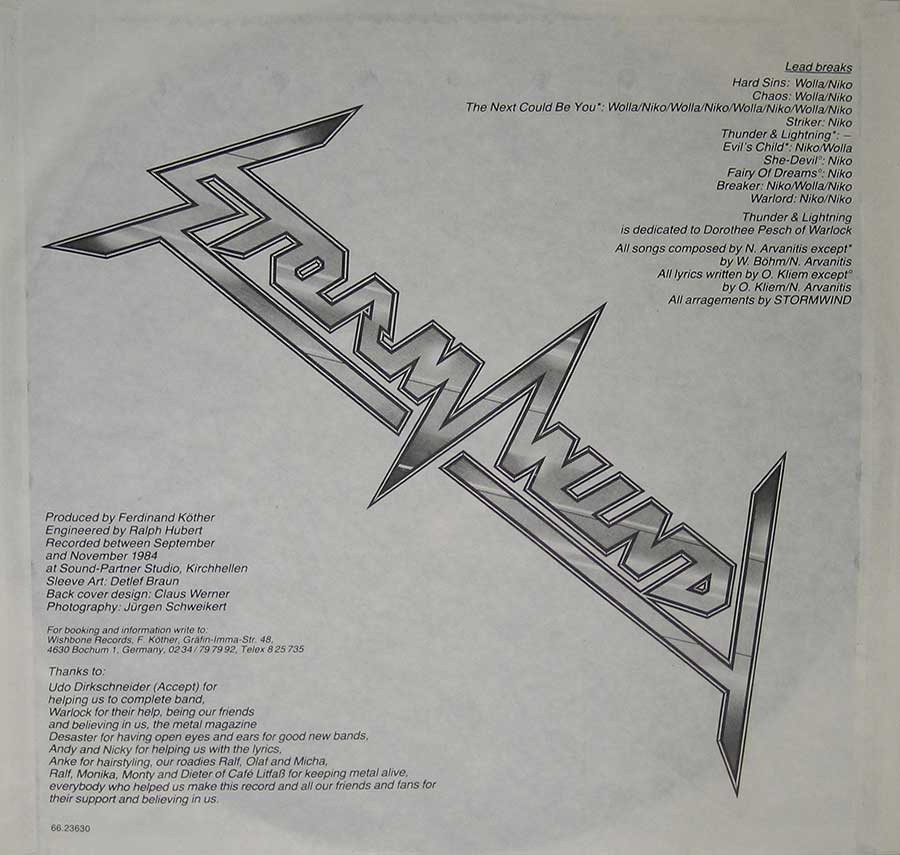
Stormwind – Taken by Storm custom inner sleeve, Wishbone Records WBLP 5, Germany 1984/85. White lyric inner with large diagonal Stormwind logo outline, detailed songwriting credits, lead break notes, production credits, dedication to Doro Pesch of Warlock, and booking address for Wishbone Records Bochum. Matte paper stock shows light foxing, edge wear and handling creases typical of original 1980s German pressings.

Slide the record out and this inner sleeve feels almost stubbornly plain. Matte white stock, no gloss, no fantasy artwork—just a giant diagonal Stormwind logo stretching from lower left to upper right like someone testing how much space a band name can occupy. The ink sits slightly grey against the paper, not deep black, and that tells you this wasn’t printed for luxury. It was printed to function.

Upper right quadrant carries the real meat: lead break notes, song-by-song guitar attributions—Wolla, Niko—stacked in tight, slightly uneven lines. The spacing drifts a touch, like the typesetter nudged things by hand. Below that, a dedication to Dorothee Pesch of Warlock. That detail always makes me pause; it anchors this record firmly in the Düsseldorf metal ecosystem instead of floating in generic 80s bravado.

Lower left corner holds the production credits and studio notes in small, compact type. Ferdinand Köther, Ralph Hubert, Sound-Partner Studio, Kirchhellen. The Wishbone Records booking address sits there like a reminder that this was still a regional operation with a telephone and a telex line. No myth-building, just contact information.

Handling marks show easily on this paper. Light foxing freckles near the edges. A faint fold line near the opening where fingers repeatedly grabbed vinyl. Corners soften fast on these inners, and this one shows mild rounding without full splits—already better than most copies that have torn along the bottom seam. The simplicity works in its favor. It isn’t pretending to be art. It’s documentation, practical and slightly austere, which in a way feels more honest than the front cover drama.

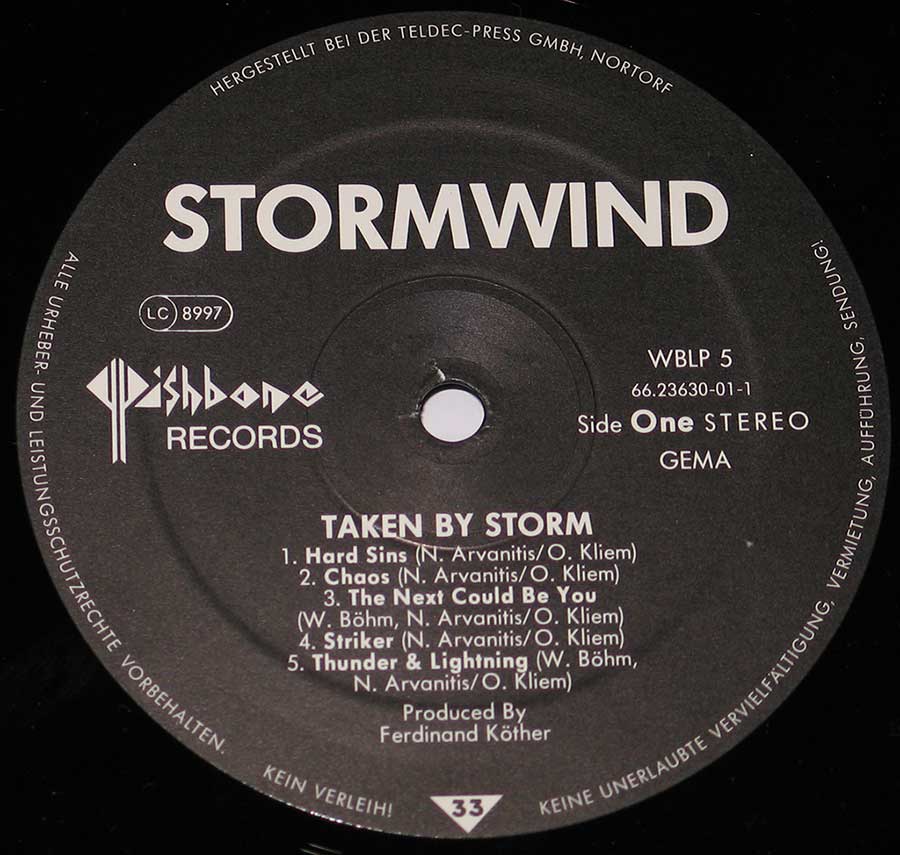
Close up of Side One record’s label
Close up of Side One label for Stormwind Taken by Storm, Wishbone Records WBLP 5, black label with white print, LC 8997, GEMA, Teldec-Press Nortorf pressing, catalogue 66.23630-01-1

This is Side One of Stormwind’s “Taken by Storm” on Wishbone Records, pressed in West Germany. The label is matte black with sharp white print, no colour distraction, no gimmicks. “STORMWIND” dominates the upper half in heavy sans-serif block letters, wide and confident, sitting above the album title in smaller capitals. To the left, the angular Wishbone Records logo looks like a stylised tuning fork or split blade—geometric, rigid, almost industrial—serving as both brand mark and visual warning that this is not a pop imprint.

Around the outer rim, the German rim text curves tightly along the edge: “Hergestellt bei der Teldec-Press GmbH, Nortorf” clearly identifies manufacturing at the Teldec plant. The rights society GEMA is printed at the right under “Side One STEREO,” alongside catalogue WBLP 5 and the additional pressing number 66.23630-01-1. LC 8997 appears in a small oval, confirming the label code. Track titles are centred in clean stacked lines, each composer credit in brackets, with “Produced by Ferdinand Köther” placed modestly below the listing. The bottom edge carries the 33 rpm triangle symbol and the familiar German anti-piracy warning text. No background artwork—just black vinyl and disciplined typography. Functional, direct, very mid-80s West German metal.

Wishbone Records, Germany Label

Wishbone Records was a small West German metal label active during the mid-1980s, supporting regional heavy metal acts. This particular black-and-white label design was used by Wishbone Records approximately between 1984 and 1986.

Colours
Matte black background with white typography
Design & Layout
Upper half dominated by band name; centred album title and track list; label logo on left; technical and rights data aligned right
Record company logo
Stylised angular “Wishbone” emblem resembling a split tuning fork or blade, geometric and industrial in appearance
Band/Performer logo
Band name printed in bold sans-serif block capitals, no graphic logo used on label
Unique features
LC 8997 label code; Teldec-Press GmbH Nortorf manufacturing credit; additional pressing number 66.23630-01-1
Side designation
“Side One STEREO” printed right of centre
Rights society
GEMA
Catalogue number
WBLP 5
Rim text language
German
Track list layout
Numbered list, centred, composer credits in parentheses beneath each title
Rights info placement
Curved rim text around outer edge; GEMA and LC code printed on right side
Pressing info
“Hergestellt bei der Teldec-Press GmbH, Nortorf” printed along upper rim
Background image
Solid black, no imagery, utilitarian finish

All images on this site are photographed directly from the original vinyl LP covers and record labels in my collection. Earlier blank sleeves were not archived due to past storage limits, and Side Two labels are often omitted when they contain no collector-relevant details. Photo quality varies because the images were taken over several decades with different cameras. You may use these images for personal or non-commercial purposes if you include a link to this site; commercial use requires my permission. Text on covers and labels has been transcribed using a free online OCR service.