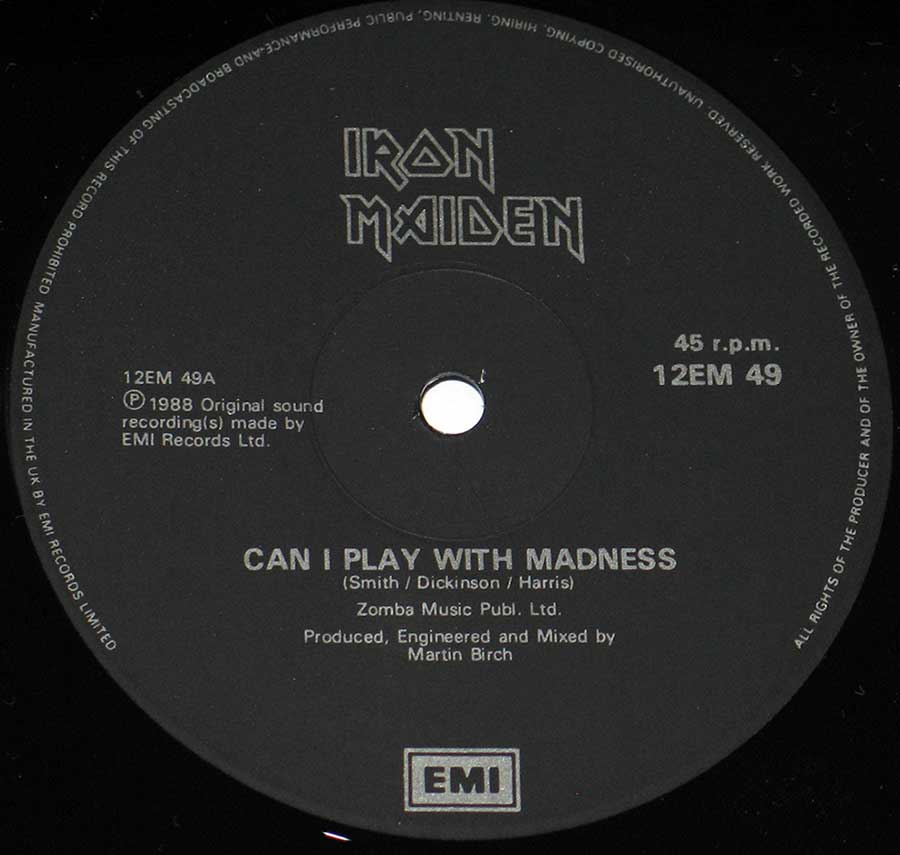
IRON MAIDEN - Can I Play with Madness 12" Vinyl Mini-LP Album

- Genuine UK Pressing with Black Record Label

"Can I Play with Madness" was the sixteenth single released by IRON MAIDEN. Released in 1988, "Can I Play with Madness" is the first single from the Seventh Son of a Seventh Son album.

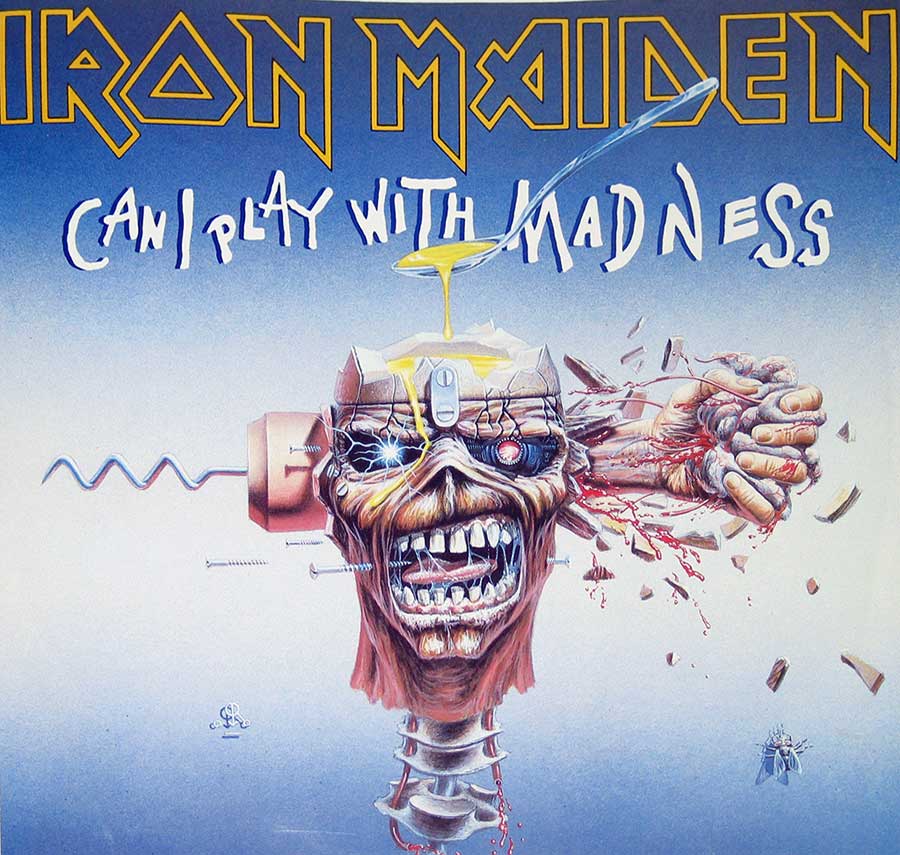
IRON MAIDEN - Can I Play with Madness England Release 12" Vinyl Album  front cover https://vinyl-records.nl

IRON MAIDEN - Can I Play with Madness 12" Vinyl Mini-LP Album - Genuine UK Pressing with Black Record Label
Album Description:

** In the shadows of prophecy and mysticism, Iron Maiden unleashed their sixteenth single, "Can I Play with Madness," a 12" Vinyl Mini-LP, a genuine UK pressing with a stark black record label. Released in 1988, this track was the first single from the enigmatic and ambitious album "Seventh Son of a Seventh Son," a conceptual masterpiece that delved into themes of fate, clairvoyance, and the struggle between good and evil.

Emerging from the historical context of the late '80s, "Can I Play with Madness" was born in an era when the world grappled with uncertainty and change. The song's narrative centers around a young man seeking answers from a seer, only to be met with visions of doom and chaos. This thematic exploration reflected the broader societal anxieties of the time, as people searched for meaning and direction amidst the shifting sands of geopolitics and cultural upheaval.

Musically, "Can I Play with Madness" is a quintessential Iron Maiden track, blending intricate melodies with powerful, driving rhythms. The song opens with a catchy, anthemic riff that immediately grabs the listener's attention. Adrian Smith and Dave Murray's guitars weave a rich tapestry of sound, their solos soaring with precision and emotion. Steve Harris' bass lines gallop with characteristic intensity, providing a solid foundation, while Nicko McBrain's drums thunder with relentless energy. Bruce Dickinson's vocals, both commanding and introspective, deliver the song's existential queries with a sense of urgency and conviction.

As the heavy metal genre continued to evolve in the late '80s, Iron Maiden stood at its forefront, pushing the boundaries of what the music could convey. "Can I Play with Madness" exemplifies the band's ability to infuse their songs with narrative depth and philosophical musings, all while maintaining their signature sonic ferocity. The track's melodic hooks and sing-along chorus made it a fan favorite, showcasing Iron Maiden's knack for creating music that was both intellectually stimulating and viscerally exciting.

Controversy was never far from Iron Maiden's doorstep, and the release of "Can I Play with Madness" was no exception. The song's dark themes and the album's overarching narrative of a prophetic seventh son drew mixed reactions. While some praised the band for their artistic ambition and willingness to tackle complex subject matter, others questioned the commercial viability of such a conceptual approach. Despite these debates, the song's impact was undeniable, solidifying Iron Maiden's reputation as fearless innovators in the heavy metal arena.

The production of "Can I Play with Madness" was once again entrusted to Martin Birch, whose collaboration with the band had already produced several iconic albums. Recorded in 1987 in England, Birch's production work on the track is meticulous and powerful, capturing the band's dynamic range and the intricate layers of their sound. His expertise ensured that every element of the song, from the soaring vocals to the galloping rhythms, was perfectly balanced and impactful.
Music Genre:

NWOBHM New Wave of British Heavy Metal 

Album Production Information:

Produced by Martin Birch

  • Martin Birch – Producer, Sound Engineer

    Treat Martin Birch like the invisible band member: you don’t see him on the sleeve, but you sure hear him in the punch, the bite, and that “turn it up” clarity. His run is legendary—starting as an engineer in the late 1960s, sharpening the sound with Deep Purple in the early 1970s, helping Rainbow hit that dramatic hard-rock stride in the mid-to-late 1970s, powering the Dio-era Black Sabbath in 1980–1981, then basically going exclusive with Iron Maiden from 1981 to 1992 before he bowed out.

    Martin Birch, to my ears, is the guy who made heavy records feel both massive and surgical—tight low end, bright attack, and a midrange that cuts like fresh steel without turning into ear-pain. He built long relationships instead of quick drive-bys: Deep Purple, Rainbow, Whitesnake, Black Sabbath, and then that famous Iron Maiden stretch from "Killers" (1981) through "Fear of the Dark" (1992), after which he retired. That’s not just a resume, that’s a whole era with his fingerprints on it.

  • Record Label & Catalognr:

    EMI 12EM 49

    Media Format:

    12" Vinyl EP  Gramophone Record
    Album weight 230 gram 

    Year & Country:

    1988 Made in England  
    Band Members and Musicians on: IRON MAIDEN Can I Play with Madness
      Band-members, Musicians and Performers
    • Bruce Dickinson - Vocals
    • Bruce Dickinson – Vocals Bruce Dickinson, born August 1958, is the powerhouse vocalist who propelled Iron Maiden to legendary status. Joining the band in 1981, his operatic range, sharp phrasing, and commanding stage presence reshaped the group’s sound and ambition, defining era-classic albums like The Number of the Beast and Powerslave. Beyond Maiden, he built a parallel career as a solo artist, commercial pilot, author, and broadcaster, giving his legacy a reach that stretches well beyond heavy metal.
    • Dave Murray - guitar
    • Dave Murray – Guitar

      Maiden’s calm killer: smooth leads, twin-guitar harmony for days, and that melodic bite that makes the “gallop” feel cinematic instead of chaotic.

      Dave Murray (born 23 December 1956, Edmonton, Middlesex, England) is one of the defining lead guitar voices of heavy metal, and in my book he’s the melodic “second spine” of Iron Maiden. His timeline with the band starts early: joining in 1976, getting briefly pushed out in 1977, then returning in 1978 and staying locked in ever since—making him one of the longest-serving members in the whole Maiden saga. During that 1977 gap he spent around six months with Urchin (Adrian Smith’s band), which is a fun little historical glitch in the matrix if you like your Maiden lore messy and human. Beyond the main band, his most notable “outside the mothership” credit is the all-star charity metal project Hear ’n Aid (1985), because apparently even guitar lifers sometimes leave the bunker to do side quests. Dave Murray Wiki

    • Adrian Smith - guitar, backing vocals
    • Adrian Smith – Guitarist, Songwriter Adrian Smith is one of those players I always associate with Iron Maiden’s classic sound and its later revival. Joining in 1980, leaving in 1990, and returning in 1999, his melodic solos and sharp songwriting helped define albums from The Number of the Beast to Brave New World and beyond.
    • Steve Harris - bass guitar, backing vocals
    • Steve Harris – Bass Guitar, Songwriter

      Iron Maiden’s engine room: galloping bass lines, history-nerd lyrics, and “captain of the ship” energy baked into every riff.

      Steve Harris (born 12 March 1956, Leytonstone, England) is the rare bassist who doesn’t just hold the floor—he draws the whole blueprint. In my book, he’s the founder and primary songwriter who’s kept Iron Maiden on its rails from 1975–present, with that instantly recognizable “gallop” driving huge chunks of the catalogue. The pre-Maiden grind matters too: first band days in Influence/Gypsy’s Kiss (1973–1974, including a documented gig run in 1974), then the older, blues-leaning Smiler period (1974–1975) where his more ambitious writing basically forced the next step: forming Maiden. Outside the mothership, he’s fronted his own hard-rock outlet British Lion (2012–present), a project that grew out of connections going back to the early 1990s and finally hit the world as his solo debut in 2012.

    • Nicko McBrain - drums
    • Nicko McBrain – Drums Nicko McBrain, born 1952, is the powerhouse drummer who has driven Iron Maiden’s thunderous engine since joining in 1982. His playing combines brute force with swing and pinpoint timing, giving albums like The Number of the Beast and Powerslave their unstoppable momentum. Before Maiden, his work with Trust and the Pat Travers Band sharpened his style, culminating in a career that redefined metal drumming.
    Complete Track Listing of: IRON MAIDEN Can I Play with Madness

    The Song/tracks on "IRON MAIDEN Can I Play with Madness" are

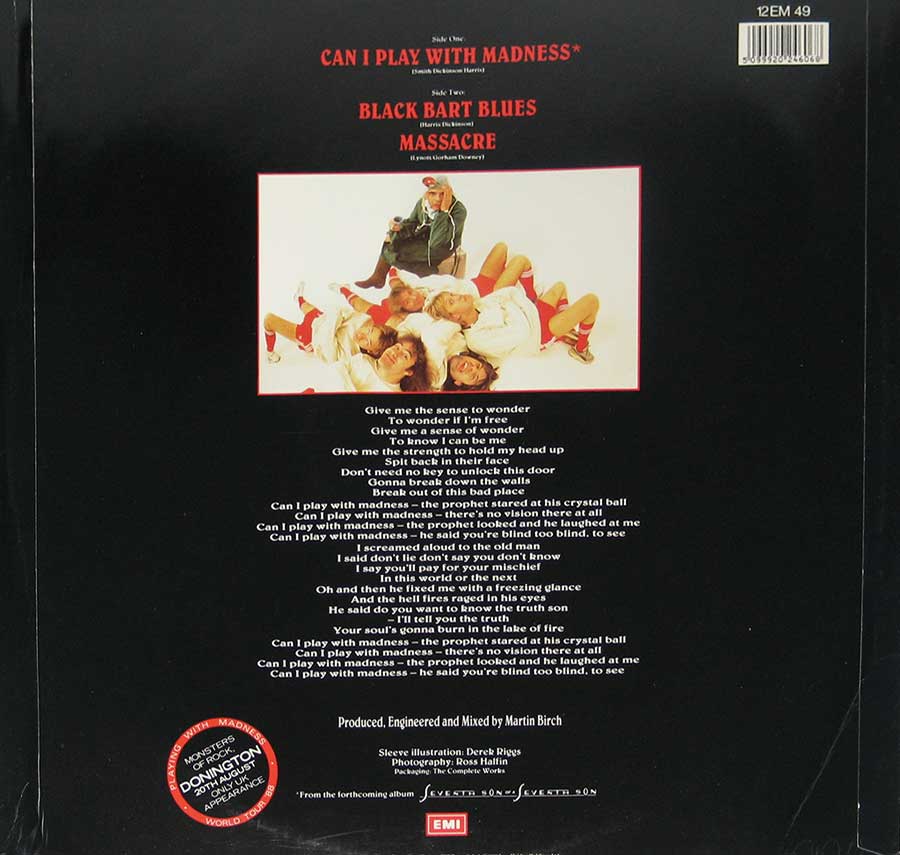
    • Can I Play with Madness (Adrian Smith, Bruce Dickinson, Steve Harris) - 3:30
    • Black Bart Blues (Harris, Dickinson) - 6:41
    • Massacre (Phil Lynott, Scott Gorham, Brian Downey; Thin Lizzy cover) - 2:54

    IRON MAIDEN - Vinyl Records Discography Home Page