- Prophecy Pressed in Plastic — Eddie Like You’ve Never Seen Him Before
This cut-to-shape edition of “The Clairvoyant” transforms Iron Maiden’s late-80s imagination into a sculpted collectible. Eddie’s three-eyed prophetic design captures the mystical energy of the Seventh Son era, turning a single into a vivid art object. It remains one of the band’s most visually striking and sought-after picture discs.
Iron Maiden’s The Clairvoyant arrives as a striking cut-to-shape picture disc, turning one of the key singles from the 1988 Seventh Son of a Seventh Son era into a collectible symbol of the band’s mystical, prophetic universe. The shaped vinyl amplifies the song’s themes of fate and foresight through bold imagery and late-’80s visual flair.
Released at a time when Maiden were at full creative power, the single sits at the heart of the album’s concept about a supernatural child burdened with visions of the future. Its exploration of prophecy and destiny echoed an era wrestling with anxieties about change, technology, and the unknown.
Musically, the track channels Maiden’s classic strengths: Steve Harris delivering a foreboding bass introduction, tight melodic interplay from the guitars, and Nicko McBrain pushing the rhythm with urgency. The arrangement builds tension layer by layer, reflecting the internal struggle of a mind overwhelmed by unwanted knowledge.
Bruce Dickinson’s vocals drive the story with emotional clarity, capturing both the weight and isolation of the clairvoyant figure. The lyrics turn philosophical, questioning life, death, and the awareness of inevitable fate without offering easy answers.
As part of Maiden’s evolving late-’80s sound, the single demonstrated the band’s ability to merge narrative depth with accessible heavy-metal power. It remains one of the standout pieces of the album’s broader storyline, balancing melody, introspection, and punch.
The shaped vinyl release adds a visual dimension to the song’s identity, transforming it into a tangible artifact of Maiden’s conceptual ambition. For collectors, it stands as both a unique physical edition and a reminder of the band’s fearless experimentation during one of their most imaginative eras.
NWOBHM – New Wave Of British Heavy Metal
A powerful branch of late-70s and 1980s British metal known for fast riffs, soaring vocals, and dramatic songwriting. Iron Maiden helped define the movement with its mix of intensity, melody, and storytelling.
EMI – Cat#: EMP 79
Record Format: Cut-to-Shape Shaped Picture Disc
1988 – Made in UK
Treat Martin Birch like the invisible band member: you don’t see him on the sleeve, but you sure hear him in the punch, the bite, and that “turn it up” clarity. His run is legendary—starting as an engineer in the late 1960s, sharpening the sound with Deep Purple in the early 1970s, helping Rainbow hit that dramatic hard-rock stride in the mid-to-late 1970s, powering the Dio-era Black Sabbath in 1980–1981, then basically going exclusive with Iron Maiden from 1981 to 1992 before he bowed out. Read more...
Martin Birch, to my ears, is the guy who made heavy records feel both massive and surgical—tight low end, bright attack, and a midrange that cuts like fresh steel without turning into ear-pain. He built long relationships instead of quick drive-bys: Deep Purple, Rainbow, Whitesnake, Black Sabbath, and then that famous Iron Maiden stretch from "Killers" (1981) through "Fear of the Dark" (1992), after which he retired. That’s not just a resume, that’s a whole era with his fingerprints on it.
Produced, Engineered & Mixed by Martin Birch
© 1988 Original Sound Recording Made by EMI Records Ltd.
Live recording produced by Tony Wilson & Martin Birch.
Released by arrangement with "The Friday Rock Show" on Radio 1.
BBC Enterprises Limited.
© BBC 1988, under exclusive license to EMI Records Ltd.
Maiden’s calm killer: smooth leads, twin-guitar harmony for days, and that melodic bite that makes the “gallop” feel cinematic instead of chaotic. Read more...
Dave Murray (born 23 December 1956, Edmonton, Middlesex, England) is one of the defining lead guitar voices of heavy metal, and in my book he’s the melodic “second spine” of Iron Maiden. His timeline with the band starts early: joining in 1976, getting briefly pushed out in 1977, then returning in 1978 and staying locked in ever since—making him one of the longest-serving members in the whole Maiden saga. During that 1977 gap he spent around six months with Urchin (Adrian Smith’s band), which is a fun little historical glitch in the matrix if you like your Maiden lore messy and human. Beyond the main band, his most notable “outside the mothership” credit is the all-star charity metal project Hear ’n Aid (1985), because apparently even guitar lifers sometimes leave the bunker to do side quests. Dave Murray Wiki
Iron Maiden’s engine room: galloping bass lines, history-nerd lyrics, and “captain of the ship” energy baked into every riff. Read more...
Steve Harris (born 12 March 1956, Leytonstone, England) is the rare bassist who doesn’t just hold the floor—he draws the whole blueprint. In my book, he’s the founder and primary songwriter who’s kept Iron Maiden on its rails from 1975–present, with that instantly recognizable “gallop” driving huge chunks of the catalogue. The pre-Maiden grind matters too: first band days in Influence/Gypsy’s Kiss (1973–1974, including a documented gig run in 1974), then the older, blues-leaning Smiler period (1974–1975) where his more ambitious writing basically forced the next step: forming Maiden. Outside the mothership, he’s fronted his own hard-rock outlet British Lion (2012–present), a project that grew out of connections going back to the early 1990s and finally hit the world as his solo debut in 2012.
Disclaimer: Track durations shown are approximate and may vary slightly between different country editions or reissues. Variations can result from alternate masterings, pressing plant differences, or regional production adjustments.
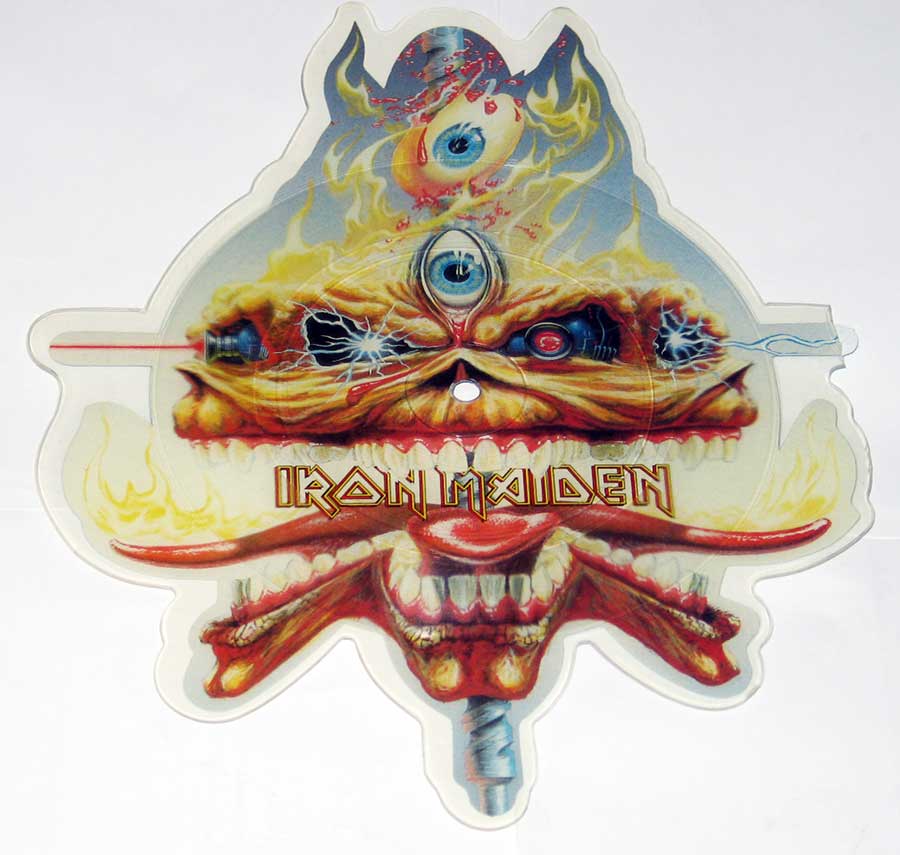
This cut-to-shape picture disc showcases a fierce and surreal interpretation of Eddie, Iron Maiden’s legendary mascot, rendered in a highly stylized design from the Seventh Son of a Seventh Son era. The disc itself is sculpted around the outer edges of the artwork, creating a jagged silhouette that mirrors the chaotic contours of Eddie’s flaming, distorted face. Three vertically aligned eyes dominate the composition: one centered and glaring, one mechanical and wired with blue energy, and the topmost eye erupting upward in a burst of molten fragments.
Eddie’s mouth stretches into a violent, bone-like snarl, with layers of exposed teeth and scorched textures radiating from the central hole of the vinyl. Yellow flames curl along the underside, while electric bolts crackle across the sides of his head, blending organic decay with sci-fi mechanics. The Iron Maiden logo appears beneath the snarling jaw, its sharp lettering embedded within the fiery color palette. Every line and glow reinforces the prophetic, supernatural theme that defined the era.
As a late-1980s shaped picture disc, this release stands out not only for its striking visual intensity but also for its sculptural presence. The unusual outline, vivid colors, and layered symbolic imagery make the object feel like both a functional record and a collectible art piece—an artifact from a time when vinyl was used not just to play music but to extend the mythology of the band itself.
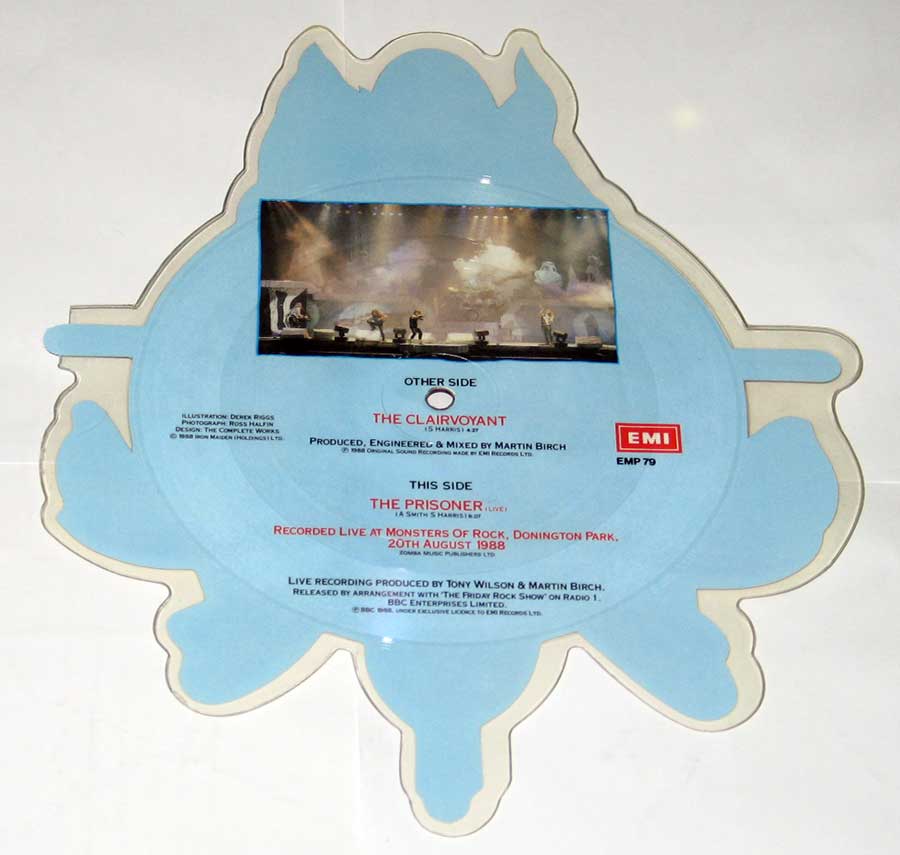
The reverse side of this cut-to-shape picture disc retains the jagged silhouette of Eddie’s head, but the artwork shifts into a calmer, icy blue backdrop with detailed production text spread cleanly across the vinyl’s face. Dominating the upper center is a rectangular live photograph of Iron Maiden performing onstage: the band members silhouetted against immense clouds of smoke, bright stadium lights, and towering stage props from the Seventh Son tour. The image adds a vivid documentary touch to the collectible format.
Below the photo, clear text identifies both tracks: “The Clairvoyant” on the opposite side and “The Prisoner (Live)” recorded at the Monsters of Rock festival in Donington Park on 20 August 1988. Production credits specify that the track was produced, engineered, and mixed by Martin Birch, with live recording production by Tony Wilson and Martin Birch. Additional lines reference BBC Enterprises, licensing agreements, and EMI’s imprint, including the red-and-white EMI logo and catalog number EMP 79 printed neatly to the right.
The lower-left section acknowledges the contributors behind the release: illustration by Derek Riggs, photography by Ross Halfin, and sleeve design by The Complete Works. The clean, organized layout contrasts dramatically with the chaotic front artwork, making this side a functional, informative complement to the disc’s sculpted, collectible form.