IRON MAIDEN - No Prayer For The Dying 12" Vinyl LP Album

"No Prayer For The Dying" is the first album recorded following the departure of guitarist Adrian Smith who left the band during the pre-production phase of the album. The album ushered in a change of vocal style for Bruce Dickinson from the operatic sound of the '80s to a raspier way of singing, and also produced Maiden's only number one single to date, "Bring Your Daughter... to the Slaughter",  This web-page has hi-res photos of the album covers, record label and a detailed description.


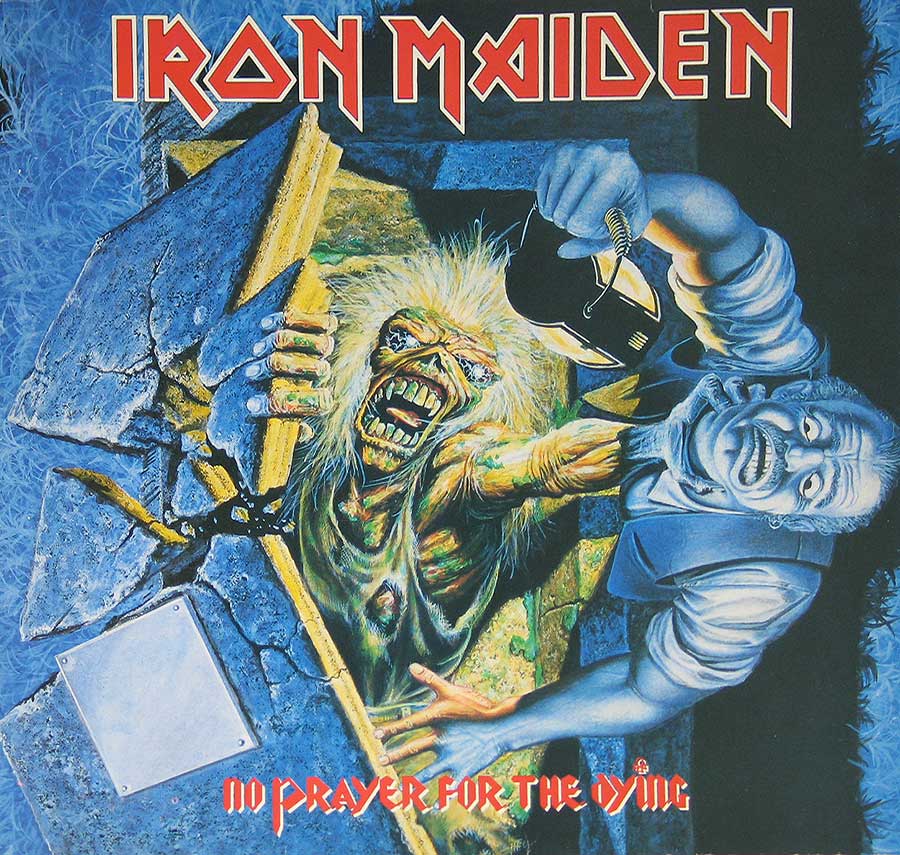
Front Cover Iron Maiden's No Prayer for the Dying album cover, featuring Eddie the mascot emerging from a grave, grabbing a terrified man by the collar.

No Prayer For The Dying: Iron Maiden's Raw Roar Amidst Changing Tides
Album Description:

In a world aflame, a beast reborn, No Prayer For The Dying, a metal storm.

The year was 1990, a time of shifting sands in the heavy metal landscape. Grunge was clawing at the gates, threatening to dethrone the titans of the genre. Amidst this turmoil, Iron Maiden, the British stalwarts of metal, unleashed their eighth studio album, "No Prayer For The Dying".

A Sonic Shift: Back to Basics

Departing from the progressive complexities of its predecessor, *Seventh Son of a Seventh Son*, "No Prayer For The Dying" embraced a rawer, more direct approach. This back-to-basics ethos was evident in the stripped-down production and the abundance of straight-ahead rockers that populated the tracklist.

The album's opening salvo, "Tailgunner," set the tone with its galloping riffs and Bruce Dickinson's soaring vocals. Other highlights included the infectious "Holy Smoke," the anthemic "Public Enema Number One," and the hauntingly beautiful "Run Silent Run Deep."

Genre and Exploration

While firmly rooted in heavy metal, "No Prayer For The Dying" showcased Iron Maiden's willingness to experiment. The album incorporated elements of hard rock, blues, and even punk, resulting in a diverse and dynamic listening experience.

This sonic exploration was further amplified by the band's new guitarist, Janick Gers, who replaced Adrian Smith during the pre-production phase. Gers' energetic playing and flamboyant stage presence injected a fresh dose of adrenaline into Iron Maiden's sound.

Controversies and Challenges

Despite its commercial success, "No Prayer For The Dying" faced its share of controversies. The album's cover art, depicting Eddie emerging from a grave, was deemed too gruesome by some retailers, leading to censored versions being issued.

The album also marked a period of transition for Iron Maiden. The departure of Adrian Smith, a key songwriter and guitarist, left a void that was difficult to fill. While Janick Gers brought his own unique style to the band, his presence inevitably altered the chemistry that had defined Iron Maiden's earlier works.

Production and Recording

"No Prayer For The Dying" was produced by Martin Birch, a longtime collaborator of Iron Maiden. Birch's signature sound, characterized by its raw power and punchy drums, was evident throughout the album.

The album was recorded at Barnyard Studios in Essex, England, using the Rolling Stones Mobile Studio. This unconventional approach allowed the band to capture a more spontaneous and live feel in their performances.

Legacy and Impact

While "No Prayer For The Dying" may not be regarded as one of Iron Maiden's most groundbreaking albums, it remains a significant entry in their discography. The album's raw energy and back-to-basics approach resonated with fans who craved a return to the band's earlier, more visceral sound.

Moreover, "No Prayer For The Dying" marked a turning point in Iron Maiden's career. The album's commercial success solidified their status as one of the leading heavy metal bands of their time. However, the departure of Adrian Smith and the changing musical landscape signaled a new era for the band, one that would be fraught with challenges and uncertainties.

The beast roars on, No Prayer For The Dying, a metal legacy born.
Music Genre:

NWOBHM, New Wave Of British Heavy Metal 

Collector's info:

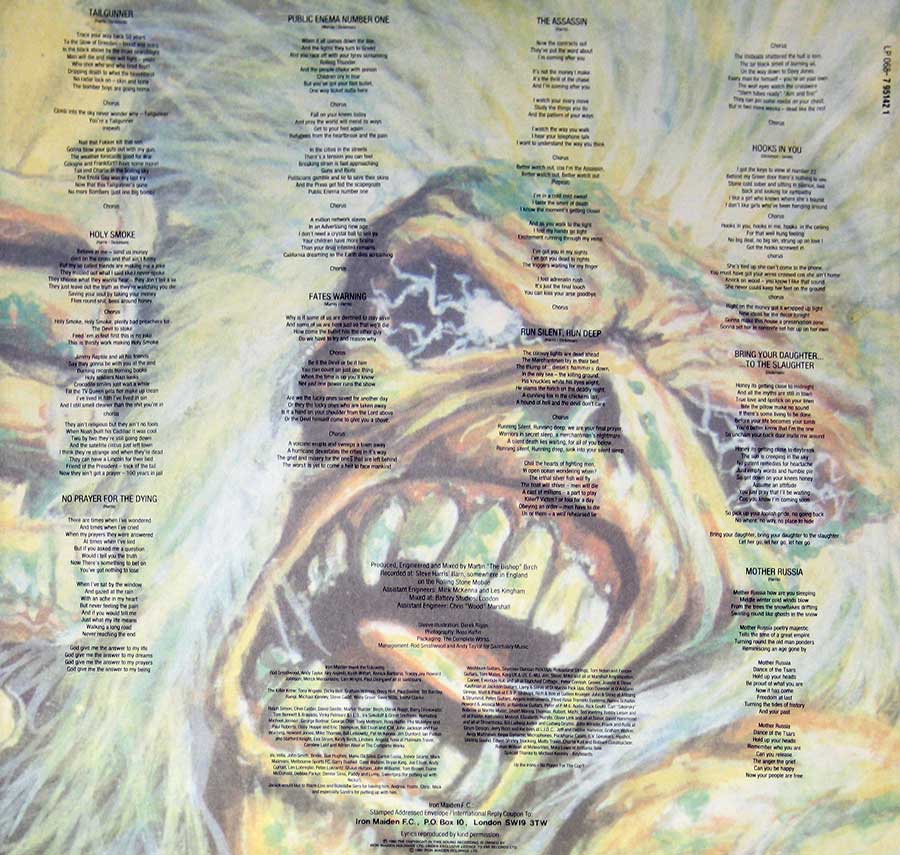
This album includes the original custom inner sleeve with album details, complete lyrics of all songs by and photos.

Album Production Information:

Produced by Martin Birch
  • Martin Birch – Producer, Sound Engineer

    Treat Martin Birch like the invisible band member: you don’t see him on the sleeve, but you sure hear him in the punch, the bite, and that “turn it up” clarity. His run is legendary—starting as an engineer in the late 1960s, sharpening the sound with Deep Purple in the early 1970s, helping Rainbow hit that dramatic hard-rock stride in the mid-to-late 1970s, powering the Dio-era Black Sabbath in 1980–1981, then basically going exclusive with Iron Maiden from 1981 to 1992 before he bowed out.

    Martin Birch, to my ears, is the guy who made heavy records feel both massive and surgical—tight low end, bright attack, and a midrange that cuts like fresh steel without turning into ear-pain. He built long relationships instead of quick drive-bys: Deep Purple, Rainbow, Whitesnake, Black Sabbath, and then that famous Iron Maiden stretch from "Killers" (1981) through "Fear of the Dark" (1992), after which he retired. That’s not just a resume, that’s a whole era with his fingerprints on it.

  • Record Label & Catalognr:

    EMI 068-7 95142

    Media Format:

    12" Vinyl LP  Gramophone Record
    Album weight: 200 gram 

    Year & Country:

    1990 Made in EEC 
    Band Members and Musicians on: IRON MAIDEN No Prayer For The Dying
      Band-members, Musicians and Performers
    • Bruce Dickinson vocals
    • Bruce Dickinson – Vocals Bruce Dickinson, born August 1958, is the powerhouse vocalist who propelled Iron Maiden to legendary status. Joining the band in 1981, his operatic range, sharp phrasing, and commanding stage presence reshaped the group’s sound and ambition, defining era-classic albums like The Number of the Beast and Powerslave. Beyond Maiden, he built a parallel career as a solo artist, commercial pilot, author, and broadcaster, giving his legacy a reach that stretches well beyond heavy metal.
    • Dave Murray guitar
    • Dave Murray – Guitar

      Maiden’s calm killer: smooth leads, twin-guitar harmony for days, and that melodic bite that makes the “gallop” feel cinematic instead of chaotic.

      Dave Murray (born 23 December 1956, Edmonton, Middlesex, England) is one of the defining lead guitar voices of heavy metal, and in my book he’s the melodic “second spine” of Iron Maiden. His timeline with the band starts early: joining in 1976, getting briefly pushed out in 1977, then returning in 1978 and staying locked in ever since—making him one of the longest-serving members in the whole Maiden saga. During that 1977 gap he spent around six months with Urchin (Adrian Smith’s band), which is a fun little historical glitch in the matrix if you like your Maiden lore messy and human. Beyond the main band, his most notable “outside the mothership” credit is the all-star charity metal project Hear ’n Aid (1985), because apparently even guitar lifers sometimes leave the bunker to do side quests. Dave Murray Wiki

    • Janick Gers guitar
      Janick Gers, born 1957, is a high-energy guitar virtuoso whose electrifying solos and wild stage presence have fueled Iron Maiden since 1990. From his early days with White Spirit and Gillan to shredding alongside Dave Murray and Adrian Smith, his dynamic style adds fire to Maiden’s sound. Discover more about his journey here.
    • Steve Harris bass guitar, backing vocals
    • Steve Harris – Bass Guitar, Songwriter

      Iron Maiden’s engine room: galloping bass lines, history-nerd lyrics, and “captain of the ship” energy baked into every riff.

      Steve Harris (born 12 March 1956, Leytonstone, England) is the rare bassist who doesn’t just hold the floor—he draws the whole blueprint. In my book, he’s the founder and primary songwriter who’s kept Iron Maiden on its rails from 1975–present, with that instantly recognizable “gallop” driving huge chunks of the catalogue. The pre-Maiden grind matters too: first band days in Influence/Gypsy’s Kiss (1973–1974, including a documented gig run in 1974), then the older, blues-leaning Smiler period (1974–1975) where his more ambitious writing basically forced the next step: forming Maiden. Outside the mothership, he’s fronted his own hard-rock outlet British Lion (2012–present), a project that grew out of connections going back to the early 1990s and finally hit the world as his solo debut in 2012.

    • Nicko McBrain drums
    • Nicko McBrain – Drums Nicko McBrain, born 1952, is the powerhouse drummer who has driven Iron Maiden’s thunderous engine since joining in 1982. His playing combines brute force with swing and pinpoint timing, giving albums like The Number of the Beast and Powerslave their unstoppable momentum. Before Maiden, his work with Trust and the Pat Travers Band sharpened his style, culminating in a career that redefined metal drumming.
    • Michael Kenney - Keyboards
    Complete Track Listing of: IRON MAIDEN No Prayer For The Dying

    The Song/tracks on "IRON MAIDEN No Prayer For The Dying" are

    • Tail Gunner (Bruce Dickinson, Steve Harris) 4:15
    • Holy Smoke (Dickinson, Harris) 3:49
    • No Prayer for the Dying (Harris) 4:23
    • Public Enema Number One (Dickinson, Dave Murray) 4:13
    • Fates Warning (Harris, Murray) 4:12
    • The Assassin (Harris) 4:18
    • Run Silent Run Deep (Dickinson, Harris) 4:35
    • Hooks in You (Dickinson, Adrian Smith) 4:08
    • Bring Your Daughter... to the Slaughter (Dickinson) 4:45
    • Mother Russia (Harris) 5:32
    Front Cover Photo Of IRON MAIDEN - No Prayer For The Dying ( EEC )
    Album cover of Iron Maiden's 1990 release "No Prayer for the Dying," depicting Eddie clawing his way out of a grave, embodying the raw energy and horror themes that define the album.
    Front Cover Photo Iron Maiden's No Prayer for the Dying album cover, featuring Eddie the mascot emerging from a grave, grabbing a terrified man by the collar.

    Note: The images on this page are photos of the actual album. Slight differences in color may exist due to the use of the camera's flash. Images can be zoomed in/out ( eg pinch with your fingers on a tablet or smartphone )

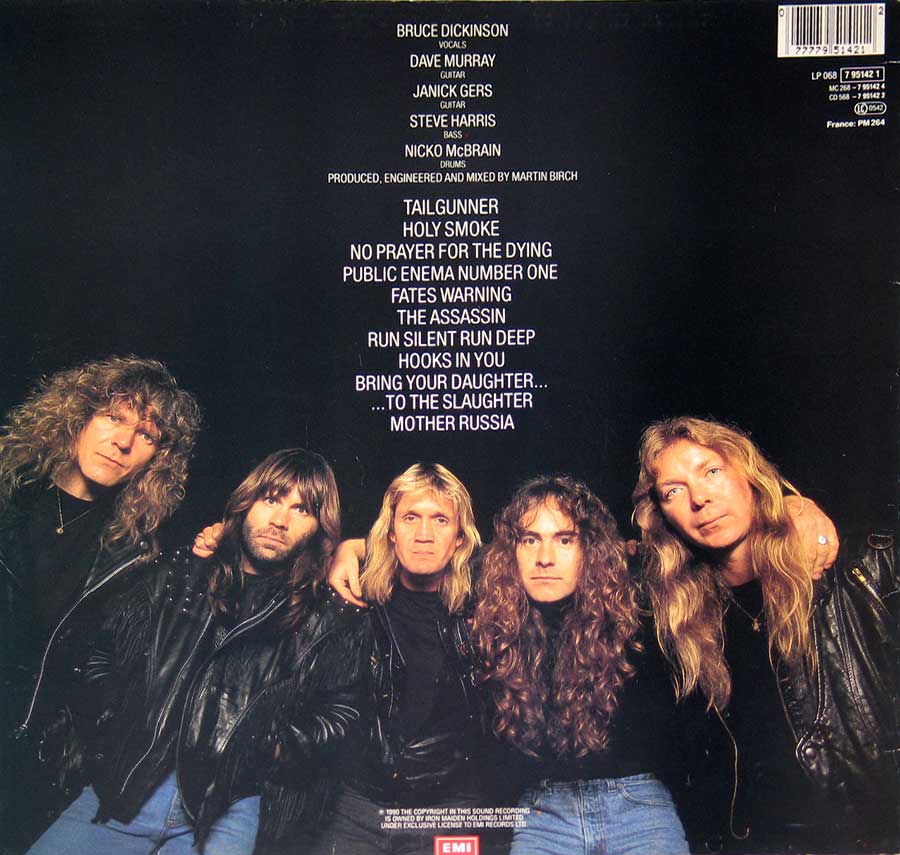
    Photo Of The Back Cover IRON MAIDEN - No Prayer For The Dying ( EEC )
    Photo of album back cover IRON MAIDEN - No Prayer For The Dying ( EEC )


    Photo One Of The Original Custom Inner Sleeve IRON MAIDEN - No Prayer For The Dying ( EEC )
    Photo One Of The Original Custom Inner Sleeve IRON MAIDEN - No Prayer For The Dying ( EEC )

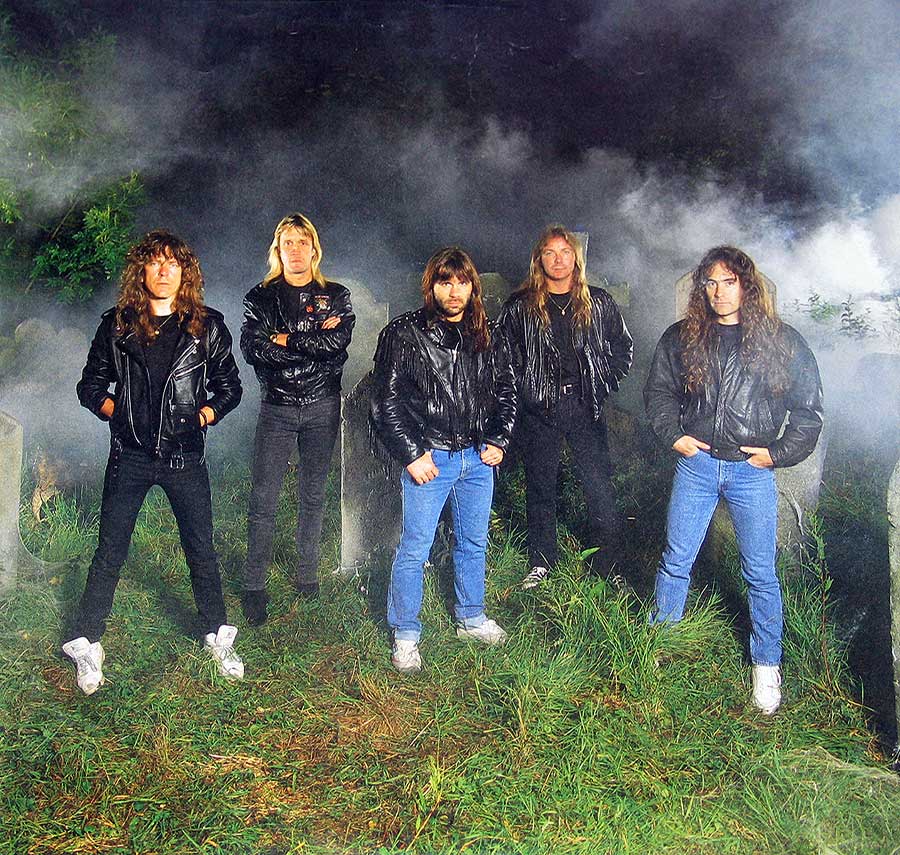
    Photo of the Iron Maiden band-members in the cemetary at night

    Photo Two of the original custom inner sleeve IRON MAIDEN - No Prayer For The Dying ( EEC )
    Photo Two of the original custom inner sleeve  IRON MAIDEN - No Prayer For The Dying ( EEC )


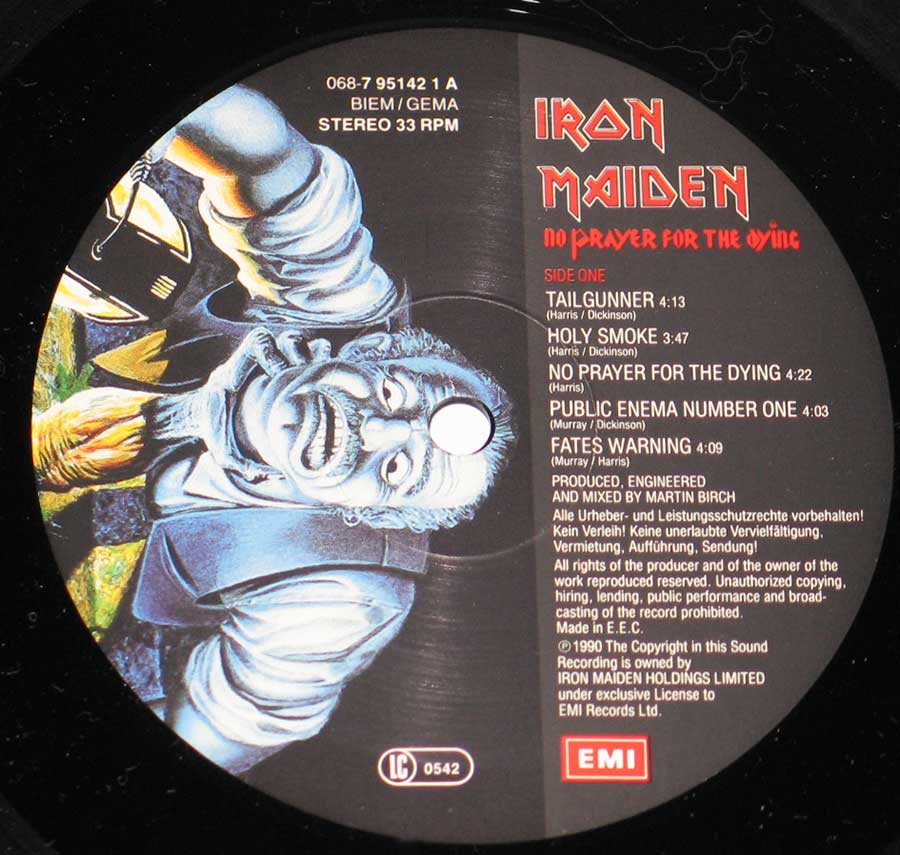
    Close up of record's label Side One IRON MAIDEN - No Prayer For The Dying ( EEC )
    Close up of Side One IRON MAIDEN - No Prayer For The Dying ( EEC )

    Record Label Details: © Copyright ℗ Sound Copyright

    IRON MAIDEN - Vinyl Records Discography Home Page