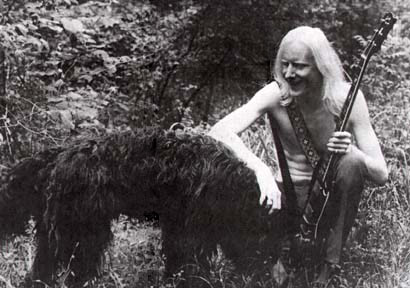
Why Johnny Winter Suddenly Ditches the Blues
Published December 1973
Johnny Winter has been making music for as long as he can remember. And he's been remembering for quite a while. He was born on February 23, 1944, in Beaumont, Texas, to musically engaged parents - his father played saxophone, plucked the banjo, and sang in church choirs, while his mother was devoted to the piano. It's hardly surprising that in this environment, Johnny's interest, as well as that of his brother Edgar, was directed towards music early on. While the two brothers were still in school, they already had their first blues group: "It and Them."
Later they changed the name to Johnny Winter and the Black Plague. However, the course was finally set when Johnny dropped out after a semester at Lamar Technical College and moved to the blues mecca of Chicago. There he wanted to really immerse himself in the blues. -- The "immersion" only lasted a few weeks. After jamming a few times with people like Mike Bloomfield and Barry Goldberg, who were still unknown at the time, he was drawn back to the South. For six years he then traveled the country.
In a large gypsy wagon with child, wife, and song. The engagements he received, along with bassist Tommy Shannon and drummer John Turner, were mostly uninteresting artistically, as the audience always just wanted to hear the current hits. But at least the many performances gave him the stage presence needed to stand in front of a critical audience. During this lean period, Johnny Winter made several attempts to get signed by record companies.
Mostly, such efforts progressed to the point where he was invited to the studio for test recordings, had to play a few popular numbers from his stage repertoire, and then was sent away with the reassurance ("Interesting, we'll get in touch. As soon as there's an opportunity to produce a record of yours...") as soon as it was clear from the charts and the mood in concert halls that Johnny Winter wasn't about to become a hit.
In 1968, he wasn't sent away for the first time. Columbia Records (in Europe, many - I estimate about four or five - companies that had previously done test recordings with Johnny, plundered their archives, and released some of these partially horrific recordings as LPs, trusting in the stupidity of the people) was fascinated by this platinum-blonde guitarist who had been frenetically praised in an article for Rolling Stone magazine and then engaged for the Fillmore East solely based on that. Johnny Winter was signed on the spot.
And that with a starting salary that was unique in Columbia's history. Only Bob Dylan gets more today. As soon as the contract signing was made public in business circles, the record company Liberty in Los Angeles got excited and released an LP called "The Progressive Blues Experiment" - an experiment generated by a certain Johnny Winter. The music tape had been given to the company by a black market dealer. The record, an aggressive blues piece with music that would soon become typical for Johnny Winter, quickly climbed the charts.
Columbia was annoyed at first but then thought it wiser to wait a bit with their first Johnny Winter album until the hype around "Blues Experiment" had died down a bit. This tactic proved to be correct, as half a year later the CBS LP effortlessly outsold the Liberty "offspring"...
Today, two years later, Johnny Winter already has four LPs on the market. Everyone will rightly ask how that's possible. Well, after taking a closer look at the two latter releases, one will notice that Johnny suddenly no longer indulges in the blues. Instead, he ditches it. And serves up hard beat rock, which, by the way, suits him perfectly. The reasons for this change in style are roughly identical to those that have previously moved every great white guitarist to switch from blues to rock. "Blues is limited in its way. And I didn't want to make the same music year in, year out." To fulfill this wish, Johnny had no choice but to replace his previous backing musicians John and Tommy ("As guys, they're great. But they can't let go of the blues. It just wasn't working anymore").
And replace them with Rick Derringer (guitar), Randy Jo Hobbs (bass), and Randy Z (drums), who had previously formed the rock band The McCoys (Hang On Sloopy). "I need a few guys who excite me and who, above all, are versatile," Johnny explains his choice. "The ex-McCoys are just right." So far, however, they haven't been quite right. At least not Randy Z. The drummer suffered a minor case of insanity due to excessive drug use and had to be hospitalized. Bobby Caldwell has been drumming for him ever since.
In summary, it can be said: The switch from blues to rock doesn't break Guitar King Johnny Winter's stride. On the contrary. This year's summer will probably show even more signs of (Johnny) Winter than any summer and winter before.