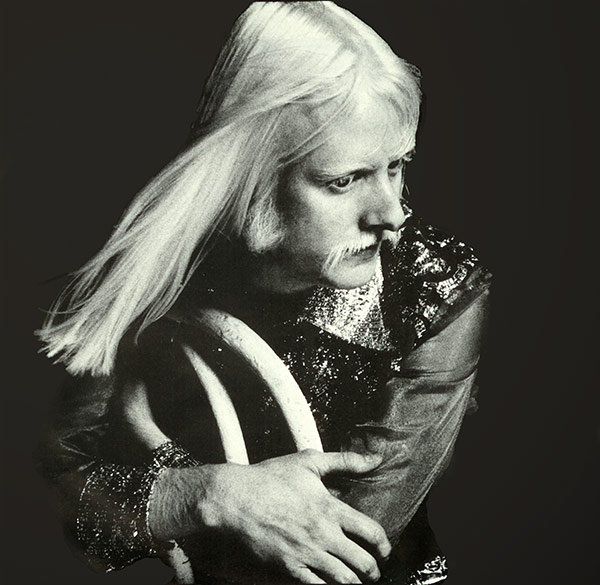
Edgar Winter: A Lifelong Musical Journey with Johnny Winter and Beyond

-  

Edgar Winter, a multifaceted musician known for his pioneering work in rock, jazz, blues, and pop, has built a remarkable career spanning several decades. Born into a musically gifted family in Beaumont, Texas, on 28 December 1946, Edgar grew up alongside his older brother, Johnny Winter, a legendary blues guitarist. Their early collaborations in the 1960s, from performing in local "school bands" to joining forces in Johnny's rising career during the late 1960s and early 1970s, laid the foundation for Edgar's own successful career. While best known for his iconic work with The Edgar Winter Group, his deep-rooted connection with Johnny remains an essential part of his musical legacy. This article explores Edgar Winter's evolution as a musician, his influential collaborations with Johnny Winter, and his lasting impact on the music world.

Photo of Johnny Winter - https://vinyl-records.nl/

Edgar Winter: A Lifelong Musical Journey with Johnny Winter and Beyond

-

Edgar Winter gets introduced as a “multi-instrumentalist” and that word always feels too polite for what he actually does. Born 28 December 1946 in Beaumont, Texas, same strange bright-heat hometown gravity as Johnny, same albinism, same sense that the room gets lighter when the Winters walk in. :contentReference[oaicite:4]{index=4}

Music didn’t “enter his life.” It was already sitting at the kitchen table. Father John Winter II (often called Johnny Winter Sr.) and mother Edwina Holland Winter raised two sons who didn’t just listen to records, they tested them. Notes, runs, mistakes, the whole glorious mess. :contentReference[oaicite:5]{index=5}

Teenage Edgar and teenage Johnny weren’t dreaming up destiny; they were trying to win a local contest and play loud enough to matter. Their first band name says everything: “Johnny and the Jammers”. Nothing academic. Just push, sweat, and the kind of teen confidence that only exists because nobody has paid the electric bill yet. :contentReference[oaicite:6]{index=6}

The brother-connection never turned into some corny Hallmark narrative, either. Edgar shows up across Johnny’s orbit in a way that feels practical: when the sound needs another color, another bite, another set of hands that can actually play. Sax, keys, vocals, percussion — whatever keeps the thing moving without turning it into polite blues homework. :contentReference[oaicite:7]{index=7}

Then comes “Entrance” in 1970, Edgar’s first studio album, and it doesn’t behave like a debut that’s waiting for permission. It sprawls. It lunges. Johnny even drops in on “Tobacco Road”, like a reminder that the family voltage is never far from the wall socket. :contentReference[oaicite:8]{index=8}

The real pop-culture lightning bolt hits with “They Only Come Out at Night” (1972). Two tracks still stalk classic rock radio like they own the place: “Frankenstein” — that stitched-together instrumental monster that keeps getting up off the slab — and “Free Ride”, a grin-with-teeth single released in August 1973, written by Dan Hartman and produced by Rick Derringer. That’s not trivia; that’s the wiring diagram. :contentReference[oaicite:9]{index=9}

Plenty of later projects exist, sure, but the most interesting thing is how Edgar keeps refusing to become a nostalgia act trapped in amber. Touring, collaborating, popping up where you don’t expect him — like the music industry’s version of a guy who “just went out for milk” and comes back three days later with a new band. B.B. King had it right: “The beautiful thing about learning is nobody can take it away from you.” Edgar plays like he took that personally. :contentReference[oaicite:10]{index=10}

Bottom line? Edgar’s best moments don’t sound like a résumé. They sound like motion: a sudden left turn, a hard stop, then the engine catches again. “Frankenstein” keeps stomping around because it’s built from nerve, not manners — and “Free Ride” still feels like trouble with a smile. That’s the kind of legacy that doesn’t need a neat little bow on it.

References

Brothers in Rock: The Musical Journeys of Johnny and Edgar Winter

A look at Edgar Winter’s rise to fame and his contributions to rock and blues alongside his brother Johnny Winter

Brothers Johnny and Edgar Winter started their professional musical careers back in the mid-Sixties when they played in a variety of local Texan bands, eventually moving to Chicago where, as members of an outfit called Black Plague, they worked many of the local clubs.

In 1968, while playing regular gigs at a New York club, The Scene, and being managed by its owner, Steve Paul , the brothers came to the attention of various record companies. Early the following year, Johnny was signed by CBS Records to a five-year contract for a reputed $300,000, and his debut album was released in June, reaching Number 24 in the US chart. The same year, 1969, saw Johnny Winter appearing live at various major gigs in the US, including the three-day Newport ’69 Pop Festival, Devonshire Downs, Northridge, California , the Newport Jazz Festival on Rhode Island, and at the Texas International Pop Festival held in Dallas, where he appeared before an estimated 120,000 people.

The new decade saw the release of a second Johnny Winter album, Second Winter , which became a best-seller while a single from it, a revival of the rock and roll classic Johnny B. Goode, was also a minor hit. The album also gave Johnny a taste of British chart success, reaching Number 58. Live performances continued to play an important role in his career, and appearances included the Atlanta Pop Festival and a New York Shea Stadium anti-war festival, where he appeared on the same bill as Paul Simon, Steppenwolf, Janis Joplin, and many other top rock names.

Meanwhile, brother Edgar, who had featured on Johnny’s album Second Winter, had formed his own band, White Trash, and the debut album Edgar Winter’s White Trash became an American chart hit while a single, Keep Playin' That Rock 'n' Roll, entered the Billboard Hot 100. May 1972 saw the release of a White Trash double album, Roadwork, which reached Number 23 in the US chart, while a reworking of the soul classic I Can’t Turn You Loose was also a hit single. Soon afterwards, however, Edgar decided to disband the outfit and went on to form The Edgar Winter Group. The first album with the new line-up, They Only Come Out at Night, produced by Rick Derringer, was a major chart hit in the States, climbing as high as Number Three and earning Edgar his first gold disc.

In 1973, The Edgar Winter Group found themselves with a surprise Number One hit single in the US with an instrumental, Frankenstein, which had originally been the B-side of Hangin’ Around, suddenly starting to pick up heavy airplay and went on to sell a million copies. Frankenstein also became a British Top 20 hit, while Edgar enjoyed another Top 20 success in the US with Free Ride.

The mid-Seventies saw both brothers continuing to make an impression on the US charts. Hangin’ Around itself became a hit for Edgar after the success of its B-side Frankenstein, and a new album Shock Treatment reached Number 13 and gold status. Two Edgar Winter singles, River’s Risin’ and Easy Street, also found favour with record-buyers. Brother Johnny, meanwhile, had a Top 40 hit with the album Saint and Sinners.

In the summer of 1976, the two brothers teamed up for a new album, Together, then early the following year, Johnny produced a Muddy Waters comeback album and toured with the blues legend, who had been one of his heroes. He also recorded his own solo album, Nothin’ But The Blues, which was released in 1977, followed by White Hot And Blue in 1978.

The Eighties saw both brothers continue recording, albeit in different capacities. While Johnny has released several albums independently and appeared at events like the San Francisco Blues Festival, younger brother Edgar has concentrated more on session work, working with names like Meat Loaf and Bette Midler. Who is to tell what the future will bring, though—it’s not impossible that Edgar will return to recording in his own right or working once again with his brother.

Until that day happens, though, there is still the Edgar Winter catalogue to delve into, and this new compilation Brothers In Rock 'n’ Roll features 10 of his best recordings, alongside another 10 from brother Johnny. It’s a collection that justifies its title and underlines the contribution they have made to the rock and roll, and blues music scene.

Chris White

  • Black Plague (Chicago club circuit)
    Venue: Black Orchid Club (South Side; distinct from the earlier Rush Street “Black Orchid” nightclub)
    Location: Intersection of W 69th Street & S Racine Avenue, Englewood area, Chicago, Illinois 60636, USA
  • The Scene (Club Residency)
    Venue: Steve Paul's The Scene (nightclub, basement venue)
    Location: 301 West 46th Street, Manhattan (Theater District), New York City, New York 10036, USA
  • Newport '69 Pop Festival
    Venue: Devonshire Downs (former racetrack / fairgrounds; now CSUN North Campus)
    Location: Area of Devonshire Street & Zelzah Avenue, Northridge, California (CSUN North Campus), USA
  • Newport Jazz Festival (late-1960s “Festival Field” era)
    Venue: Festival Field (historic festival grounds; later built over)
    Location: Between JT Connell Highway & Girard Avenue area; address anchor: 90 Girard Avenue, Newport, Rhode Island 02840, USA
    Note: the modern Newport Jazz Festival is held at Fort Adams State Park (90 Fort Adams Drive, Newport, RI 02840).
  • Texas International Pop Festival (1969)
    Venue: Open fields adjacent to Dallas International Motor Speedway (DIMS), along I-35E
    Location: Lewisville, Texas, USA (near the Round Grove Road / Hebron Parkway area by I-35E)
    Marker / visitor anchor: Hebron Station (DCTA), 952 Lakeside Circle, Lewisville, Texas 75057, USA.
  • Atlanta International Pop Festival (1969)
    Venue: Atlanta International Raceway (now Atlanta Motor Speedway / “EchoPark Speedway”)
    Location: 1500 Tara Place, Hampton, Georgia 30228, USA
  • Shea Stadium Anti-War Festival (Festival for Peace / Summer Festival for Peace, 1970)
    Venue: Shea Stadium (William A. Shea Municipal Stadium)
    Location: 123–01 Roosevelt Avenue, Flushing, Queens, New York, New York 11368, USA
  • San Francisco Blues Festival
    Venue: Great Meadow, Fort Mason Center for Arts & Culture
    Location: 2 Marina Boulevard (at Buchanan Street), San Francisco, California 94123, USA