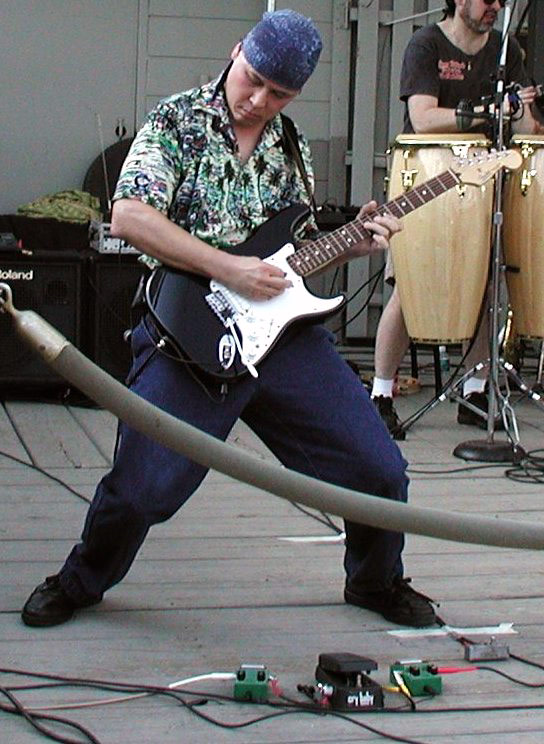
Floyd Radford: A Guitarist's Journey with Tin House and Johnny Winter
Floyd Radford never reads like the “guitar hero” type on paper. More like the quiet plugs in, and makes the whole band sound tighter without announcing it. The Pegasus profile even jokes you might have been sitting next to him in engineering class, completely clueless. That’s the vibe: introvert wiring, loud history.
The guitar obsession starts in 1963, age 11. Elvis is the hook. Later comes the slightly annoyed realization that Elvis wasn’t always the one actually playing those parts, but the damage was done: the sound had already sunk its teeth in. A year after that, an electric guitar shows up during a family trip to Japan, and suddenly the kid is playing clubs in Hawaii at 12, too young to legally exist in the room. So they park him at a table in the corner during breaks, like talent you can’t quite admit you hired.
Central Florida in 1965. New schools, new rooms, new bands. Tin House is where it gets serious: teen centers, youth clubs, school dances, but played like the ceiling might collapse. Then Winter’s End Pop Festival in 1970 at what’s now SpeedWorld in Bithlo. Tin House goes on second to warm up the crowd, gets dragged back for a second day because the audience won’t stop roaring, and a Rolling Stone photographer catches Radford in the act. That’s not “influential.” That’s lightning touching ground.
Johnny Winter’s manager offers Tin House an opening slot and help toward a deal with Epic. Radford is 17, so the parents have to sign off like it’s a field trip. Two months after graduation they’re in New York recording in CBS Studio C while Paul McCartney is upstairs in Studio A working on his first solo album. Tin House’s first job after recording is opening for Alice Cooper in Detroit. Second job: opening for Johnny Winter and Buddy Miles at the Fillmore East. If you played the Fillmore back then, you didn’t need to explain yourself.
Next chapter gets messy in the good way: Radford plays guitar for Edgar Winter’s White Trash while still staying loyal to Tin House, and both bands tour through the end of 1971. Great for stories, terrible for sleep. “Excessive playing wore Radford out” is how the Pegasus article puts it, and that sounds polite. Translation: the road chewed him up and didn’t even apologize.
Mid-70s brings the second rise: a broke stretch in Los Angeles (the potato-a-day era), then a phone call that flips the table. Johnny Winter needs a guitar player, and two weeks later Radford is on stage in London filming a TV show. The next two years, 1974–76, are his peak by his own telling. Muddy Waters had it right: “The blues had a baby and they called it rock and roll.” Radford just kept showing up to babysit the baby and the amplifier.
The live document from that period is "Captured Live!" Recorded in September 1975 across three California stops (San Bernardino, San Diego, Oakland), released in 1976, and built for the one thing Johnny’s band always did better than the charts: real crowds. Peter Frampton opens on that tour and records obsessively with a mobile unit, night after night. Radford’s side-stage line says it all: "When you listen to it, know that I was standing on the side of the stage, watching him play." That’s not a quote from a man addicted to spotlight. That’s a working musician clocking greatness like it’s weather.
Toward the end of the run, the Edgar Winter Group joins in, and the guitar chairs shuffle: Radford keeps playing with Johnny while Rick Derringer plays with Edgar. Earlier, the roles had been reversed. The band jokes they all graduated from the Winter Brothers School of Music, which is funny because it’s true. Then the whole thing ends abruptly when Johnny gets sick and cancels a Tampa engagement with ZZ Top. No grand finale. Just the plug pulled out of the wall.
So yeah, the “legacy and impact” part? Keep it. But earn it. The earned version is this: a guitarist who could do the job in Tin House, in Edgar’s camp, and in Johnny’s live band, then walk into a classroom later and keep his mouth shut about the Fillmore. That’s not myth-making. That’s a life with the volume knob turned down on purpose.
References
- Pegasus (UCF Alumni), Nov/Dec 2004: "Rock and Roll Fantasy" (PDF)
- Vinyl-Records.nl: "Captured Live!" promotional copy (high-resolution album cover photos)
- Johnny Winter: "Captured Live!" (recording dates, venues, personnel)
- Edgar Winter: "Edgar Winter's White Trash" (album and credits)
- Discogs: Johnny Winter "Captured Live!" (pressing notes and recording locations)