Pink Floyd - Wish You Were Here 12" Vinyl LP Album

- East-German release on Amiga Records

Released during a tumultuous period, Pink Floyd's "Wish You Were Here" 12" Vinyl LP on Amiga Records in East Germany symbolizes a unique cultural intersection. Amidst Cold War tensions, this musical masterpiece transcended boundaries, resonating globally. Its intricate soundscapes and poignant lyrics mirrored the zeitgeist, fostering a connection that surpassed geopolitical divides. The East German release adds a layer of historical significance, encapsulating the album's enduring impact during a pivotal time.


High Resolution Photo #1 PINK FLOYD Wish You Were Amiga

Transcript of liner notes

A transcript of the origial of the East-German release of "Wish You Were Here" with history of Pink Floyd's discography with background information on "Wish You Were Here" ( in German Language )

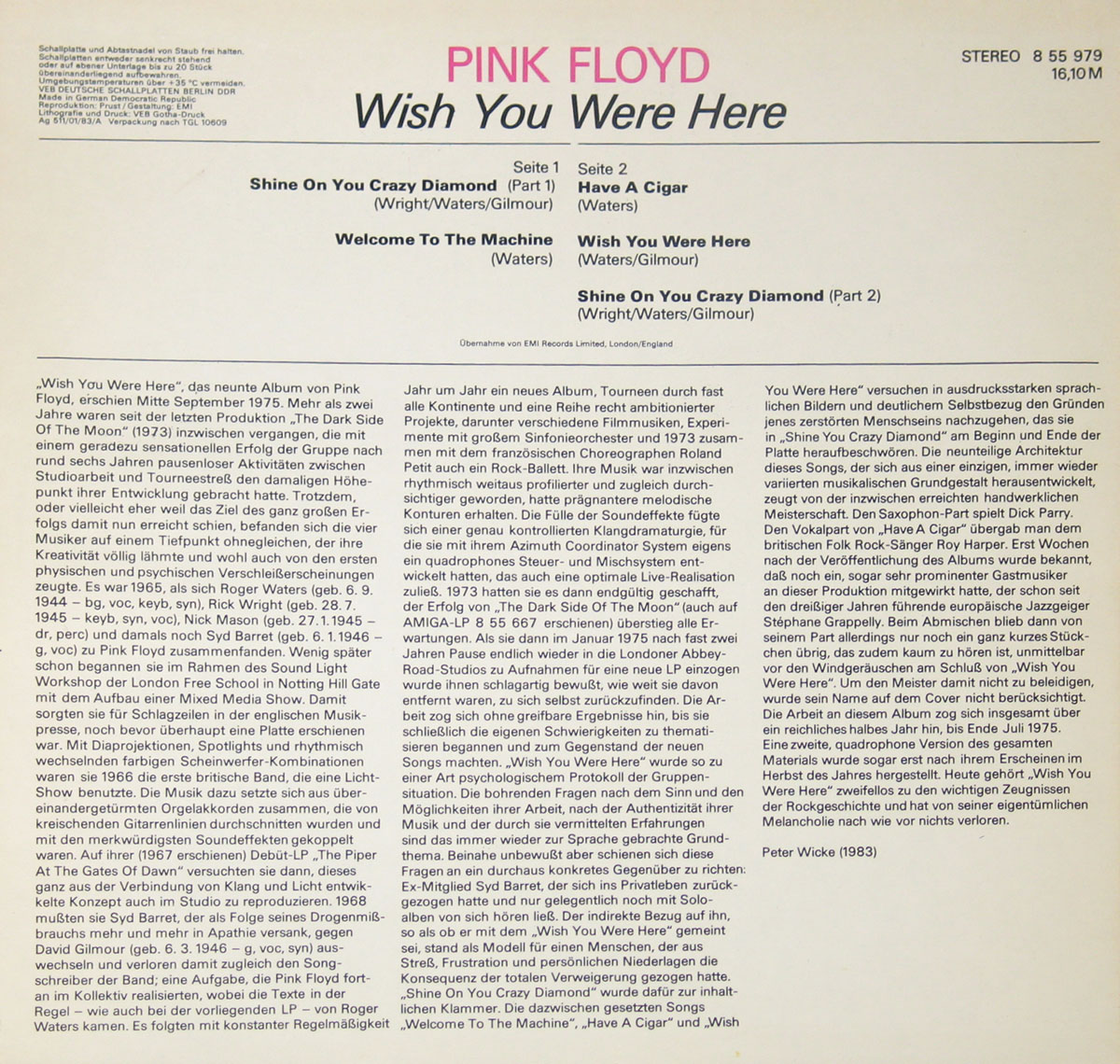
„Wish You Were Here”, das neunte Album von Pink Floyd, erschien Mitte September 1975. Mehr als zwei Jahre waren seit der letzten Produktion "The Dark Side Of The Moon" (1973) inzwischen vergangen, the mit einem geradezu sensationellen Erfolg der Gruppe nach rund sechs Jahren pausenloser Aktivitaten zwischen Studioarbeit und TourneestreR den damaligen Hohe-punkt ihrer Entwicklung gebracht hatte.

Trotzdem, oder vielleicht eher weil das Ziel des ganz groRen Erfolgs damit nun erreicht schien, befanden sich the vier Musiker auf einem Tiefpunkt ohnegleichen, der ihre Kreativitat vollig lahmte und wohl auch von den ersten physischen und psychischen VerschleiRerscheinungen zeugte. Es war 1965, als sich Roger Waters (geb. 6. 9. 1944 - bg, voc, keyb, syn), Rick Wright (geb. 28.7. 1945 - keyb, syn, voc), Nick Mason (geb. 27.1.1945 - dr, perc) und damals noch Syd Barret (geb. 6.1.1946 -g, voc) zu Pink Floyd zusammenfanden.

Wenig spater schon begannen sie im Rahmen des Sound Light Workshop der London Free School in Notting Hill Gate mit dem Aufbau einer Mixed Media Show. Damit sorgten sie fur Schlagzeilen in der englischen Musik-presse, noch bevor Oberhaupt eine Platte erschienen war.

Mit Diaprojektionen, Spotlights und rhythmisch wechselnden farbigen Scheinwerfer-Kombinationen waren sie 1966 die erste britische Band, die eine Licht-Show benutzte. Die Musik dazu setzte sich aus Ober-einandergeturmten Orgelakkorden zusammen, die von kreischenden Gitarrenlinien durchschnitten wurden und mit den merkwOrdigsten Soundeffekten gekoppelt waren.

Auf ihrer (1967 erschienen) Debut-LP The Piper At The Gates Of Dawn" versuchten sie dann, dieses ganz aus der Verbindung von Klang und Licht entwikkelte Konzept auch im Studio zu reproduzieren. 1968 mussten sie Syd Barret, der als Folge seines Drogenmiss-brauchs mehr und mehr in Apathie versank, gegen David Gilmour (geb. 6. 3.1946 - g, voc, syn) auswechseln und verloren damit zugleich den Song-schreiber der Band; eine Aufgabe, die Pink Floyd fortan im Kollektiv realisierten, wobei die Texte in der Regel - wie auch bei der vorliegenden LP - von Roger Waters kamen.

Es folgten mit konstanter Regelmalligkeit Jahr um Jahr ein neues Album, Tourneen durch fast alle Kontinente und eine Reihe recht ambitionierter Projekte, darunter verschiedene Filrnmusiken, Experimente mit grossem Sinfonieorchester und 1973 zusammen mit dem franzosischen Choreographen Roland Petit auch ein Rock-Ballett. lhre Musik war inzwischen rhythmisch weitaus profilierter und zugleich durch-sichtiger geworden, hatte pragnantere melodische Konturen erhalten.

Die ssine der Soundeffekte fugte sich einer genau kontrollierten Klangdramaturgie, fur die sie mit ihrem Azimuth Coordinator System eigens ein quadrophones Steuer- und Mischsystem entwickelt hatten, das auch eine optimale Live-Realisation zuliess. 1973 hatten sie es dann endgultig geschafft, der Erfolg von The Dark Side Of The Moon" (auch auf AMIGA-LP 8 55 667 erschienen) uberstieg alle Erwartungen.

Als sie dann im Januar 1975 each fast zwei Jahren Pause endlich wieder in die Londoner Abbey-Road-Studios zu Aufnahrnen fur eine neue LP einzogen wurde ihnen schlagartig bewugt, wie weit sie davon entfernt waren, zu sich selbst zuruckzufinden. Die Arbeit zog sich ohne greifbare Ergebnisse hin, bis sie schlieslich die eigenen Schwierigkeiten zu thematisieren begannen und zum Gegenstand der neuen Songs machten.

„Wish You Were Here" wurde so zu einer Art psychologischem Protokoll der Gruppen-situation. Die bohrenden Fragen each dem Sinn und den Mtiglichkeiten ihrer Arbeit, auch der Authentizitat ihrer Musik und der durch sie vermittelten Erfahrungen sind das immer wieder zur Sprache gebrachte Grund-thema. Beinahe unbewusst aber schienen sich diese Fragen an ein durchaus konkretes Gegenuber zu richten.

Ex-Mitglied Syd Barret, der sich ins Privatleben zurUck-gezogen hatte und nur gelegentlich noch mit Solo-alben von sich hoeren liess. Der indirekte Bezug auf ihn, so als ob er mit dem „Wish You Were Here" gemeint sei, stand als Modell fur einen Menschen, der aus Stres, Frustration und perstinlichen Niederlagen die Konsequenz der totalen Verweigerung gezogen hatte. „Shine On You Crazy Diamond" wurde dafOr zur inhalt-lichen Klammer.

Die dazwischen gesetzten Songs „Welcome To The Machine", Have A Cigar" und „Wish You Were Here" versuchen in ausdrucksstarken sprach-lichen Bildern und deutlichem Selbstbezug den Grunden jenes zerstorten Menschseins nachzugehen, das sie in „Shine You Crazy Diamond" am Beginn und Ende der Platte heraufbeschworen.

Die neunteilige Architektur dieses Songs, der sich aus einer einzigen, immer wieder varierten musikalischen Grundgestalt herausentwickelt, zeugt von der inzwischen erreichten handwerklichen Meisterschaft. Den Saxophon-Part spielt Dick Parry. Den Vokalpart von "Have A Cigar" Obergab man dem britischen Folk Rock-Sanger Roy Harper. Erst Wochen each der Veroffentlichung des Albums wurde bekannt, das noch ein, sogar sehr prominenter Gastmusiker an dieser Produktion mitgewirkt hatte, der schon seit den dreigiger Jahren fiihrende europaische Jazzgeiger Stephane Grappelly.

Beim Abmischen blieb dann von seinem Part allerdings nur noch ein ganz kurzes Stuck-chen Obrig, das zudem kaum zu horen ist, unmittelbar vor den Windgerauschen am Schlug von „Wish You Were Here". Um den Meister damit nicht zu beleidigen, wurde sein Name auf dem Cover nicht berucksichtigt. Die Arbeit an diesem Album zog sich insgesamt Ober ein reichliches halbes Jahr hin, bis Ende Juli 1975. Eine zweite, quadrophone Version des gesamten Materials wurde sogar erst each ihrem Erscheinen im Herbst des Jahres hergestellt.

Heute gehort „Wish You Were Here" zweifellos zu den wichtigen Zeugnissen der Rockgeschichte und hat von seiner eigent0mlichen Melancholic each wie vor nichts verloren.

Peter Wicke (1983)
Music Genre:

Acid Psychedelic Music
Pink Floyd Collector's Noted: 

Stamper/Matrix codes:
Side 1: 8 55 979 - 1C 683 EN NT A0 (stamped)
Side 2: 8 55 979 - 2A 683 E NT AR (stamped)

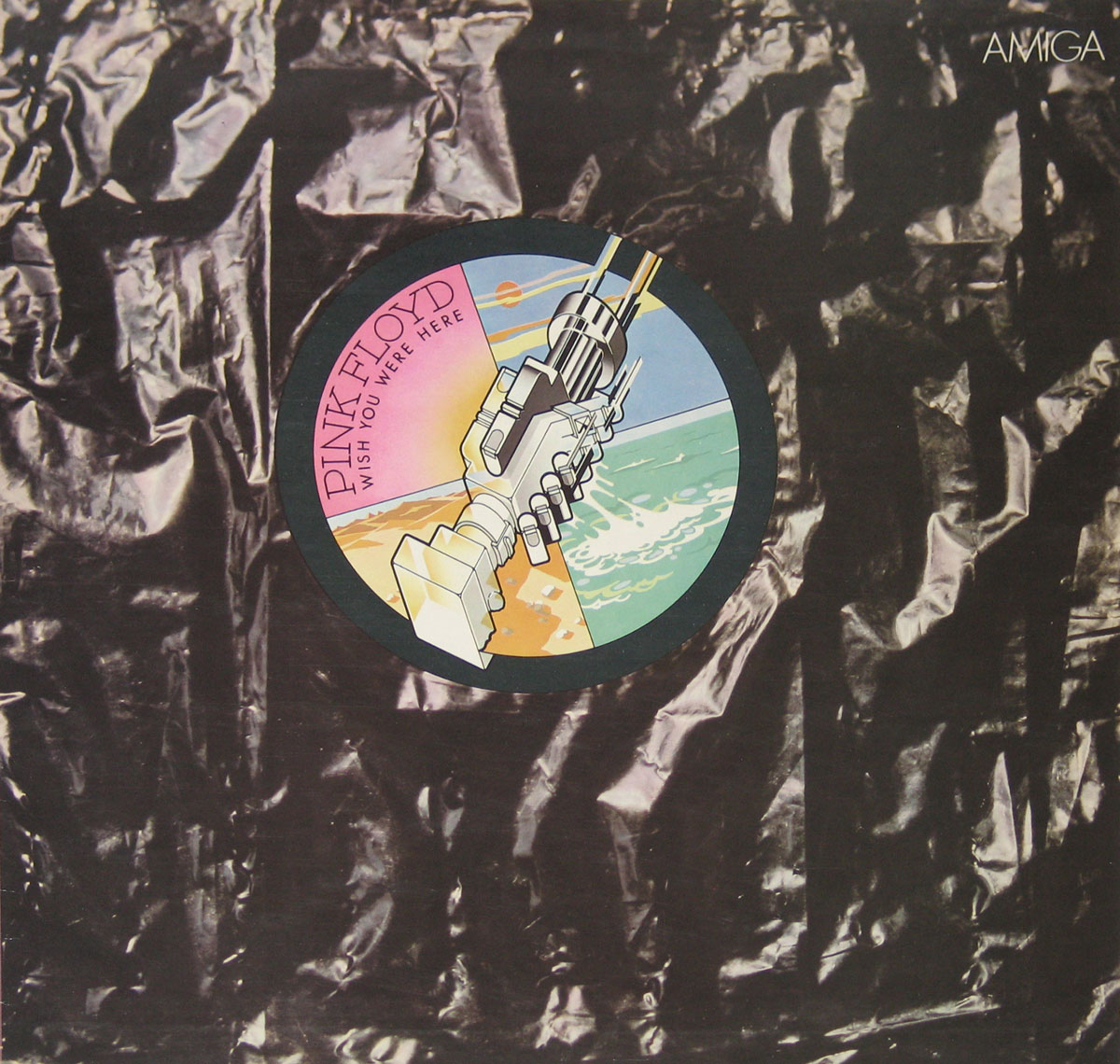
Album Front Cover:
Ccover has black crumpled paper design.
Upper right corner has Amiga logo.

Back cover:
At the top left it says "Schallplatte und Abtastnadel von Staub frei halten. Schallplatte entweder senkrecht stehend oder auf ebener Unterlage bis zu 20 Stuck ubereinanderliegend aufbewahren. Umgebungstemperaturen ueber +35 C vermeiden. VEB DEUTSCHE SCHALLPLATTEN BERLIN DDR Made in German Democratic Republic. Reproduktion: Prust / Gestaltung: EMI Lithographie und Druck: VEB Gotha-Druck Ag 511/01/83/A Verpackung nach TGL 10609."
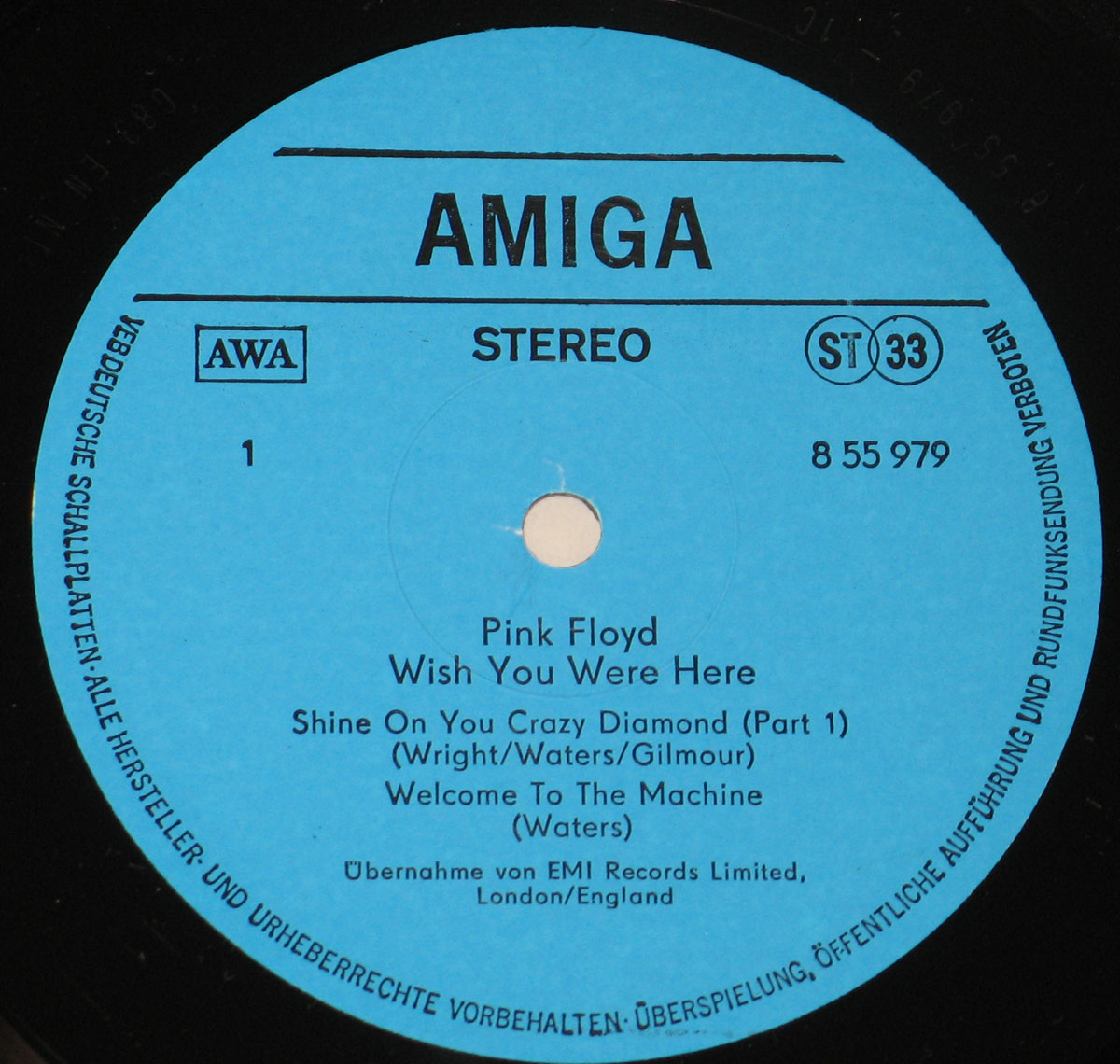
Blue Amiga Record Label

Top center it reads "PINK FLOYD WISH YOU WERE HERE."

Top right says " STEREO 8 55 979 - 16,10 M." (16,10 M is the price in East-German currency).

Detailed three column biography/liner notes written in German by Peter Wicke (1983) on the back of the cover

Album Production information:

Producer: Pink Floyd

Recorded at Abbey Road Studio

Album Cover Design: Hipgnosis

  • Hipgnosis – British album cover art design group

    Hipgnosis is my favorite proof that a record sleeve can be a full-on mind game, not just a band photo with better lighting.

    Hipgnosis is the legendary London-based art design group that turned rock sleeves into visual myths. The core duo, Storm Thorgerson and Aubrey "Po" Powell, were childhood friends of the Pink Floyd inner circle in Cambridge—a connection that allowed them to bypass the stiff mandates of EMI’s in-house design department in 1968. Their debut, "A Saucerful of Secrets," was only the second time in EMI history (after The Beatles) that an outside firm was granted creative control. The very name "Hipgnosis" was a piece of found art; Syd Barrett, during one of his more enigmatic phases, scrawled the word in ballpoint pen on the door of the South Kensington flat he shared with the duo. Thorgerson loved the linguistic friction of it: the "Hip" for the new and groovy, and "Gnosis" for the ancient, hidden knowledge. While Peter Christopherson later joined as a third partner in 1974, that initial Barrett-endorsed moniker defined a decade of surrealist mastery for bands like Led Zeppelin, Genesis, and 10cc, before the group dissolved in 1983.

  • Photography: Aubrey Powell ( took the photo of the two businessmen shaking hands, one of them engulfed in flames. )

    Sleeve design and photography assistance: Howard Bartrop, Jeff Smith, Peter Christopherson, and Richard Manning assisted with the overall design and photography setup.

    Graphics Design: George Hardie NTA* created the graphics used on the sleeve

    Record Label & Catalognr:

    Amiga AWA 8 55 979 (855979)
    Media Format: 12" Full-Length Vinyl LP  Gramophone Record
    Album weight: 220 gram 

    Year and Country:

    1983 Made in East-Germany
    Band Members and Musicians on: Pink Floyd Wish You Were Here DDR AMIGA
      Band-members, Musicians and Performers Pink Floyd is:
    • Roger Waters - bass, vocals
    • Roger Waters – Bass, vocals, songwriter

      Roger Waters is the guy I blame (politely) when a Pink Floyd song stops being “spacey vibes” and starts staring straight through you with lyrics that feel like a courtroom cross-examination.

      Roger Waters is, to my ears, Pink Floyd’s razor-edged storyteller: bassist, singer, and the main lyric engine who pushed the band from psychedelic drift into big, human-scale themes. His key band period is Pink Floyd (1965–1985), where he became the dominant writer through the 1970s and early 1980s, before leaving and launching a long solo career (1984–present). After years of public tension, he briefly reunited with Pink Floyd for a one-off performance at Live 8 in London on 2 July 2005—basically the musical equivalent of spotting a comet: rare, bright, and gone again. Since the late 1990s he’s toured extensively under his own name, staging huge concept-driven shows that revisit Floyd classics like "The Dark Side of the Moon" (notably on the 2006–2008 tour) and "The Wall" (2010–2013), because apparently subtlety is not the point when you’ve got something to say.

    • Nick Mason - percusssion
    • Nick Mason – Drums, percussion

      Nick Mason is the steady heartbeat I always come back to in Pink Floyd: the only constant member since the band formed in 1965, quietly holding the whole weird universe together while the rest of the planet argues about everything else.

      Nick Mason is Pink Floyd’s drummer, co-founder, and the one guy who never clocked out: his main performing period with Pink Floyd runs from 1965 to the present, and he’s the only member to appear across every Pink Floyd album. Outside the mothership, he’s had a very “I’m not done yet” second act: in 2018 he formed Nick Mason’s Saucerful of Secrets (2018–present) to bring the band’s early psychedelic years back to the stage. He’s also stepped out under his own name with projects like the solo album "Nick Mason’s Fictitious Sports" (released 1981), which is basically him taking a left turn into jazz-rock just to prove he can. And yes, he was part of that blink-and-you-miss-it full-band moment at Live 8 in London in 2005, when the classic lineup briefly reunited and reminded everyone why this band still haunts people.

    • Dave Gilmour - Guitar, vocals
    • David Gilmour – Guitar, vocals

      David Gilmour is the voice-and-fingers combo I hear whenever Pink Floyd turns from “spacey” into straight-up cinematic: he joined in 1967 and basically helped define what “guitar tone with emotions” even means.

      David Gilmour is, for me, the calm center of Pink Floyd’s storm: an English guitarist, singer, and songwriter whose playing can feel gentle and devastating in the same bar. His earliest band period worth name-dropping is Jokers Wild (1964–1967), before he stepped into Pink Floyd in 1967 as Syd Barrett’s situation unraveled. From there his main performing era is Pink Floyd (1967–1995), including the post-Roger Waters years where the band continued under his leadership and released "A Momentary Lapse of Reason" (1987) and "The Division Bell" (1994), with a later studio coda in "The Endless River" (2014). Outside Floyd, he’s had a long solo run (1978–present) with albums ranging from "David Gilmour" (1978) to "Luck and Strange" (2024), and he even did a sharp side-quest in 1985 with Pete Townshend’s short-lived supergroup Deep End. And for one historic night, the classic lineup reunited at Live 8 in Hyde Park, London on 2 July 2005—one of those “you had to be there (or at least press play)” moments.

    • Rick Wright - keyboards, vocals
    • Richard Wright – Keyboards, vocals

      Richard Wright is the secret atmosphere machine in Pink Floyd: the guy who can make one chord feel like a whole weather system, and then casually add a vocal harmony that makes it hit even harder.

      Richard Wright (born Richard William Wright) is, for me, the understated genius of Pink Floyd: co-founder, keyboardist, and occasional lead vocalist whose textures are basically baked into the band’s DNA. His main performing period with Pink Floyd runs from 1965 to 1981 (including the early albums through the massive arena years), then he returned as a full member again from 1987 to 1994 for the later era tours and albums. In between those chapters, he didn’t just vanish into a fog machine: he released a solo album, "Wet Dream" (1978), and later "Broken China" (1996), and he also had a proper side-project moment with Zee (1983–1984), which produced the album "Identity" (1984). He passed away in 2008, but his playing still feels like the part of Pink Floyd that makes the air shimmer.

    Complete Track Listing of: Pink Floyd Wish You Were Here DDR AMIGA

    The Song/tracks on "Pink Floyd Wish You Were Here Gt Britain" are

      Side One:
    1. Shine on your Crazy Diamond (Part One, Two, Three, Four, Five)
    2. Welcome to the Machine
      Side Two:
    1. Have a Cigar
    2. Wish You Were Here
    3. Shine Ony Your Crazy Diamond (Part Six, Seven, Eight, Nine)
    Photo of Pink Floyd Album's Front Cover 
    High Resolution Photo #1 PINK FLOYD Wish You Were Amiga  
    Photo of Pink Floyd Album's Back Cover  
    High Resolution Photo #2 PINK FLOYD Wish You Were Amiga  
    Close-up Photo of Pink Floyd's Record Label 
    High Resolution Photo #3 PINK FLOYD Wish You Were Amiga  

     Note: the pictures on this page are actual photos of the album. Slight differences in color may exist due to the use of the camera's flash. Images can be zoomed in/out ( eg pinch with your fingers on a tablet or smartphone ).

    Index of PINK FLOYD's -Wish You Were Here Vinyl Album Information and Album Cover Gallery
    PINK FLOYD - Wish You Were Here (East-Germany) 12" Vinyl LP
    PINK FLOYD - Wish You Were Here (East-Germany) album front cover

    Amiga AWA 8 55 979 , 1973 , East-Germany

    Released during a tumultuous period, Pink Floyd's "Wish You Were Here" 12" Vinyl LP on Amiga Records in East Germany symbolizes a unique cultural intersection. Amidst Cold War tensions, this musical masterpiece transcended boundaries, resonating globally. Its intricate soundscapes and poignant lyrics mirrored the zeitgeist, fostering a connection that surpassed geopolitical divides. The East German release adds a layer of historical significance, encapsulating the album's enduring impact during a pivotal time.

    Learn more
    PINK FLOYD - Wish You Were Here (France) 12" Vinyl LP
    PINK FLOYD - Wish You Were Here (France) album front cover

    Harvest 2C 068-96918 , 1975 , France

    Pink Floyd's "Wish You Were Here" 12" Vinyl LP, released in France, epitomizes progressive rock excellence. Recorded at Abbey Road Studio, the album's iconic cover, designed by Hipgnosis, features a powerful image captured by Aubrey Powell. Meticulous sleeve design by various talents and graphic artistry by George Hardie NTA enhance the immersive experience. With complete lyrics and photos in the inner sleeve, this release, cataloged as Harvest 2C 068-96918, remains a timeless masterpiece, contributing significantly to the band's legacy.

    Learn more
    PINK FLOYD - Wish You Were Here (Germany Druckhaus) 12" Vinyl LP
    PINK FLOYD - Wish You Were Here (Germany Druckhaus) album front cover

     Harvest – 1 C 064-96 918 , 1975 , Germany

    "Wish You Were Here" is the ninth studio album by English progressive rock group Pink Floyd, released in September 1975. Inspired by material they composed while performing across Europe, it was recorded over numerous sessions at London's Abbey Road Studios. The album explores themes of absence, the music business, and former band-mate Syd Barrett's mental decline.

    Learn more
    PINK FLOYD - Wish You Were Here (Germany) 12" Vinyl LP
    PINK FLOYD - Wish You Were Here (Germany) album front cover

    EMI Harvest / Electrola 1C 062-96 918 , 1975 , Germany

    The German release of Pink Floyd's iconic album, "Wish You Were Here," on 12" Vinyl LP, marked a significant moment in 1975 music history. Produced by EMI Harvest/Electrola (Catalognr: 1C 062-96 918), the album's distinctive sound and emotional resonance showcased the band's mastery. The German edition, "Made in Germany," stands as a testament to Pink Floyd's enduring influence on the international music scene during that era.

    Learn more
    PINK FLOYD - Wish You Were Here (Greece) 12" Vinyl LP
    PINK FLOYD - Wish You Were Here (Greece) album front cover

    EMI Harvest 14C 066-96918 / 2J 066-96918 / SHVL 814A , 1975 , Greece

    The Greek release of Pink Floyd's "Wish You Were Here" (EMI Harvest 14C 066-96918) encapsulates the band's iconic 1975 album within the unique sociocultural context of Greece during the post-junta era. As a tangible relic of the analog age, this 12" Vinyl LP Album stands as both a musical masterpiece and a historical artifact, providing a sensory journey through time and a reflection of the nation's collective experience.

    Learn more
    PINK FLOYD - Wish You Were Here (Gt Britain) 12" Vinyl LP
    PINK FLOYD - Wish You Were Here (Gt Britain) album front cover

    EMI SHVL 814 , 1975 , Gt Britain

    Pink Floyd's 1975 release, "Wish You Were Here," is a progressive rock masterpiece that defined the genre's mid-70s zenith. Recorded at Abbey Road Studios, the album's sonic brilliance fused with iconic cover art by Hipgnosis and graphics by George Hardie. A British production, it encapsulates the era's cultural and musical evolution, leaving an enduring legacy as a symbol of progressive rock's innovative spirit.

    Learn more
    PINK FLOYD - Wish You Were Here (Netherlands Yellow Dots) 12" Vinyl LP
    PINK FLOYD - Wish You Were Here (Netherlands Yellow Dots) album front cover

     Harvest – 5C 062-96918 , 1975 , Netherlands

    The Netherlands release of Pink Floyd's "Wish You Were Here" 12" Vinyl LP, identified by the catalog number 5C 062-96918, encapsulates the meticulous production and visual identity of the 1970s. This era-defining artifact reflects the band's commitment to sonic landscapes and the European market's receptivity to progressive rock. The consistent catalog number across album covers and labels highlights a dedication to quality control and a cohesive aesthetic.

    Learn more
    PINK FLOYD - Wish You Were Here (Netherlands) 12" Vinyl LP
    PINK FLOYD - Wish You Were Here (Netherlands) album front cover

    EMI Harvest 1A 064-96918 , 1975 , Netherlands

    Pink Floyd's "Wish You Were Here" 12" Vinyl LP Album, Netherlands release (catalognr: EMI Harvest 1A 064-96918), epitomizes the musical landscape of 1975. Amidst a vinyl revival, its white dots on the label add visual charm. The record's conceptual depth, addressing alienation and human complexity, transcends its era. The "Made in Holland" stamp signifies global impact, making it a timeless masterpiece bridging cultures and generations.

    Learn more
    PINK FLOYD - Wish You Were Here (Spain) 12" Vinyl LP
    PINK FLOYD - Wish You Were Here (Spain) album front cover

    Harvest 1J 066-96918 , 1975 , Spain

    Pink Floyd's 1975 Spanish release of "Wish You Were Here" on 12" Vinyl LP made a profound impact in the Progressive Rock era. Recorded at Abbey Road Studio, the album, with iconic cover art by Hipgnosis, encapsulated the socio-cultural context of Spain's transition to democracy. Aubrey Powell's striking photograph and the Harvest catalog number highlighted its international significance, solidifying Pink Floyd's legacy in the progressive and psychedelic music movement.

    Learn more
    PINK FLOYD - Wish You Were Here (Sweden) 12" Vinyl LP
    PINK FLOYD - Wish You Were Here (Sweden) album front cover

    EMI 7C 062-96918 , 1975 , Sweden

    The 1975 Swedish release of Pink Floyd's "Wish You Were Here" on a 12" vinyl LP (Catalog nr: EMI 7C 062-96918) is a cultural gem. Reflecting the band's global influence, the album explores themes of alienation and critiques the music industry. Its meticulous production and iconic cover art symbolize the 1970s music scene. A tangible connection to the era, this release remains a cherished artifact in the history of European music.

    Learn more
    PINK FLOYD - Wish You Were Here (USA) 12" Vinyl LP
    PINK FLOYD - Wish You Were Here (USA) album front cover

    Columbia PC 33453 , 1975 , USA

    Pink Floyd's "Wish You Were Here," released in 1975, is a landmark 12" Vinyl LP Album produced at Abbey Road Studios, London. The gatefold cover unfolds to reveal intricate artwork, complementing the original thick paper inner sleeve with lyrics and photos. A symbol of the 1970s, the album captures the essence of an era marked by cultural shifts and musical exploration, making it a timeless gem in rock music history.

    Learn more
    PINK FLOYD Main Index