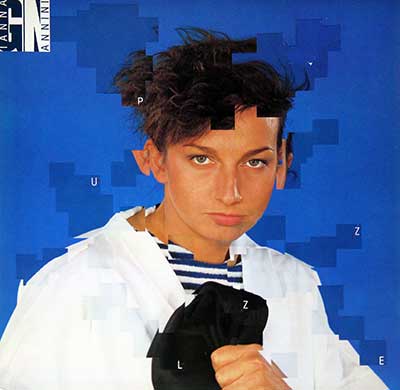
- Structured cover
Gianna Nannini's "Puzzle" 12" vinyl LP album is a mesmerizing exploration of Italian pop, rock, and electronic fusion. With a structured cover design, the album showcases Nannini's iconic voice and dynamic style. Each track weaves a musical tapestry, creating an immersive experience for listeners. A must-have for fans, the album stands as a testament to Nannini's enduring influence in the realm of Italo music.
Released in 1984, "Puzzle" marks the moment where Gianna Nannini levels up hard. Working with Conny Plank, she locks attitude, melody, and studio precision into a 12" vinyl LP that sounds confident, cinematic, and very aware of its own power.
The album lives right in that prime 80s crossover zone, where muscular rock hooks meet sleek synth textures without tripping over each other. Plank’s production keeps everything tight and dramatic, framing Nannini’s unmistakable rasp as the emotional core while letting electronics and guitars widen the soundstage.
Plank wasn’t just polishing takes here; he shaped the album’s atmosphere and momentum. The balance between punch and space gives the record clarity without sanding off its edge, and the fact that Gianna Nannini is credited as co-producer on some editions fits perfectly with how focused and self-assured the album feels.
The defining moment is "Fotoromanza", the track that pushed "Puzzle" beyond Italy and into full-on European consciousness. Its success was amplified by a striking music video directed by Michelangelo Antonioni, an unexpected but iconic crossover that helped turn the song into a genuine cultural flashpoint.
That impact translated into real numbers as well, with "Puzzle" going platinum in Italy and charting strongly across Europe. Sharp songwriting, a fearless vocal presence, and Plank’s crisp, high-voltage production are exactly why this album still defines Nannini’s 1980s peak.
Rock/Pop from Italy
Rock- and pop-oriented material from Italy, blending melodic songwriting with a distinctly European production style typical of the early to mid-1980s.
Metronome Musik / Dischi Ricordi – Cat#: 813 387
This structured cover album includes the original custom inner sleeve with album details, complete lyrics of all songs by Gianna Nannini, and photographs.
Record Format: 12" LP Vinyl Gramophone Record
1984 – Germany
Creative co-pilot of “Puzzle”, shaping its identity from song structure to final attitude. Read more...
Gianna Nannini played a decisive role in steering “Puzzle” beyond being just another produced album and into something that feels authored from the inside out. As co-producer, control over arrangements, vocal dynamics, and overall direction is unmistakable, especially in how the songs balance raw urgency with tightly framed studio precision. Choices around tempo, vocal layering, and when to let electronics push forward versus pulling them back all point to an artist fully invested in how this record should hit emotionally and physically. That hands-on involvement gives the album its confidence and cohesion, making it sound less like a compromise between artist and producer and more like a shared vision executed with intent.
Architect of krautrock’s most futuristic sounds and a studio alchemist long before that was a buzzword. Read more...
Conrad “Conny” Plank sits at the center of my mental map of experimental European rock. Active from the late 1960s until his death in 1987, he helped shape Kraftwerk during their early Kling Klang years, captured the motorik pulse of Neu! in the early 1970s, and refined the abstract electronics of Cluster and Harmonia. By the late ’70s and early ’80s, his studio became a magnet for outsiders like Ultravox, Eurythmics, and Devo, bridging krautrock experimentation with emerging synth-pop and post-punk.
The voice, attitude, and creative center of “Puzzle”. Read more...
Gianna Nannini drives the album with a vocal performance that is raw, urgent, and deliberately pushed to the front. Piano, synths, and Emulator parts are used as force multipliers, reinforcing tension rather than softening it. The electric violin adds an abrasive edge that keeps the record from settling into polite pop territory.
Tight rhythm guitar built for momentum, not decoration. Read more...
Claudio Cottolosto supplies controlled, punchy guitar work that locks songs into place. Riffs reinforce structure and drive, giving the album physical weight without cluttering the arrangements.
Texture and color layered into the rock framework. Read more...
Rudy Spinello adds melodic guitar lines and mandolin accents that widen the album’s emotional range, slipping subtle contrast into otherwise hard-edged arrangements.
Low-end muscle fused with early digital texture. Read more...
Hans Bär anchors the rhythm with assertive bass lines while feeding electronic layers into the mix, helping blend live performance with programmed precision.
Straight-ahead groove keeping the album grounded. Read more...
Claudio “Golinelli” Golini delivers solid, rhythm-focused bass work that supports both rock and electronic elements without pulling focus.
Mechanical precision shaping the album’s pulse. Read more...
Pino Scagliarini programs sequenced parts that tighten the rhythm and push the record firmly into early-80s electronic territory.
The electronic backbone behind the album’s tension. Read more...
Conny Plank uses electronic tools to sharpen drama and momentum, balancing human performance with controlled machinery.
Hybrid drumming with punch and snap. Read more...
Rodger Brown blends acoustic power with Simmons electronics, giving the album its aggressive, modern rhythmic edge.
Extra drive keeping the energy locked. Read more...
Freddy Steady reinforces the album’s momentum with tight, no-frills drumming that stays focused on impact.
Disclaimer: Track durations are not listed. Track order reflects the standard LP configuration.
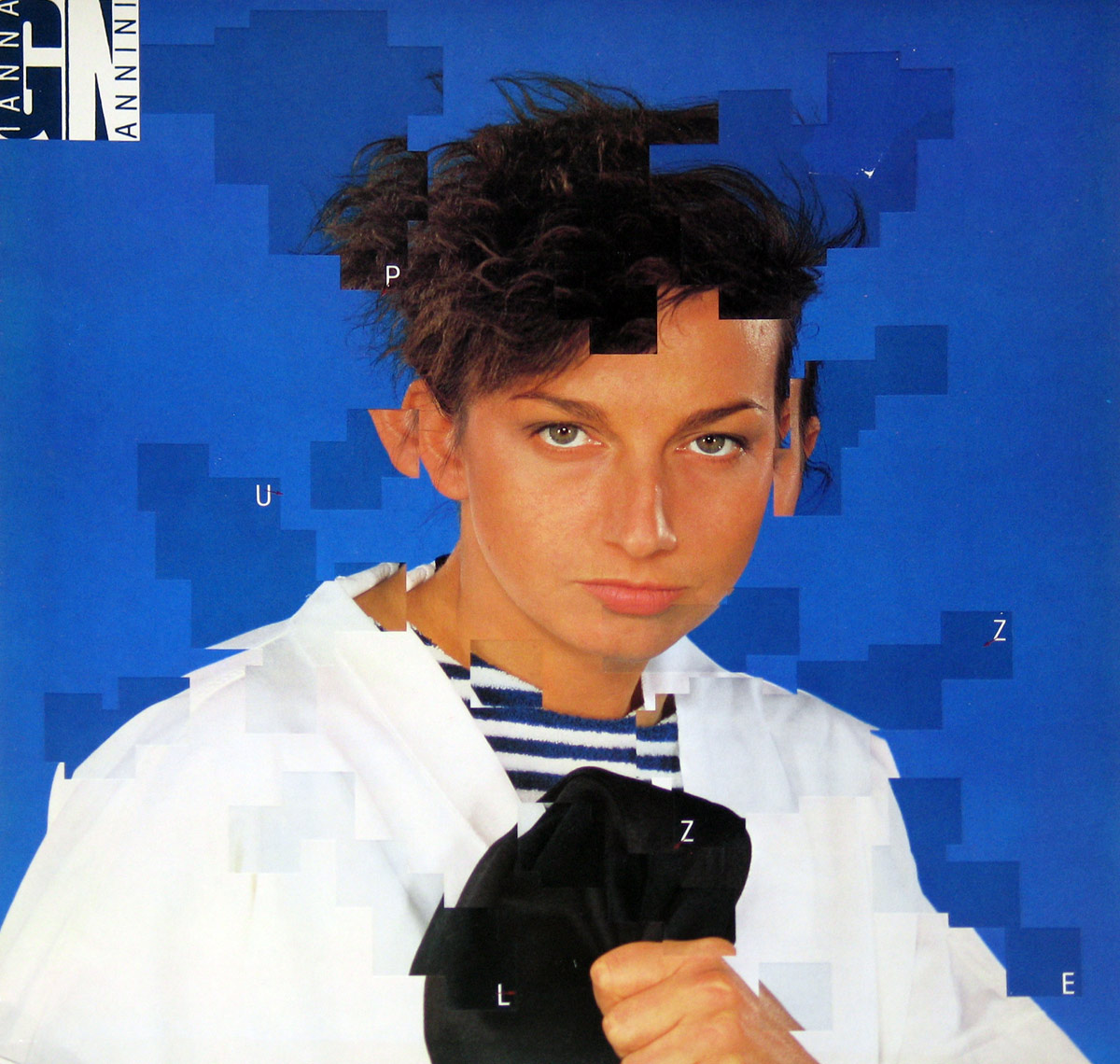
This front cover hits immediately with a stark, confrontational studio portrait set against a flat, saturated blue background that fills the entire frame. Centered tightly is a woman staring straight into the camera with a hard, unblinking gaze, cropped from the chest upward. The framing is deliberate and claustrophobic, leaving no visual escape, a design choice that translates power and control rather than softness or glamour.
The most striking element is the fragmented, block-like mosaic effect layered over the image, especially across the hairline, forehead, and upper shoulders. These rectangular interruptions feel intentionally digital and mechanical, very much rooted in early-1980s graphic experimentation. They partially disrupt the portrait without obscuring it, creating tension between human presence and artificial structure.
The subject’s short, dark hair is styled loosely, with visible texture and movement, contrasting with the rigid geometry of the overlay. Facial features are sharp and evenly lit, with minimal shadowing, suggesting controlled studio lighting designed for clarity rather than mood. The eyes are the focal point, positioned slightly above center, locking attention immediately.
Clothing reinforces the era and attitude: a bright white jacket dominates the lower half of the frame, creating high contrast against the blue background. Beneath it, a horizontally striped shirt adds visual rhythm without distracting from the portrait. A dark, possibly black glove or fabric element is pulled close to the chest, introducing a strong black accent that anchors the composition.
Typography is intentionally minimal on this cover, allowing the image to carry the full weight. Small, scattered letters embedded within the mosaic blocks hint at the album title without traditional placement, reinforcing the fractured, modernist concept. From a collector’s standpoint, this design is unforgiving: any ring wear, corner damage, or color fade shows instantly, making clean copies especially desirable.
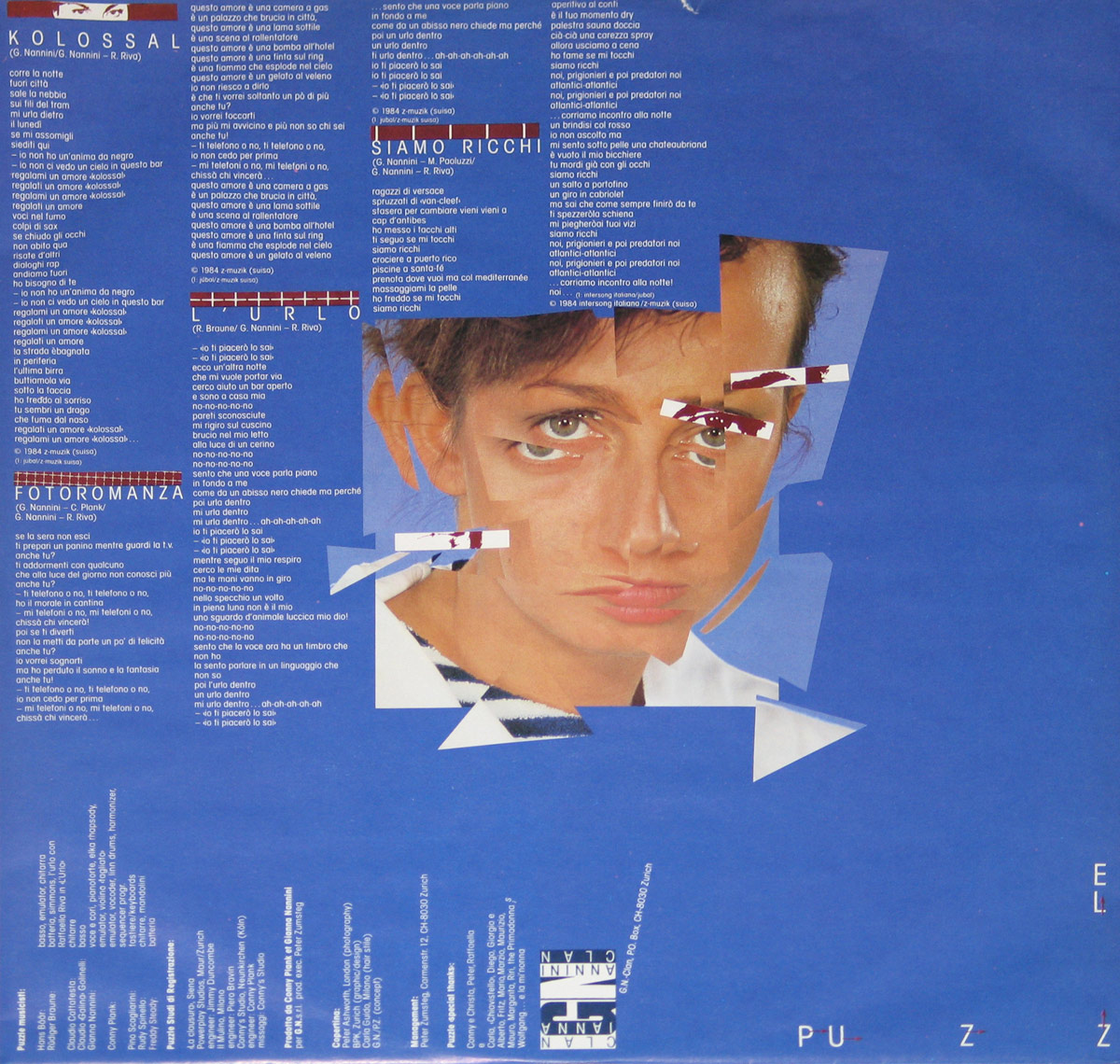
This back cover is dominated by a solid, saturated blue background that matches the front sleeve and immediately signals visual continuity. The surface is densely packed with white text blocks containing full song lyrics, track titles, and writing credits, laid out in strict vertical columns. The design prioritizes information density over decoration, turning the sleeve into a functional document rather than a decorative afterthought.
Track titles such as “Kolossal”, “Fotoromanza”, “L’Urlo”, and “Siamo Ricchi” are clearly separated and set in clean, legible type, optimized for reading directly from the sleeve. The typography is consistent, thin, and sharp, with no unnecessary stylistic flourishes, which helps preserve clarity even under imperfect lighting conditions common when handling vinyl.
At the center of the composition, a fragmented photographic portrait breaks through the text field. Only the eyes and partial facial features are visible, assembled from angular shards that echo the mosaic effect used on the front cover. This visual interruption keeps the sleeve from becoming purely informational while reinforcing the album’s fractured, modernist identity.
Orientation plays a deliberate role here. Several elements, including logos and catalog information, are rotated ninety degrees, forcing the record to be physically turned in the hands. This interaction is intentional and typical of mid-1980s European sleeve experimentation, encouraging closer inspection rather than passive viewing.
Along the lower area, production credits, copyright notices, and label information are printed in compact blocks, including references to Metronome Musik and Dischi Ricordi. From a collector’s perspective, this sleeve is extremely condition-sensitive: scuffs, spine wear, or ink fading disrupt the uniform blue field instantly, making clean, unfaded copies increasingly difficult to find.
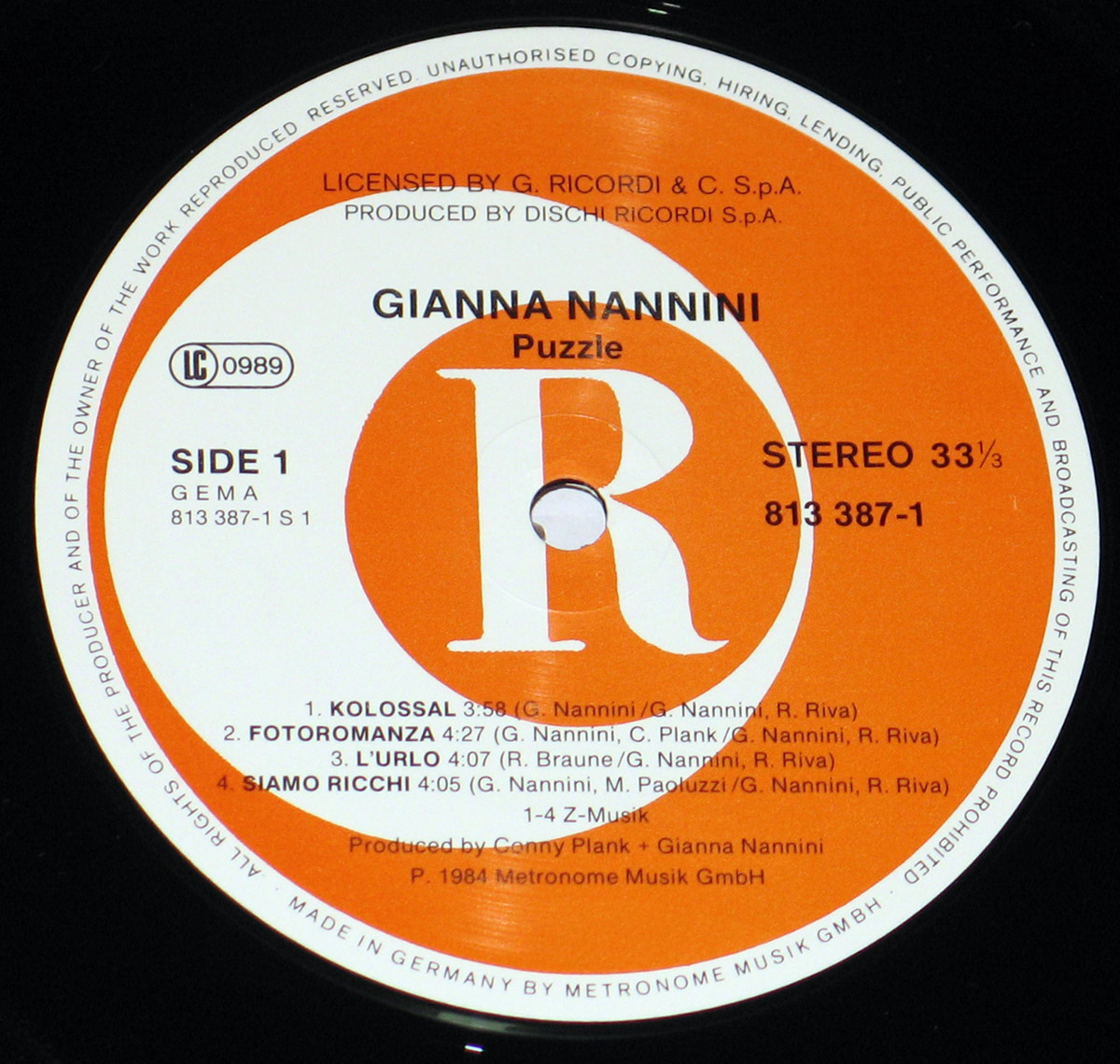
This image shows a tight, well-lit close-up of the Side One record label from the original 12-inch vinyl pressing of “Puzzle”. The label uses a bold orange field framed by a clean white outer ring, a classic Metronome Musik design that immediately dates the pressing to the early-to-mid 1980s. The surface appears clean and flat, with no obvious spindle trails cutting through the text, which is always the first thing checked when judging play wear.
At the center sits the large stylized R logo, printed sharply and evenly, surrounding the spindle hole. Above it, the artist name Gianna Nannini and album title Puzzle are clearly legible, aligned horizontally and printed in solid black. The type is crisp, with no bleeding into the paper stock, a good indicator of a clean original print run rather than a later, softer reissue.
On the left side, Side 1 and GEMA rights information are printed alongside the full catalog reference 813 387-1 S1. On the right, the format marking Stereo 33 1/3 confirms standard LP playback speed. These details are essential for accurate identification, especially when catalog numbers differ subtly between countries or pressings.
The track listing is printed below the center, with exact running times for “Kolossal,” “Fotoromanza,” “L’Urlo,” and “Siamo Ricchi.” Songwriting credits are included line by line, reinforcing that this label was designed to be informative rather than decorative. Beneath the tracks, production credit clearly states Produced by Conny Plank + Gianna Nannini.
Around the outer rim, small but fully readable copyright text circles the label, including licensing by G. Ricordi & C. S.p.A. and manufacturing credit Made in Germany by Metronome Musik GmbH. From a collector’s standpoint, the clarity of this rim text matters: wear, groove polish creep, or label fading would immediately reduce value, none of which appear visible here.
All images on this site are photographed directly from original vinyl LP covers and record labels in my collection. Differences in color or contrast may occur due to lighting conditions and camera equipment used over the years. Images may be used for personal or non-commercial purposes with attribution; commercial use requires permission.
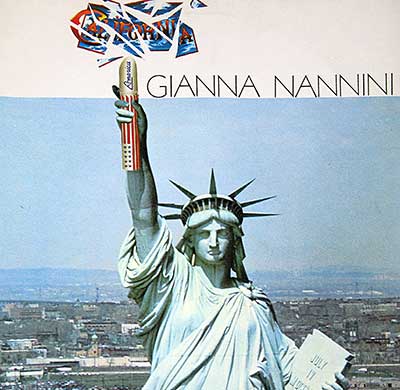
Dischi Records / Metronome 0065.014 , 1979 , Germany
Gianna Nannini's 1979 LP "California" stands as a landmark in her discography. This Italo rock masterpiece features a notable rendition of "Me and Bobby McGee" sung in Italian. The 12" vinyl LP album captures Nannini's raw energy, showcasing her evolving style in the late '70s. "California" is a dynamic blend of rock influences, cementing Nannini's reputation as a pioneering force in Italian music.
Learn more
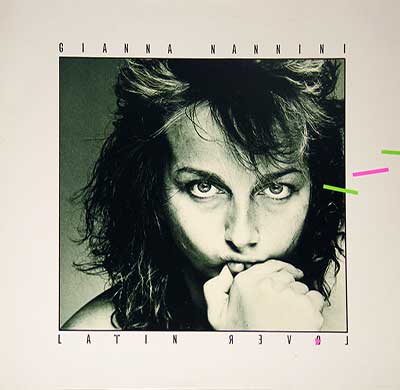
G. Ricordi 0065.027, Dischi Ricordi SPA, Metronome Records , 1982 , Made in Germany
Gianna Nannini's 1982 LP "Latin Lover" is a musical triumph, showcasing her fifth studio album with a fusion of Italian passion and international flair. Produced by Conny Plank, the album features diverse elements, including Plank's drumming and guest musician Annie Lennox on piano. Nannini's charismatic vocals and innovative collaborations make "Latin Lover" a standout 12" vinyl LP, blending genres seamlessly.
Learn more
Metronome Musik / Dischi Ricordi 813 387 , 1984 , Germany
Gianna Nannini’s “Puzzle” captures her 1984 breakthrough moment, blending Italian rock attitude with sharp synth-driven production. Produced with Conny Plank, the album balances raw vocals, electronic tension, and stadium-ready hooks, anchored by the era-defining single “Fotoromanza” and wrapped in a striking structured sleeve design.