BYRDS – Byrdmaniax 12" Vinyl LP Album

- UK Gatefold / Fold Open Cover • Orange CBS Label

Album Front Cover Photo of BYRDS – Byrdmaniax Visit: https://vinyl-records.nl/

"Byrdmaniax" is one of those Byrds albums that refuses to sit quietly in the discography. Released in 1971, it captures a band in transition, balancing country rock instincts with a newly polished studio approach that surprised fans and critics alike. Recorded across multiple sessions at Columbia Studios in Hollywood, the album pairs confident songwriting with layered production, resulting in a record that feels deliberate, reflective, and occasionally controversial. It may not shout for attention, but it rewards listeners willing to lean in and follow the Byrds into their early-seventies mindset.

Table of Contents

"Byrdmaniax" (1971) Album Description:

Some albums kick the door in. "Byrdmaniax" kind of… opens it politely, walks in, and quietly rearranges the furniture while you are still processing who even lives here now. It is a transitional Byrds record—country rock and pop leaning into a more polished shape—released as a 1971 UK gatefold that feels like a snapshot of a band still moving, even when the world wanted them frozen in their glory days.

1. Introduction on the band and the album

This is The Byrds in their tenth-album era: not the wide-eyed folk-rock revolutionaries anymore, but a road-worn unit trying to sound current without pretending the late ’60s never happened. The page itself calls out the reality: mixed reception, but also a few moments that still hit—like the satirical sting of "I Wanna Grow Up To Be A Politician" and the gospel glow of "Glory, Glory".

2. Historical and cultural context

By 1971, rock was splintering into a thousand confident directions at once—bigger sounds, tighter songs, and a serious hunger for “authentic” roots. Country rock and pop weren’t enemies; they were roommates, sharing the same radio and arguing over who got to control the chorus. "Byrdmaniax" lands right in that crosswind: not chasing trends like a desperate teenager, but also not living in a museum display case.

3. How the band came to record this album

You can practically hear the calendar pages flipping: sessions spread across June and October 1970, then January and March 1971, all at Columbia Studios in Hollywood, with orchestral overdubs arriving later like someone decided the story needed more lighting. With Terry Melcher and Chris Hinshaw producing, the vibe reads as “make it land,” the classic early-’70s studio impulse to smooth the edges and aim for a bigger, cleaner frame.

4. The sound, songs, and musical direction

The album’s DNA is country rock with pop instincts: warm harmonies, a steady hand on the steering wheel, and that occasional studio gloss that makes you wonder what it sounded like five minutes earlier, before the polish. "Glory, Glory" opens with a gospel lean—bold, a little unexpected—and it sets a tone of trying something, not just repeating yesterday’s headlines.

When the record gets playful, it is sharp about it. "I Wanna Grow Up To Be A Politician" throws its sarcasm in a short, punchy burst—like the band raising an eyebrow at the world and then moving on before it turns into a lecture. And when it gets reflective, it does it without melodrama: the closer "Jamaica Say You Will" (a Jackson Browne cover) slides out with a calm, late-night mood that feels like the lights going down in a half-empty club.

5. Comparison to other albums in the same genre/year

A lot of early-’71 country rock wore its denim and road dust proudly—leaner, more “live,” less dressed up for company. "Byrdmaniax" often chooses the opposite: it reaches for a more arranged, more sculpted sound, like the band is trying to make the same kind of songs but in a sharper suit. The result is a record that can feel gentler than its peers, but also strangely distinctive because it refuses to pretend it was recorded in one perfect, sweaty take.

If you are mapping the vibe, here is the quick mental filing system:

  • Where some 1971 country rock chased raw momentum, this one leans into finish.
  • Where some pop-rock chased instant hooks, this one allows odd turns and mood shifts.
  • Where many bands doubled down on identity, The Byrds sound like they are still negotiating theirs.
6. Controversies or public reactions

No scandal fireworks here—just the slow-burn kind of controversy that happens when expectations get loud. The page says it straight: it had a mixed reception, and the band’s shift in feel and finish clearly didn’t charm everyone. Some listeners hear “refinement,” others hear “overcooked,” and both camps can make their case without anyone throwing a chair.

7. Band dynamics and creative tensions

The lineup tells the story in human terms: Roger McGuinn as the last original anchor, Clarence White bringing serious country-rock muscle, and Skip Battin and Gene Parsons filling the frame with harmony, groove, and texture. That combination can sound like a team—or like a compromise—depending on the moment. It is not a band collapsing, but it is a band redefining itself in real time.

8. Critical reception and legacy

"Byrdmaniax" rarely gets crowned as the obvious “must-own” Byrds masterpiece, and honestly, that is part of why it is interesting. It is the kind of record collectors come back to when they are tired of the greatest-hits narrative and want the messy middle chapters. On vinyl—especially as a UK gatefold with that orange CBS label vibe—it becomes less about hype and more about holding a real artifact from a band navigating the early ’70s like everyone else: imperfectly, but with style.

9. Reflective closing paragraph

I do not spin "Byrdmaniax" to time-travel back to 1965. I spin it to hear a famous band sounding human—trying angles, chasing clarity, and occasionally landing something quietly gorgeous when nobody is looking. Decades later, the grooves still smell faintly of studio ambition, road fatigue, and that special kind of optimism you only get when you are brave enough to change course mid-flight.
Album Key Details: Genre, Label, Format & Release Info

Music Genre:

Country Rock, Pop

Country rock blends traditional American roots music with rock structures, while pop elements bring melodic hooks and accessible song forms, reflecting the Byrds’ early-1970s shift toward a more polished, mainstream sound.

Label & Catalognr:

Orange CBS – Cat#: S 64389 / KC 30640, with Walking Eye around spindle hole

Matrix/Stamper Codes: the vinyl record does not have any stamper codes.

Album Packaging

Gatefold / FOC (Fold Open Cover) album cover design with photos of the Byrds on the inside cover pages.

Media Format:

Record Format: 12" LP Vinyl, Stereo, Gramophone Record
Total Weight: 290g

Release Details:

Release Date: 1971

Release Country: Made in England

Production & Recording Information:

Producers:
  • Terry Melcher – Producer

    The classic Byrds sound-architect returned, then (controversially) put a glossy Hollywood bow on the finished tapes.

    Terry Melcher, co-produced "Byrdmaniax" and shepherded the project through its last stretch after the main sessions wrapped, overseeing the final mixdown work and the added orchestral and choir overdubs that became the album’s biggest talking point. That decision didn’t just “decorate” the songs—strings, horns, and voices actively reshape the mood, pushing the record toward a bigger, more arranged 1971 sheen that the band later protested.

  • Chris Hinshaw – Producer

    The co-producer who stayed behind with the reels when the Byrds hit the road again, turning unfinished sessions into a finished album.

    Chris Hinshaw, co-produced the album and was part of the small “after-hours” crew that completed the record once the band left the studio, handling the practical, make-it-real work of finishing mixes and coordinating the additional overdub sessions. That behind-the-console role matters here: the album’s defining polish—especially the post-session orchestration—comes from the production room decisions as much as the band’s performances.

Recording Location:
Columbia Studios – Hollywood, California, USA
Recording dates: 2 June & 6 October 1970; 9–26 January & 1–6 March 1971
Orchestral overdubs recorded mid-March to early April 1971 at the same location.
  • Columbia Studios, Hollywood – Recording studio

    One of those big-label Hollywood rooms built for “get it done” sessions, then used here as both workshop and finishing suite.

    Columbia Studios, Hollywood, hosted the album across scattered dates from mid-1970 into early 1971, and it’s also where the later orchestral overdubs were added—meaning the same facility captured both the band’s core takes and the “post-production makeover.” In this era, Columbia’s Hollywood operation was tied to the label’s West Coast recording and mastering setup at Columbia Square, and that professional, controlled environment is exactly how a country-rock band can end up wearing full strings and horns without the whole thing collapsing into chaos.

Album Cover Design & Artwork:
  • Virginia Team – Album cover design

    The behind-the-scenes packaging hands who turn “an album” into “a thing you want to pick up and keep.”

    Virginia Team, contributed to the cover design and overall presentation for "Byrdmaniax," shaping how the record is introduced before the needle ever drops. The choices here are not decorative filler: typography, layout, and the way images are framed set the album’s tone as a 1971 major-label artifact—more finished, more “packaged,” and very much part of the era’s shift toward slicker country-rock and pop crossover.

  • John Berg – Album cover design

    Columbia’s heavyweight art-direction brain, brought in to make the sleeve look like it belonged in the label’s front window.

    John Berg, as a key Columbia Records art director, helped shape the visual “packaging voice” of "Byrdmaniax"—the kind of design work that quietly signals prestige, budget, and intent. This is the same design brain behind sleeves in my collection like Blue Öyster Cult – "Secret Treaties", Loverboy – "Get Lucky", Steppenwolf – "Monster", Johnny Winter – "Captured Live" and "Still Alive And Well", Jeff Beck – "Blow By Blow", Judas Priest – "Screaming For Vengeance", Jim Steinman – "Bad For Good", and the wonderfully left-field John Cale & Terry Riley – "Church Of Anthrax". On "Byrdmaniax", that same visual authority is at work: not a scruffy bar-band document, but a carefully assembled 1971 release designed to sit confidently among Columbia’s heavyweight titles—albums that look important before the needle ever drops.

  • Anne Garner – Album cover design

    The detail-work side of cover design lives here: the small choices that make a gatefold feel “designed,” not just printed.

    Anne Garner, is credited on the cover design, contributing to the album’s final visual presentation and how the photography and text are balanced across the sleeve. That matters on a record like this: when the music leans into polish and post-production, the artwork has to sell the same “finished” story in one glance—before anyone gets to argue about whether the orchestration was a masterstroke or an overreach.

Photography:
  • Don Jim – Album cover photography

    The lens behind the sleeve’s first impression, setting the mood before Side One even gets a chance to speak.

    Don Jim, supplied the cover photography used to front "Byrdmaniax," giving the album its immediate visual identity in the racks. Cover photos aren’t background decoration on vinyl—this is the handshake moment—so the imagery becomes part of the album’s narrative: a late-era Byrds statement presented with that early-’70s confidence and a distinctly “major label” finish.

Inside Cover Photography:
  • Derek Lepper – Inside cover photography

    Inside photos are where the album stops being a product and starts looking like a band with real gravity.

    Derek Lepper, is credited for inside cover photography, contributing imagery that lives in the gatefold space—where collectors actually linger. Those inside shots don’t just “show the band”; they frame the era, the vibe, and the posture of a group balancing country-rock roots with a more polished studio direction.

  • Ed Caraeff – Inside cover photography

    A music-photography heavyweight in the credits, bringing that professional “album-world” look to the inside spread.

    Ed Caraeff, contributed inside cover photography, helping shape the visual atmosphere that surrounds the music on the gatefold. The effect is subtle but real: strong inside images make the album feel larger than its runtime, turning a listening session into a little world—exactly what vinyl is supposed to do when it’s behaving.

  • Gene Parsons – Inside cover photography

    The rare kind of credit that hints at a band member helping document the era, not just perform it.

    Gene Parsons, is credited for inside cover photography on "Byrdmaniax," adding to the gatefold’s visual story from within the band’s own orbit. That kind of contribution matters on an album made across scattered dates and heavy touring: the inside photos become the “human evidence” around the music—faces, moments, and presence—so the sleeve feels like a living chapter, not just a container.

Band Members / Musicians:

Band Line-up:
  • Roger McGuinn – vocals, guitar

    The last original Byrd still steering the ship, McGuinn anchors the album with his unmistakable vocal tone and ringing guitar style, even as the band drifts further from its folk-rock origins.

    Roger McGuinn, the Byrds’ founding voice and resident compass, turns "Byrdmaniax" into something that still sounds like the Byrds even when the era is begging everyone to reinvent themselves. Lead vocals and that bright, chiming guitar approach give the album its familiar spine, while the songwriting keeps the record moving between moods: the gospel-leaning opener "Glory, Glory" sets an unexpected tone, "I Trust" brings a personal, steadier center, and the sharp little grin of "I Wanna Grow Up to Be a Politician" proves the band could still jab at the world without writing a manifesto. The McGuinn pen is all over this set, including co-writes like "Pale Blue" (with Gene Parsons) and "Kathleen's Song" (with Jacques Levy), making his contribution here less about nostalgia and more about holding the album together when the production choices threaten to pull it in different directions.

  • Clarence White – vocals, guitar

    A virtuoso with country instincts baked into his fingertips, White brings precision, fire, and emotional depth, often sounding like he is playing one album ahead of everyone else.

    Clarence White, the country-rock spark plug in the later Byrds machine, supplies the kind of guitar work that makes the “country” part feel earned instead of costume jewelry. On "Byrdmaniax" his playing threads through the album’s polished surfaces with sharp phrasing and that clean-but-human attack—exactly what keeps the songs from turning into soft-focus wallpaper when the arrangements get bigger. Vocals are credited too, but the real signature is the guitar personality: quick, confident lines that push the band’s late-era sound further into country rock without losing the Byrds’ sense of melody. The album even gives him a songwriter stamp via "Green Apple Quick Step" (co-written with Gene Parsons), a short, punchy moment that feels like a band member leaving a fingerprint on the actual track list, not just the session tape.

Band Line-up:
  • Skip Battin – electric bass, vocals

    Battin’s melodic bass lines and harmony vocals add a subtle pop sensibility, smoothing some of the album’s sharper creative edges.

    Skip Battin, the Byrds’ early-’70s bass anchor and resident pop-instinct troublemaker, brings a springy, melodic bottom end that helps "Byrdmaniax" glide instead of stomp. Bass and vocals are the obvious job description, but the album-specific stamp is the songwriting: "Tunnel of Love," "Citizen Kane," and "Absolute Happiness" all carry Battin co-writes (with Kim Fowley), which is basically the record’s permission slip to get weird, playful, and a little sideways. Those tracks tilt the album toward pop and offbeat character, making the whole thing feel less like “country rock assignment” and more like a band still willing to smirk in the middle of a serious decade.

  • Gene Parsons – drums, harmonica, banjo, vocals

    More than just the drummer, Parsons colors the record with rootsy textures, grounding the arrangements while quietly expanding the Byrds’ sonic palette.

    Gene Parsons, the rare drummer who shows up with extra instruments and real songwriter credits, gives "Byrdmaniax" its “band in a room” heartbeat even when the album is dressed up in studio polish. Drums keep the tracks moving, but the album’s flavor comes from the added colors listed right on the page—harmonica and banjo—those little rootsy details that make country rock feel lived-in instead of carefully manufactured. Parsons also stamps the track list as a writer: "Pale Blue" (co-written with Roger McGuinn) and "Green Apple Quick Step" (co-written with Clarence White) are straight-up album-specific contributions, not general Byrds mythology. Even the package gets a Parsons touch on this release, with an inside-cover photo credit elsewhere on the page—because sometimes the best band members help tell the story in the grooves and in the gatefold.

Complete Track-listing:

Tracklisting Side One:
  1. Glory, Glory (4:03)
  2. Pale Blue (2:22)
  3. I Trust (3:19)
  4. Tunnel of Love (4:59)
  5. Citizen Kane (2:36)
Video: Byrds - Glory, Glory
Tracklisting Side Two:
  1. I Wanna Grow Up to Be a Politician (2:03)
  2. Absolute Happiness (2:38)
  3. Green Apple Quick Step (1:49)
  4. My Destiny (3:38)
  5. Kathleen's Song (2:40)
  6. Jamaica Say You Will (3:27) Cover
    Cover of Jackson Browne’s song, closing the album on a reflective, understated note.
Video: Byrds - Jamaica Say You Will

Disclaimer: Track durations shown are approximate and may vary slightly between different country editions or reissues. Variations can result from alternate masterings, pressing plant differences, or regional production adjustments.

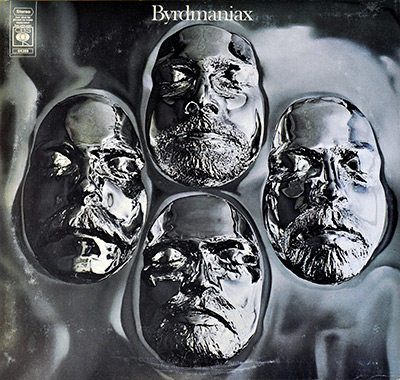
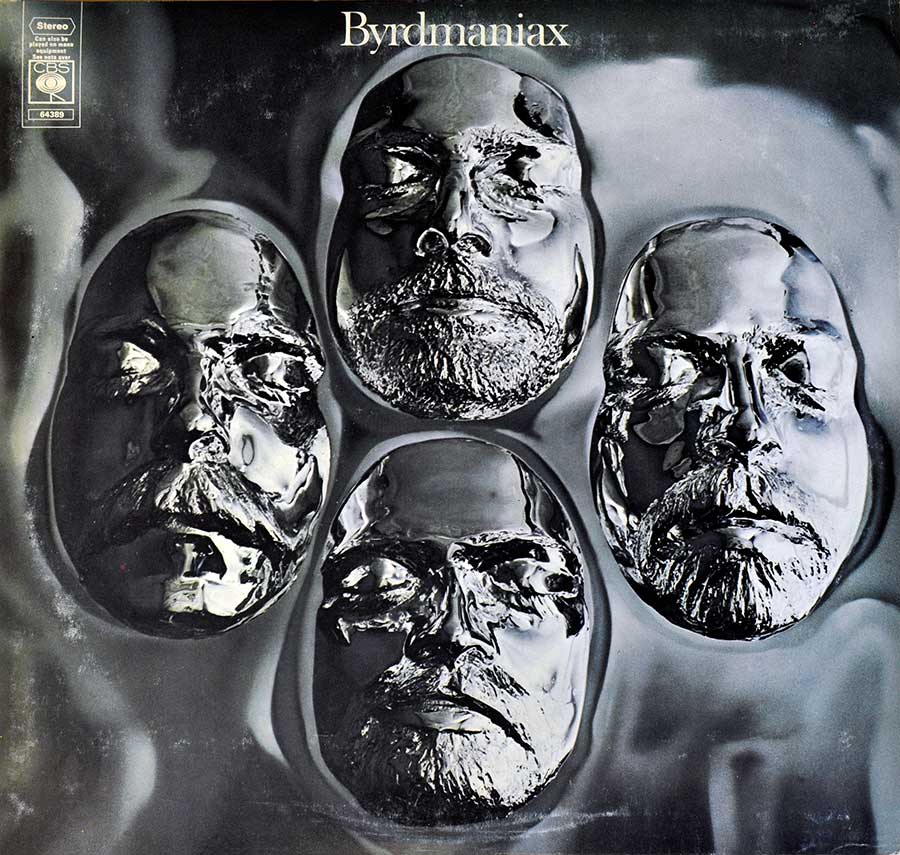
Album Front Cover Photo
Front cover photo of The Byrds' LP 'Byrdmaniax' on CBS. A stark black-and-silver design shows four shiny, chrome-like male face casts (bearded, mask-like) floating in a smoky grey field, arranged in a loose diamond: one large face at top center, one at left, one at right, and one at bottom. The title 'Byrdmaniax' appears in white serif type at the top. Top-left has a boxed CBS logo with 'Stereo' above it and catalog number '64389' below. Light surface wear and small specks are visible, useful for identifying the exact sleeve print and condition.

First thing that hits: this is a black-and-silver front cover that looks like it was designed to freak out record-shop browsers at arm’s length. Four metallic, mask-like face casts dominate the center, each one rendered like polished chrome with hard highlights and deep shadows. The faces read as adult men with heavy moustaches and beards, but they look more like sculpted molds than living portraits—smooth in places, rough and pitted in others, with the “skin” reflecting the studio lights in sharp white streaks.

Layout is clean and controlled. The album title “Byrdmaniax” sits at the very top in white serif lettering, centered, with plenty of breathing room above the artwork. On the upper-left corner, a boxed CBS block is printed in white: “Stereo” at the top, a small note underneath about mono compatibility, the CBS logo in the middle, and the number 64389 at the bottom. That little corner box matters for collectors, because it’s the quick visual fingerprint for this CBS sleeve variant and helps confirm you’re looking at the right front cover print, not a later redesign.

The four faces are arranged like a diamond: one large face centered near the top, staring forward; a second face on the left turned in profile; a third on the right facing forward but slightly angled; and a fourth at the bottom, also forward-facing, with a heavier, more shadowed beard area. Each “mask” sits in its own soft-edged oval space, as if suspended in cloudy liquid or fog. Background tone shifts from near-black at the top to a lighter, smoky grey toward the lower half, with blurry cloud shapes that make the faces feel like they’re floating rather than pasted onto a flat backdrop.

Condition details show up in the photo and they’re not just cosmetic trivia. Small specks and tiny marks are visible across the dark areas (especially near the top edge), and the black field shows subtle scuffing that reads like normal sleeve handling rather than a deep gouge. Corners look reasonably intact in this image, with no obvious tears, but the overall surface shows the kind of light wear that helps distinguish a real, handled copy from a “too perfect” reproduction scan. Overall, this is a high-contrast, high-impact sleeve where the typography, the CBS corner box, and those chrome face casts do the job: instant ID, instant mood, and zero confusion in a stack of records.

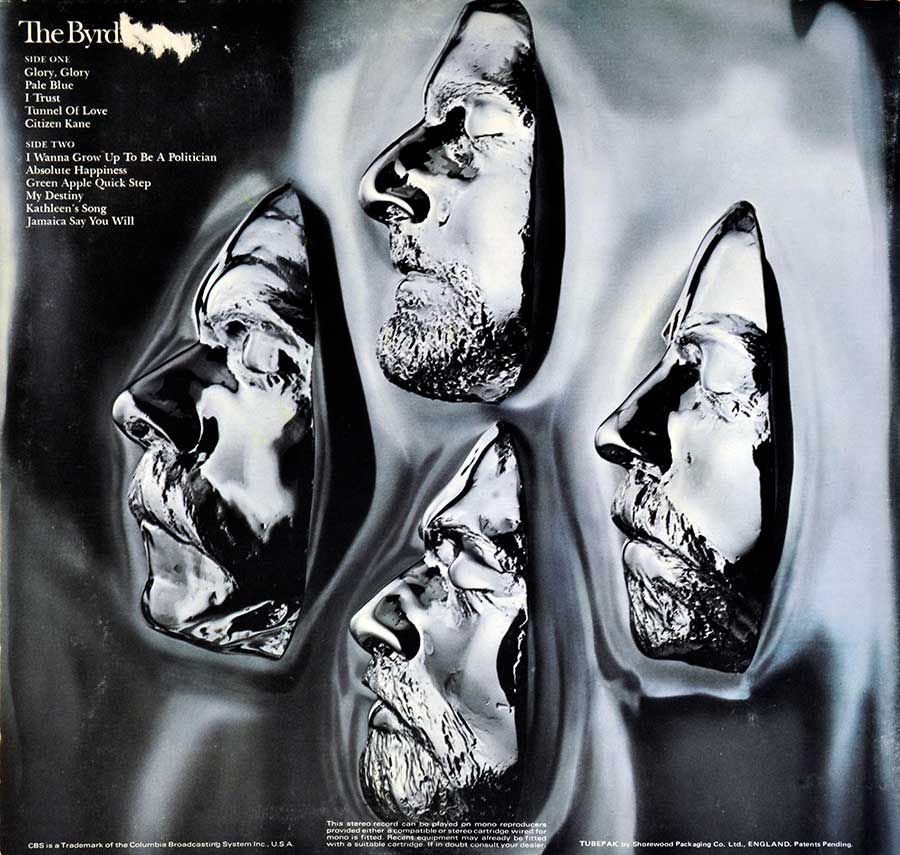
Album Back Cover Photo
Back cover photo of The Byrds' LP 'Byrdmaniax' (CBS). Left side shows the band name in white serif type with a full track list split into SIDE ONE and SIDE TWO. The rest is dominated by four chrome-like bearded face casts in profile floating in a smoky grey field. Small white legal/mono-compatibility text runs along the bottom edge. Noticeable sleeve wear includes a torn/scuffed patch near the top-left title area and light edge wear, useful for condition grading and confirming this specific back cover print.

Back cover of “BYRDS - Byrdmaniax” (UK CBS sleeve), photographed straight-on, with a high-contrast black/grey design that matches the front cover’s cold metallic vibe. The left side is the information zone: “The Byrds” appears at the top-left in white serif lettering, followed by the full track list split into SIDE ONE and SIDE TWO in smaller white type. That layout is collector-friendly: quick scan, no nonsense, and it confirms the exact running order at a glance.

Track list is printed clearly and reads as follows. Side One: “Glory, Glory”, “Pale Blue”, “I Trust”, “Tunnel Of Love”, “Citizen Kane”. Side Two: “I Wanna Grow Up To Be A Politician”, “Absolute Happiness”, “Green Apple Quick Step”, “My Destiny”, “Kathleen’s Song”, “Jamaica Say You Will”. Typography stays consistent and tight, with clean line spacing and no decorative clutter—just the essentials, which is exactly what matters when checking a copy in a stack.

The right two-thirds is pure artwork: four chrome-like, mask-shaped male faces with moustaches and beards, all shown in profile, floating in a smoky, swirled grey background. One face sits high in the center-right, a second large one occupies the left-middle (overlapping the grey field but not the text column), a smaller face appears near the lower center, and another profile sits to the right side. Highlights are harsh and glossy, with black shadows cutting into the “cheek” and “jaw” areas, making the faces look like sculpted casts or molds rather than living portraits.

Condition tells show up clearly in this photo and they matter for grading. A rough, torn-looking scuff patch sits near the top-left, partially chewing into the black background around the title area, and there’s mild edge wear along the borders. Along the bottom edge, small white print includes technical/legal notes; the most readable block is a mono playback compatibility statement centered low, plus additional CBS trademark and manufacturing/packaging lines running across the base. Overall, this is the kind of back cover that rewards close inspection: track list accuracy, typography style, and the wear patterns that prove it’s a real handled sleeve, not a sterile scan.

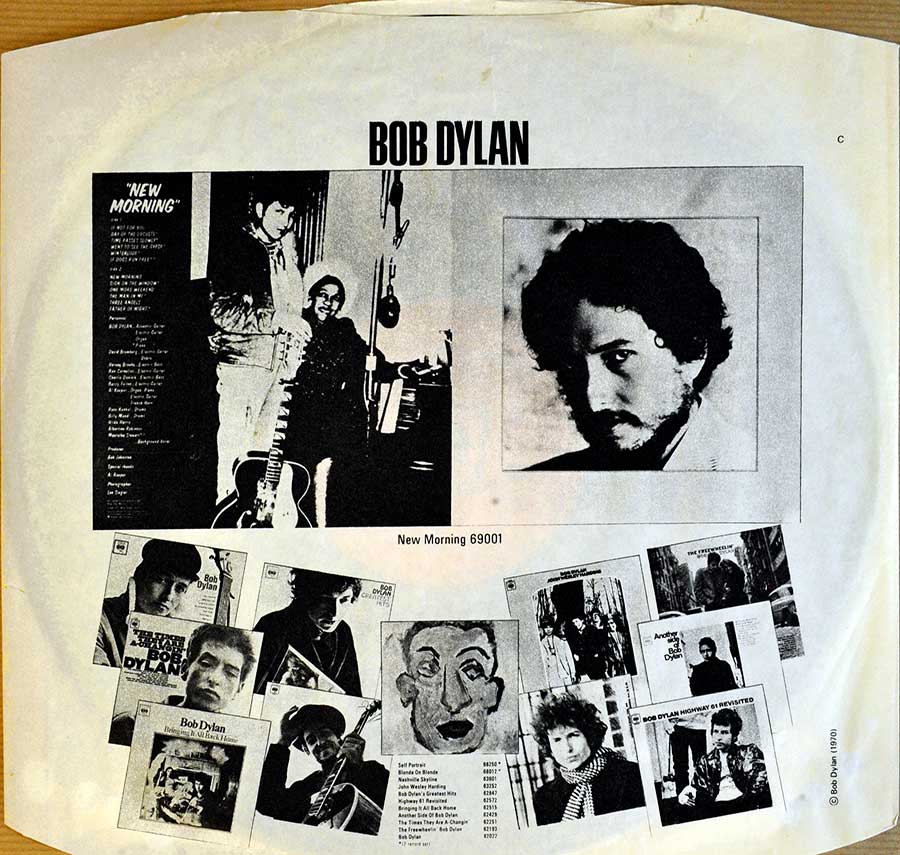
First Photo of Company Inner Sleeve
Photo of a CBS company inner sleeve included with The Byrds' 'Byrdmaniax' LP. Off-white paper sleeve with light wrinkles and age toning. Center shows a large 'BOB DYLAN' header above a collage-style promotion for the album 'New Morning' (catalog number 69001), including a black-and-white studio photo panel and a separate portrait of Dylan. Bottom half displays many small thumbnail images of other Bob Dylan LP covers and a short list of catalog numbers. Copyright line reads '© Bob Dylan (1970)'.

This is one of those classic CBS “company” inner sleeves that turns up in UK CBS-era albums, and it’s a dead giveaway for the period packaging that came with this "Byrdmaniax" copy. The sleeve is plain, thin paper in an off-white/cream tone, with visible aging: light wrinkles, mild creasing, and uneven discoloration that usually comes from decades of record storage. No die-cut center hole is visible here; instead, the focus is the printed advertisement panel, which is exactly what collectors check for when confirming an original inner sleeve versus a random replacement.

The entire design is a Bob Dylan promo layout. At the top, big bold black text reads “BOB DYLAN” centered, with a thin horizontal rule line beneath it. Just below, the main panel advertises “New Morning,” and the title appears again in smaller text with a catalog reference: “New Morning 69001” printed under the central image block. The featured visuals are split: on the left, a dark, high-contrast rectangular image that looks like album packaging and studio imagery combined; on the right, a square portrait of Dylan’s face, cropped close, with curly hair and a direct, serious expression. The contrast between the black-heavy left panel and the lighter portrait panel is deliberate—CBS marketing loved that clean “two-panel” look for maximum readability on cheap paper.

The bottom half is basically a mini Dylan catalog sampler. A scattered row of small black-and-white album cover thumbnails spreads across the lower area, overlapping slightly like a contact-sheet collage. Several covers are recognizable by layout and typography (even when the details are tiny), and the intent is obvious: this sleeve isn’t just holding your record, it’s selling you the next ten records. Near the lower center-right is a compact block of text listing album titles and catalog numbers in a neat column—small, dense type that you’d never read casually, but collectors absolutely do when matching a sleeve to the right era.

Along the lower right edge, a copyright line is visible: “© Bob Dylan (1970)”. That date is important as a packaging clue: it anchors the printed inner sleeve design to the early-1970s CBS catalog cycle, which fits perfectly with a 1971 album like "Byrdmaniax" showing up with a Dylan promo inner. Overall condition looks honest: not shredded, not heavily stained, but clearly handled and stored—exactly the kind of inner sleeve that signals “original set” rather than “later tidy-up.”

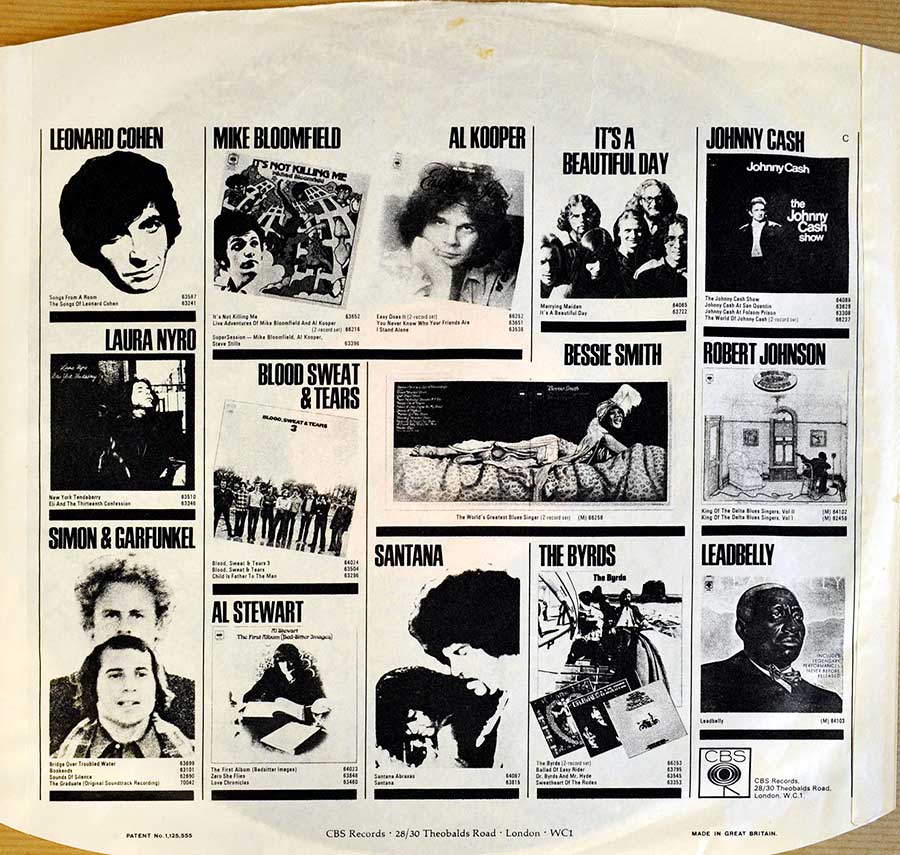
Second Photo of Company Inner Sleeve
Second photo of the CBS company inner sleeve supplied with The Byrds' 'Byrdmaniax' UK LP. Off-white paper sleeve printed with a grid of CBS artist/album advertisements: large artist names in bold caps above small black-and-white album cover images and catalog numbers. Visible panels include Leonard Cohen, Mike Bloomfield, Al Kooper, It’s A Beautiful Day, Johnny Cash, Laura Nyro, Blood, Sweat & Tears, Bessie Smith, Robert Johnson, Simon & Garfunkel, Al Stewart, Santana, The Byrds, and Leadbelly. Bottom edge shows CBS Records London address and 'MADE IN GREAT BRITAIN' text; paper shows wrinkles, creases, and age toning.

This is the “other side” view of the same kind of CBS company inner sleeve that came with this UK "Byrdmaniax" copy, and it’s pure early-’70s label marketing: a big tiled catalog grid printed on off-white paper. The sleeve paper shows real-world age—wrinkles, soft creases, and uneven yellowing—exactly the kind of patina that separates an original inner from a modern replacement. The top edge is slightly wavy, and the corners and borders show mild handling wear, but nothing looks ripped or cut out.

The design is a collage of CBS artists and albums. Each block uses bold, all-caps artist names as headers, with a small black-and-white album cover image underneath, plus tiny catalog numbers printed beside or below. The grid is dense but organized: heavy black headers, thin dividing lines, and lots of small typography that was meant to be scanned quickly in a record shop, not admired like artwork. This is functional advertising disguised as packaging.

Artists visible across the grid include Leonard Cohen, Mike Bloomfield, Al Kooper, It’s A Beautiful Day, Johnny Cash, Laura Nyro, Blood, Sweat & Tears, Bessie Smith, Robert Johnson, Simon & Garfunkel, Al Stewart, Santana, The Byrds, and Leadbelly. The Byrds block is especially collector-relevant here: the inner sleeve is literally advertising other Byrds titles while your Byrds record sits inside it—an easy era marker for CBS UK packaging and a nice confirmation that this sleeve belongs with a CBS family release.

Bottom margin has the real “verification” text collectors look for. The CBS logo sits in a boxed mark at the lower right area, and the address line reads “CBS Records, 28/30 Theobalds Road, London, W.C.1.” Across the bottom edge, small print includes “CBS Records • 28/30 Theobalds Road • London • WC1” and the phrase “MADE IN GREAT BRITAIN”. That UK address and the manufacturing statement are the practical tells: they tie this inner sleeve to the British CBS distribution chain, which makes it a believable match for your UK gatefold Byrdmaniax sleeve instead of a later, generic inner that wandered in from somewhere else.

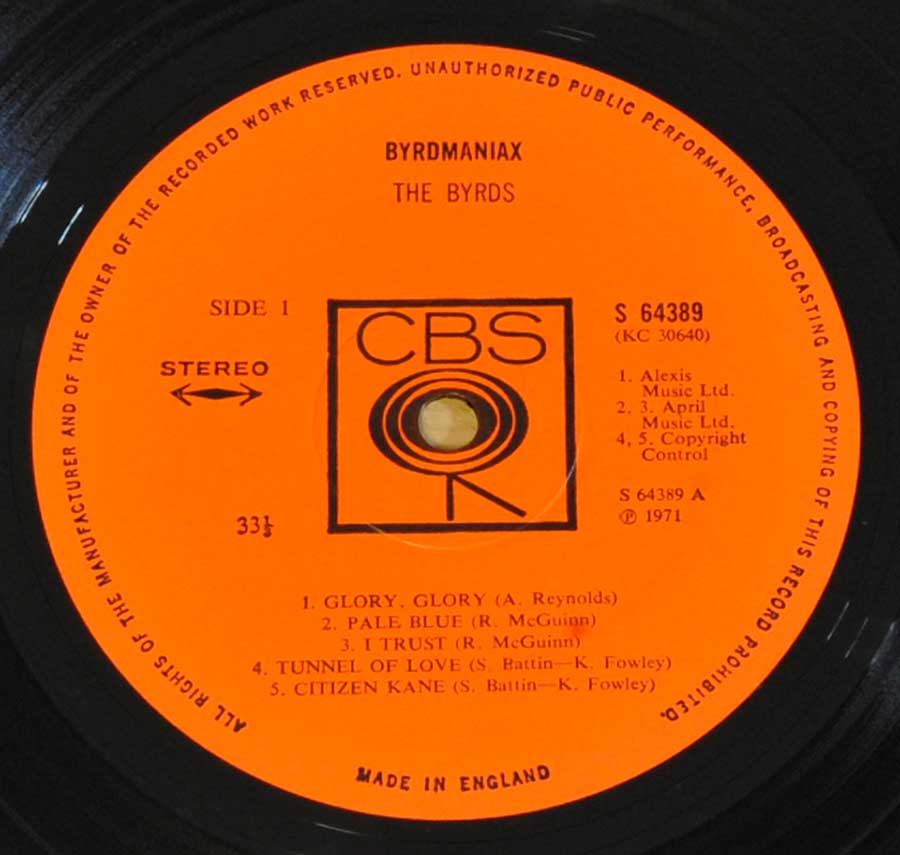
Close up of Side One record’s label
Close up of Side 1 record’s label
Close up of Side One orange CBS UK label for BYRDS - Byrdmaniax: CBS boxed logo around the spindle hole, catalog S 64389 (KC 30640), matrix S 64389 A, 1971, Made in England, stereo arrows, and Side 1 track list with songwriter credits.

Orange CBS UK label close-up for Side 1 of “BYRDMANIAX” by The Byrds, with the classic CBS boxed logo printed right across the spindle hole.

Key tells visible on this pressing: catalog S 64389 (with KC 30640 in brackets), side identifier Side 1, Stereo with the left-right arrow symbol, speed 33 1/3, matrix/side code S 64389 A, and the year mark 1971.

Bottom rim confirms manufacturing origin with MADE IN ENGLAND, and the track list is printed in a neat numbered block including songwriter credits (the kind of detail that helps verify you’ve got the correct label variant in hand).

CBS, United Kingdom (Made in England) Label

This is the orange CBS UK label used on this copy of “BYRDMANIAX” by The Byrds. Everything that matters for identifying the pressing is printed in the open: the big boxed CBS logo around the spindle hole, the catalog pair S 64389 and (KC 30640), the side/matrix marking S 64389 A, and the clear MADE IN ENGLAND line at the bottom. Rim text circles the edge in English, spelling out the standard “all rights reserved / unauthorized broadcasting” warning, which is another quick UK-era tell on CBS labels.

Colours
Bright orange background with black print; black CBS boxed logo.
Design & Layout
Top center: album title “BYRDMANIAX” and artist “THE BYRDS.” Left: “SIDE 1,” “STEREO” with channel arrow symbol, and “33 1/3.” Center: CBS boxed logo printed over the spindle hole. Right: catalog number block, publishing/rights lines, matrix “S 64389 A,” and year “1971.” Bottom: numbered track list with songwriter credits and “MADE IN ENGLAND.”
Record company logo
A square box with “CBS” at the top and a stylized eye-like target around the spindle hole: concentric rings form the “eye,” with a straight line extending downward/right like a pointer. Practical use: it frames the center hole and makes the label instantly recognizable from across a room (and across a pile of records).
Band/Performer logo
No separate band logo on the label; the artist name “THE BYRDS” is printed in plain uppercase text.
Unique features
Orange CBS UK label; “STEREO” arrow symbol; catalog pairing S 64389 with (KC 30640); matrix/side code S 64389 A; year 1971; “MADE IN ENGLAND” at bottom; track list includes songwriter credits; publisher/rights lines listed on the right (Alexis Music Ltd., 3 April Music Ltd., Copyright Control).
Side designation
“SIDE 1” printed to the left of the CBS logo.
Rights society
No rights-society logo visible on this label (no BIEM/MCPS-style mark shown).
Catalogue number
S 64389 (KC 30640)
Rim text language
English (rights warning text runs around the outer rim).
Track list layout
Numbered list centered toward the bottom, each track followed by songwriter credit in brackets/parentheses; five tracks for Side 1: “Glory, Glory,” “Pale Blue,” “I Trust,” “Tunnel of Love,” “Citizen Kane.”
Rights info placement
Rights warning printed as rim text around the outer edge; additional publisher/rights lines printed in a compact block to the right of the CBS logo.
Pressing info
“MADE IN ENGLAND” printed along the bottom of the label.
Background image
Solid orange label field; no illustration or photo background, just clean print designed for readability.

All images on this site are photographed directly from the original vinyl LP covers and record labels in my collection. Earlier blank sleeves were not archived due to past storage limits, and Side Two labels are often omitted when they contain no collector-relevant details. Photo quality varies because the images were taken over several decades with different cameras. You may use these images for personal or non-commercial purposes if you include a link to this site; commercial use requires my permission. Text on covers and labels has been transcribed using a free online OCR service.

Index of THE BYRDS - Selected Vinyl Album Discography and Album Cover Gallery

THE BYRDS - Byrdmaniax album front cover vinyl LP album https://vinyl-records.nl

CBS Records S 64389 (KC 30640), 1971, United Kingdom

THE BYRDS - Byrdmaniax

Released in 1971, “Byrdmaniax” captures The Byrds in their late-era country-rock phase, blending reflective songwriting with unexpectedly polished studio production. Recorded in Hollywood and later embellished with orchestral overdubs, the album divided critics but reveals depth on repeat listens. Tracks like “Glory, Glory” and “I Wanna Grow Up to Be a Politician” show a band still pushing forward, even as the classic Byrds era was clearly fading.

THE BYRDS - Farther Along 12" Vinyl LP
THE BYRDS - Farther Along  album front cover vinyl record

The core of "Farther Along" was recorded during an intense five-day session in London. The band, led by frontman Roger McGuinn with Chris Hillman, Skip Battin, and Gene Parsons, largely self-produced the album. The emphasis was on live, unadorned recordings that captured their raw energy.

Learn more
THE BYRDS - Greatest Hits 12" Vinyl LP
THE BYRDS - Greatest Hits  album front cover vinyl record

This is the first Dutch release of "Greatest Hits" by "The Byrds" and the record label has a solid Orange colour and the CBS "Walking Eye" Company Logo. Later issues of the Dutch release have an orange to yellow colour grading on the label.

Learn more
THE BYRDS - Greatest Hits 12" Vinyl LP
THE BYRDS - Greatest Hits album front cover vinyl record

Embassy Records was a budget label famous for selling cover versions of popular hits exclusively through Woolworths stores. They offered cheaper alternatives to original singles, targeting young listeners with limited budgets. Embassy thrived in the 1950s and 60s, known for quick production and affordability

Learn more
THE BYRDS - Mr Tambourine Man 12" Vinyl LP
THE BYRDS - Mr Tambourine Man album front cover vinyl record

The album's opening track, "Mr Tambourine Man," is a Bob Dylan cover that the band made their own. The song features the band's signature vocal harmonies, jangly guitars, and the distinctive 12-string Rickenbacker guitar played by lead guitarist Roger McGuinn. The song's success helped establish the band

Learn more
THE BYRDS - S/T Self-Titled 12" Vinyl LP
THE BYRDS - S/T Self-Titled album front cover vinyl record

The reunion album aimed to revisit the sound that made The Byrds famous nearly a decade earlier: jangly guitars, tight harmonies, and a folk-country foundation. While some songs echoed the band's earlier work, there was also a sense of seasoned musicianship and a willingness to take subtle risks.

Learn more
THE BYRDS - Sweetheart of the Rodeo 12" Vinyl LP
THE BYRDS - Sweetheart of the Rodeo album front cover vinyl record

By the time The Byrds entered the studio to record "Sweetheart of the Rodeo," the band had weathered significant changes. Founding members David Crosby and Gene Clark had departed, leaving Roger McGuinn and Chris Hillman as the core members. New to the fold were Gram Parsons, a rising star with a passion

Learn more
THE BYRDS - Turn Turn Turn 12" Vinyl LP
THE BYRDS - Turn Turn Turn album front cover vinyl record

The Mono edition of the album is highly sought after by collectors and music enthusiasts. The Mono version of the album is different from the stereo version in that it has a more raw and authentic sound. The Mono edition has a single channel of audio, which gives it a more unified and coherent sound.

Learn more
THE BYRDS - Untitled 12" Vinyl LP
THE BYRDS - Untitled  album front cover vinyl record

The Byrds' "Untitled" album was a double LP set that included both live recordings and studio tracks. The live recordings were taken from concerts that the band had performed at the Fillmore East in New York City and the Fillmore West in San Francisco. The studio tracks were recorded at Columbia Studios

Learn more