CRO-MAGS – BEST WISHES 12" Vinyl LP Album

- New York Hardcore Punk / Crossover Metal (1989, Profile Records)

Album Front Cover Photo of CRO-MAGS – Best Wishes Visit: https://vinyl-records.nl/

“Best Wishes” is the moment where Cro-Mags deliberately stepped out of the New York hardcore pit and into heavier, colder territory. Released in 1989 on Profile Records, this second album trades raw speed for crushing weight, locking hardcore intensity into a crossover metal frame. The riffs grind instead of sprint, the rhythms hit with controlled force, and tracks like “Death Camps” and “Age of Quarrel” feel built to endure rather than explode. Produced by Chris Williamson and Tom Soares, and mastered by Howie Weinberg, the sound is dense, disciplined, and unapologetically serious. The stark artwork and UK pressing add to its collector appeal, making this a key late-’80s document of a scene evolving whether fans were ready or not.

Table of Contents

"Best Wishes" (1989) Album Description:

Introduction

"Best Wishes" is the sound of Cro-Mags slamming the door behind them and refusing to look back. Released in 1989, this album captures a band deliberately stepping away from the street-brawl purity of their debut and charging headfirst into darker, heavier territory. It’s less about speed-for-speed’s sake and more about weight, intent, and consequence.

Historical and Cultural Context

By the late ’80s, New York hardcore was splintering into new shapes, with thrash metal bleeding into punk basements and vice versa. 1989 was the year where scenes stopped pretending they were separate, and "Best Wishes" sits right in that crack. While bands like Leeway and D.R.I. were already flirting with crossover, Cro-Mags went all in, trading raw velocity for something colder and more disciplined .

How the Band Came to Record This Album

After the chaos and mythology surrounding "The Age of Quarrel", the band found themselves at a crossroads. Line-up shifts, hard touring, and internal friction forced Cro-Mags to either repeat themselves or evolve. "Best Wishes" feels like the result of choosing evolution, even if it meant alienating part of their original audience.

The Sound, Songs, and Musical Direction

Sonically, this album hits like reinforced concrete. The riffs are thicker, the tempos more controlled, and the atmosphere noticeably more grim. Tracks like "Death Camps" and "Age of Quarrel" don’t sprint — they march, dragging a sense of inevitability behind them.

Comparison to Other Albums of the Era

Compared to the frantic violence of early hardcore or the speed-obsessed thrash releases of the same year, "Best Wishes" feels almost restrained. Where albums by Anthrax or Suicidal Tendencies leaned into adrenaline, Cro-Mags leaned into pressure. The result is closer in spirit to late-’80s metallic hardcore than straight punk.

Controversies and Public Reactions

Unsurprisingly, the album split the crowd. Some fans accused the band of abandoning hardcore roots, while others embraced the heavier sound and turned the volume knob further right. The irony is that the controversy itself proved how influential Cro-Mags already were — nobody argues this loudly about bands that don’t matter.

Band Dynamics and Creative Tensions

Creative control and personal tensions hover over this record like low smoke. You can hear a band tightening its grip, musically and ideologically, even as internal fractures deepen. "Best Wishes" sounds unified, but the cracks are part of what gives it its edge.

Critical Reception and Legacy

At release, the album confused as many listeners as it impressed. Over time, though, its reputation has grown — not as a replacement for the debut, but as its darker sibling. Today, it’s often cited as a crucial stepping stone between hardcore punk and modern crossover metal.

The Origin of the Band Name: Cro-Mags

The name Cro-Mags comes from Cro-Magnon, early modern humans — a nod to primal instinct, survival, and raw physicality. It’s a perfectly blunt metaphor for a band obsessed with strength, endurance, and stripping things down to their most brutal essentials. Subtlety was never the point.

Reflective Closing

Decades later, "Best Wishes" still sounds confrontational, uncompromising, and slightly uncomfortable — exactly how it should. It’s not the album you play to relive youth; it’s the one you play to remember that scenes evolve whether you like it or not. The grooves still smell faintly of sweat, tension, and unfinished business.
Album Key Details: Genre, Label, Format & Release Info

Music Genre:

Hardcore Punk, Crossover Metal

Label & Catalognr:

PROFILE – Cat#: FILER 274

Media Format:

Record Format: 12" Vinyl Stereo Gramophone Record
Total Weight: 230g

Year & Country:

1989 – England

Production & Recording Information:

Producers:
  • Chris Williamson – Producer (Rock Hotel Productions)

    The steady hand behind the album’s overall direction.

    Chris Williamson shaped Best Wishes by keeping the band focused on weight and discipline rather than raw speed. I hear his influence in the tighter song structures and the colder, more deliberate pacing compared to the debut. He helped steer the album away from chaotic hardcore energy toward a heavier, more controlled crossover sound without sanding off its aggression.

  • Tom Soares – Producer

    Bridged performance and production from inside the studio.

    Tom Soares played a crucial role in translating the band’s live intensity into something solid and repeatable on tape. On this album, his producer’s ear shows in the balance between heaviness and clarity, making sure the riffs hit hard without turning into noise. The result feels intentional and grounded rather than frantic.

Sound & Recording Engineers:
  • Tom Soares – Sound Engineer, Mix Engineer

    Controlled the sonic weight and final balance.

    As engineer and mixer, Tom Soares gave Best Wishes its dense, muscular sound. I hear his hand in the thick guitar tones and the way the rhythm section locks in with almost mechanical force. Nothing feels accidental here; the mix emphasizes pressure and groove over speed, reinforcing the album’s darker character.

  • Jamie Locke – Sound Engineer

    Helped capture the raw performances without polish.

    Jamie Locke’s contribution sits in the way the performances feel immediate and unfiltered. On this record, the drums and vocals retain a live-room bite that keeps the album from sounding overproduced. I hear his work in the sense that the band sounds present, physical, and slightly dangerous.

  • Robert Windsor – Sound Engineer

    Supported the sessions with consistency and control.

    Robert Windsor helped ensure the recording sessions stayed tight and usable. His engineering support is felt in the clean separation between instruments, especially when the arrangements slow down and grow heavier. The album benefits from that clarity, letting each part hit with intent instead of collapsing into chaos.

Mastering Engineer & Location:
  • Howie Weinberg – Mastering Engineer

    Mastering legend with over 200 Gold and Platinum albums to his name.

    Howie Weinberg is a renowned mastering engineer whose work has defined the sound of countless legendary albums. With over 200 Gold and Platinum records, he has mastered classics by Metallica, Nirvana, and Slayer, shaping the sonic punch and clarity of modern rock and metal. His mastering touch became an industry benchmark that still echoes through generations.

Album Cover Design & Artwork:
  • Gaile Vazbys – Art Direction

    Defined the album’s stark visual identity.

    Gaile Vazbys gave Best Wishes a visual language that matches its cold, confrontational sound. The artwork avoids excess and spectacle, instead reinforcing the album’s seriousness and sense of discipline. For me, the cover feels like a warning label rather than decoration, perfectly aligned with the music inside.

Photography:
  • Frank White – Photographer

    Legendary metal photographer who captured the genre from the inside, not the sidelines.

    Frank White started photographing hard rock and heavy metal at an absurdly young age, already documenting giants like Led Zeppelin and Ronnie James Dio in his early teens. From 1975 until 2009 he followed Dio closely, resulting in one of the most complete visual archives of the singer’s career and a dedicated photobook. During the 1980s his raw, unpolished images appeared on album covers and inner sleeves for bands such as Anthrax, Overkill, Cro-Mags, Nuclear Assault, Hades, and many others, defining the look of underground metal at its peak.

Band Members / Musicians:

Band Line-up:
  • Harley Flanagan – Vocals, Bass

    Founder, frontman, and ideological engine of the band.

    Harley Flanagan is the core force behind Best Wishes, both musically and philosophically. On this album I hear him deliberately slowing things down, letting the riffs breathe and the lyrics cut deeper. His bass is thick and grounding, locking the songs into a heavy, almost oppressive groove, while his vocals sound more controlled and confrontational than before, matching the album’s colder, more disciplined direction.

  • Parris Mayhew – Guitar

    Architect of the album’s darker guitar language.

    Parris Mayhew’s guitar work on Best Wishes feels methodical and intimidating rather than frantic. I hear him pushing the band away from hardcore blur and toward a more metallic sense of tension, using slower riffs and deliberate repetition to build weight. His playing gives the album its sense of menace, making the songs feel like they’re closing in rather than racing past.

  • Doug Holland – Guitar

    Reinforced the album’s dense and layered guitar attack.

    Doug Holland’s presence adds thickness and stability to the guitar sound on Best Wishes. Where one guitar sets the mood, his playing helps fill out the low end and reinforce the album’s physical weight. I hear his contribution most in the way the riffs feel stacked and immovable, giving the record its bulldozer-like momentum.

  • Pete Hines – Drums

    Anchored the shift from speed to controlled force.

    Pete Hines’ drumming on Best Wishes feels purposeful and restrained compared to earlier Cro-Mags material. Instead of constant acceleration, he leans into groove and impact, letting the songs hit harder by giving them space. For me, his playing is a key reason the album sounds heavier without necessarily sounding faster.

Complete Track-listing:

Tracklisting Side One:
  1. "Death Camps" (5:22)
  2. "Days Of Confusion" (2:19)
  3. "The Only One" (4:55)
  4. "Down But Not Out" (3:59)
Video: Cro-Mags - Death Camps
Tracklisting Side Two:
  1. "Crush The Demoniac" (3:56)
  2. "Fugitive" (4:40)
  3. "Then And Now" (3:12)
  4. "Age Of Quarrel" (4:45)
Video: Cro-Mags - Age of Quarrel

Disclaimer: Track durations shown are approximate and may vary slightly between different country editions or reissues. Variations can result from alternate masterings, pressing plant differences, or regional production adjustments.

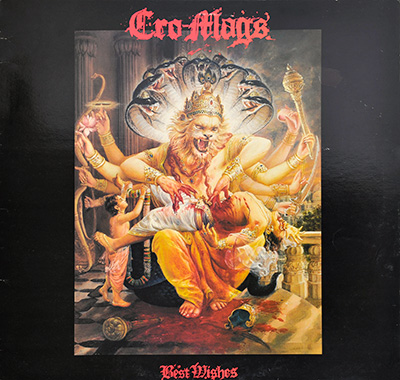
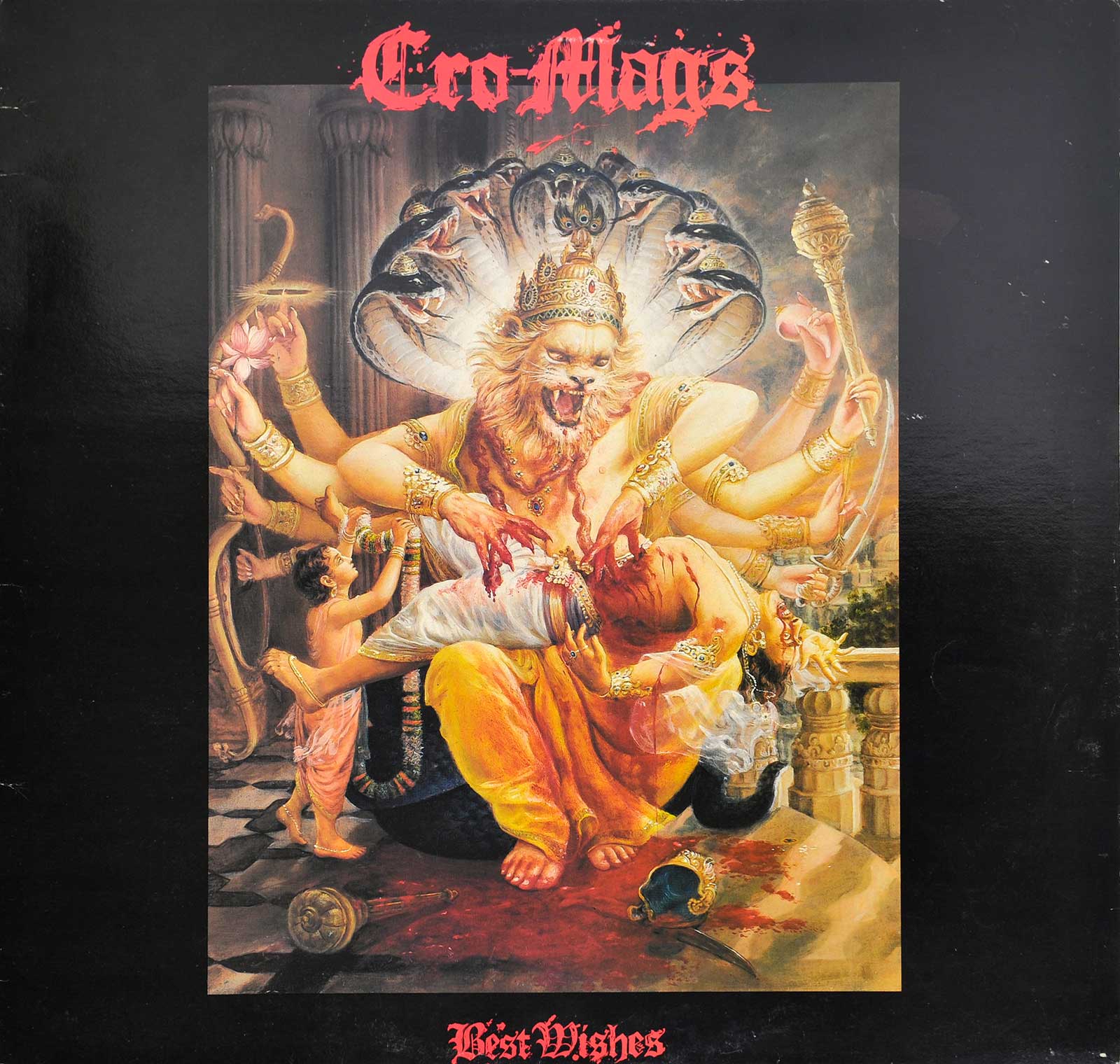
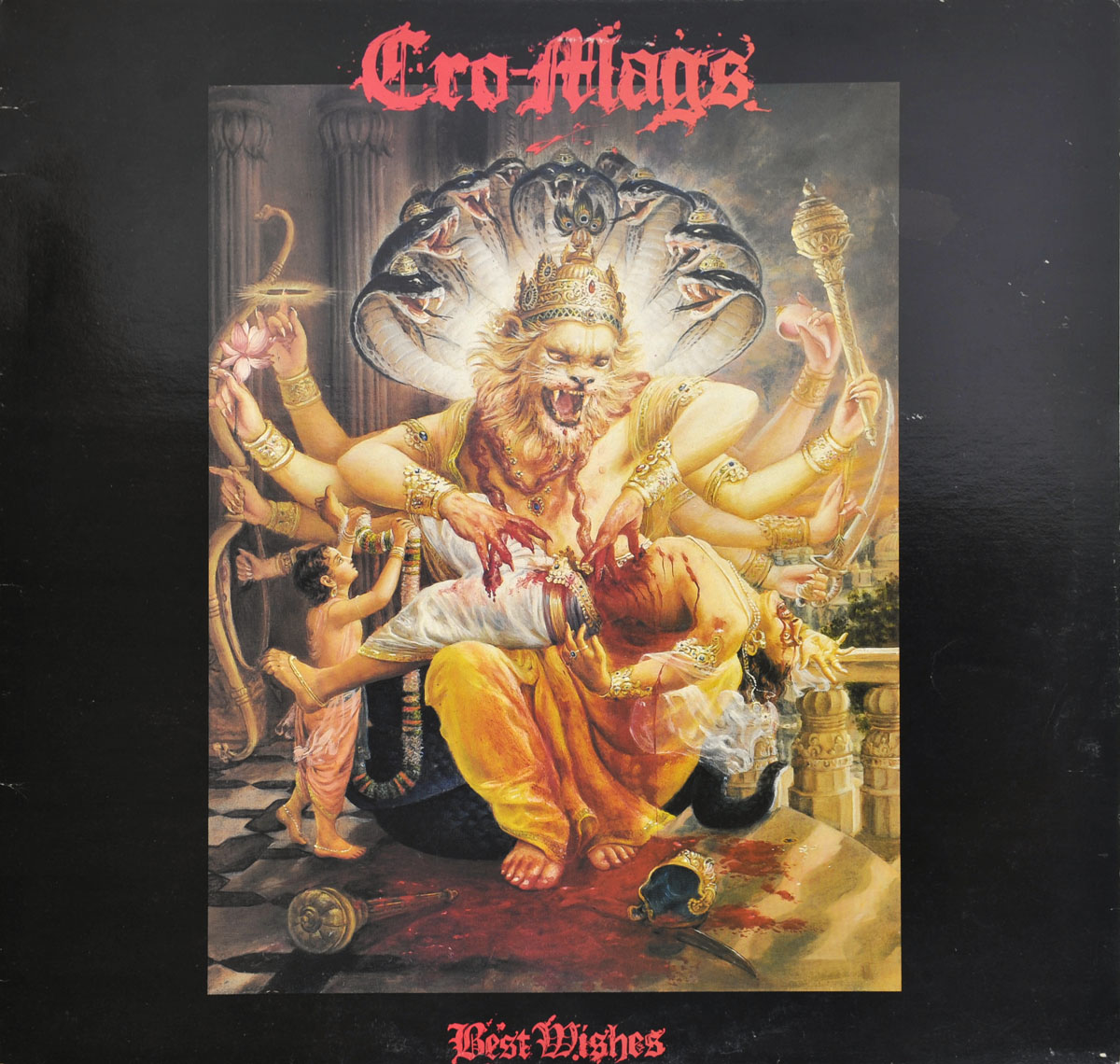
Album Front Cover Photo
Front cover of Cro-Mags Best Wishes LP showing a violent mythological scene with a lion-headed, multi-armed deity seated on a throne, blood on its hands and garments, a human figure being torn apart, coiled serpents forming a halo, classical stone architecture in the background, and the Cro-Mags logo in distressed red lettering at the top, with the album title Best Wishes printed in matching red gothic type at the bottom, emphasizing the album’s dark, confrontational tone and iconic late-1980s hardcore crossover artwork.

This is the front cover artwork of Best Wishes by Cro-Mags, photographed directly from the original vinyl sleeve. The image is dominated by a central, throne-seated figure with a lion’s head and multiple human arms, immediately signaling aggression, dominance, and mythological brutality. The figure wears a crown and ornate gold jewelry, with several arms holding ritual objects while others grip and tear into a human body laid across its lap. Blood is clearly visible on the hands, chest, and flowing garments, making the violence explicit rather than symbolic.

Behind the figure, a ring of large, dark serpents arches upward, their open mouths forming a halo-like frame around the head. This detail is crucial: it adds depth and menace, pulling the eye upward and reinforcing the sense of controlled chaos rather than random violence. The background shows classical stone columns and architectural elements, suggesting a temple or palace setting, rendered in muted greys and browns that contrast with the warm golds and reds of the central figure.

In the lower left area, a smaller human figure stands near the throne, reaching upward, which adds scale and reinforces how imposing the central figure is. At the bottom of the image, broken objects and spilled blood sit on a tiled floor, grounding the scene physically and making it feel staged, deliberate, and ceremonial. The black border around the artwork is wide and even, typical of late-1980s LP sleeves, and frames the image tightly without distractions.

Typography is minimal but aggressive. The Cro-Mags logo appears at the top in jagged, distressed red lettering that looks scratched or torn, instantly readable and high-contrast against the dark background. The album title Best Wishes appears at the bottom in a matching red gothic-style font, smaller but still sharp, visually anchoring the composition. From a collector’s perspective, this cover is a statement piece: confrontational, uncompromising, and perfectly aligned with the band’s shift toward a heavier, colder sound on this record.

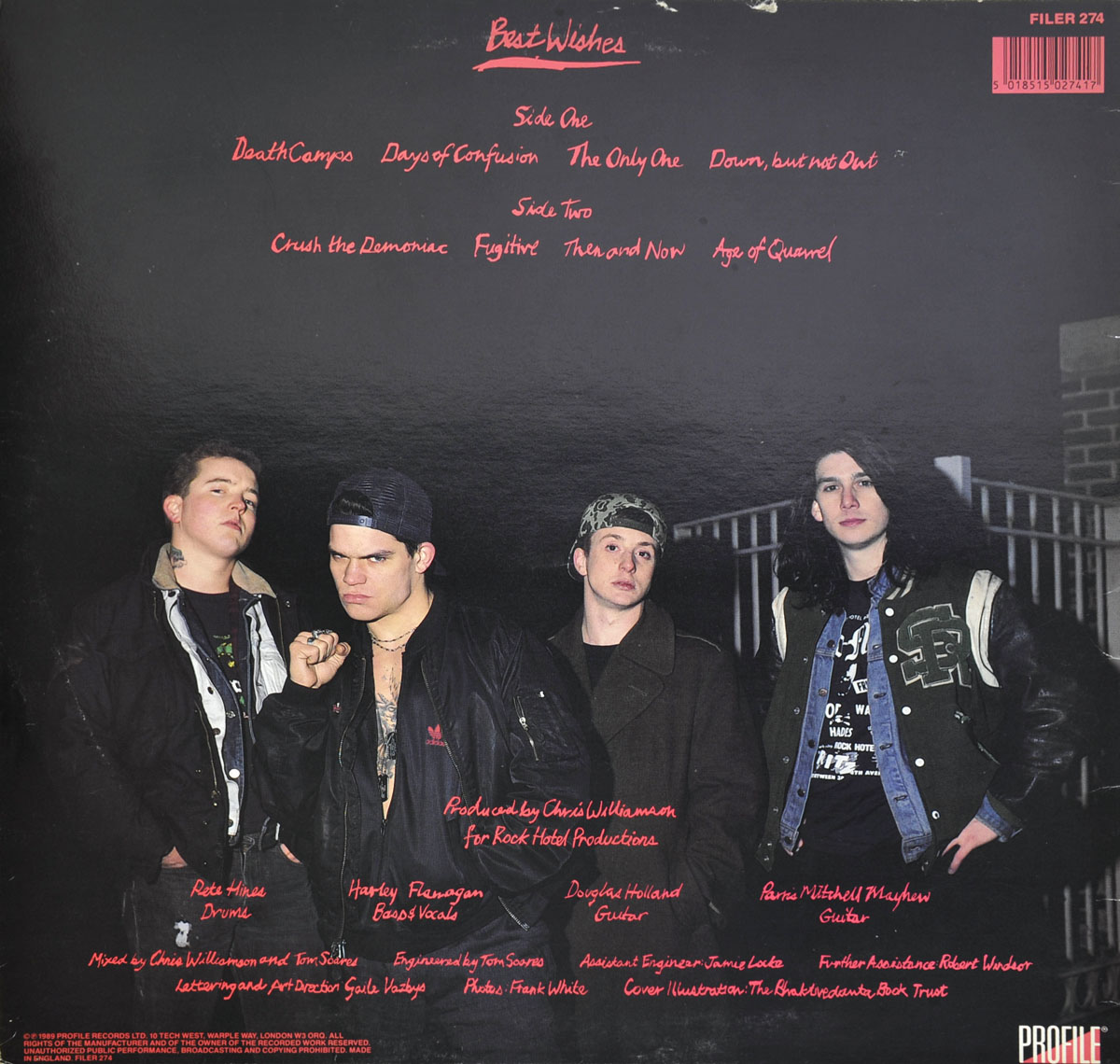
Album Back Cover Photo
Back cover of the Cro-Mags Best Wishes LP showing the band members standing together in a dark outdoor setting, with the full tracklisting printed above in red handwritten-style lettering, individual musician credits placed near each person, production and engineering credits along the bottom, the catalog number FILER 274 and barcode at the top right, and the Profile Records logo in the lower right corner, documenting the album’s layout, credits, and late-1980s hardcore aesthetic.

This is the back cover of the original Best Wishes vinyl LP by Cro-Mags, photographed directly from the sleeve in my collection. The upper half of the cover is dominated by the album title and complete tracklisting, all printed in rough, handwritten-style red lettering against a dark, almost black background. The layout is clean and deliberate, with Side One and Side Two clearly separated, making the structure of the record immediately readable.

Centered below the tracklisting is a band photo showing four band members standing shoulder to shoulder in what appears to be an outdoor, urban night setting. The lighting is low and flat, emphasizing attitude over polish. Clothing is unmistakably late-1980s hardcore: dark jackets, hoodies, baseball caps, and layered shirts, all worn rather than styled. Each member’s name and role are printed directly beneath them in the same red handwritten font, anchoring faces to functions without clutter.

Along the lower portion of the sleeve, the production credits are printed in small but legible red text. Credits include production, mixing, engineering, assistant engineering, art direction, photography, and cover illustration, all tightly packed but still readable on the original sleeve. The credit block feels utilitarian, prioritizing information over design flourish, which fits the album’s serious tone.

In the top right corner, the catalog number FILER 274 and the barcode are clearly visible, a key detail for collectors identifying this Profile Records pressing. The Profile Records logo appears in the bottom right corner, clean and sharply printed. From a collector’s perspective, this back cover is essential documentation: track order, band lineup, production credits, and label identifiers are all present, making it as informative as the front cover is confrontational.

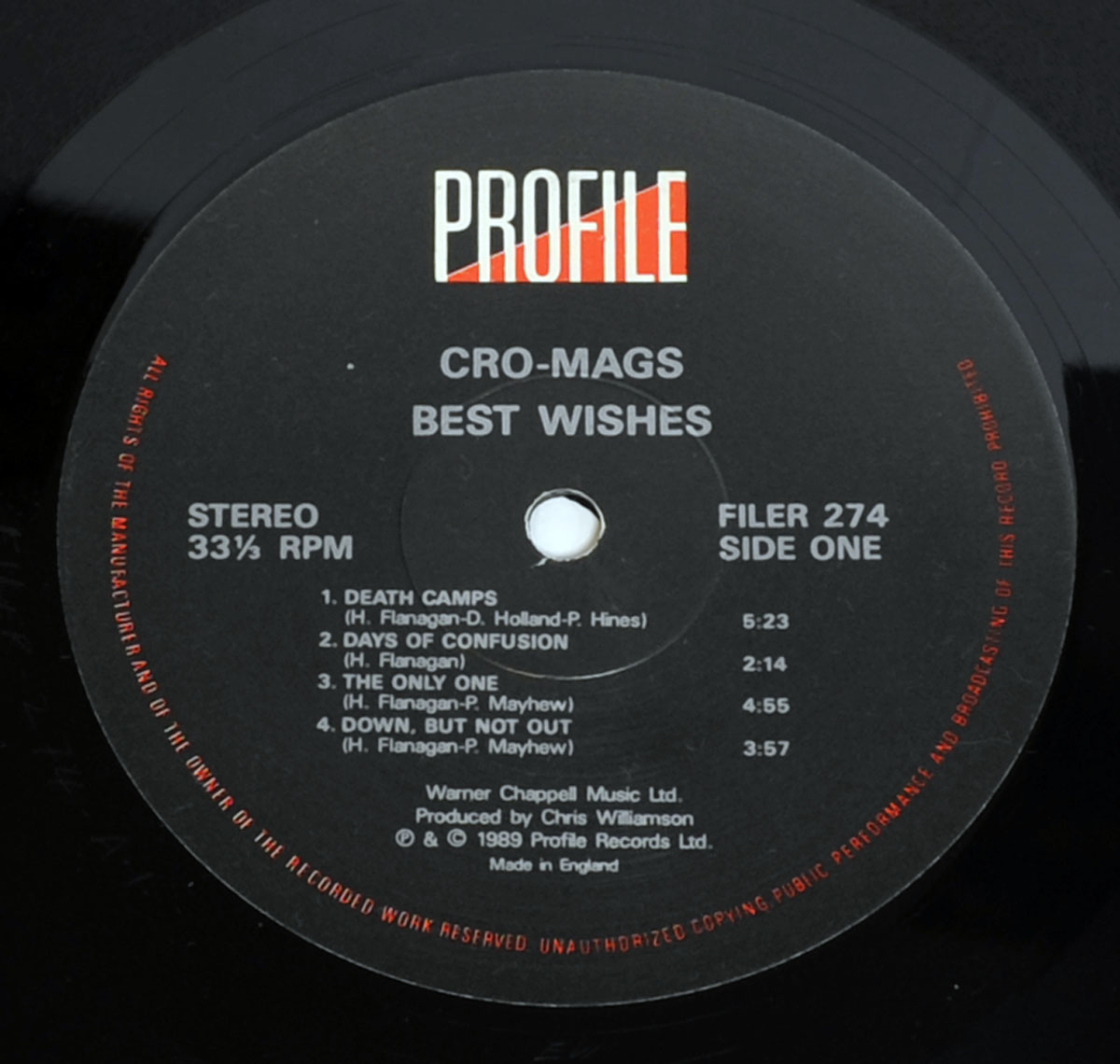
Close up of Side One record’s label
Close up of Side One label for CRO-MAGS Best Wishes showing the black Profile Records label with red-and-white logo, album title, track list, catalog number FILER 274, and 33⅓ RPM stereo markings

This image shows a close-up of the Side One record label from the original vinyl pressing of Best Wishes by Cro-Mags. The label sits on a matte black background, surrounded by visible concentric grooves of the vinyl, with light reflections revealing normal surface texture and play wear typical of a used but well-kept LP.

At the top of the label is the Profile Records logo, printed in bold white capital letters with three vertical red bars cutting through the right side of the word. This graphic element functions as both branding and orientation, immediately identifying the label and visually anchoring the top of the disc when placed on a turntable.

Centered beneath the logo, the band name CRO-MAGS and album title BEST WISHES are printed in clean, white sans-serif text, aligned for quick readability while the record spins. To the right, the catalog number FILER 274 and Side One designation are clearly printed, confirming this as the first side of the record.

The left side of the label lists playback information, including Stereo and 33⅓ RPM, confirming the format and speed. Below, the full Side One track listing appears in compact white text, including song titles, songwriter credits, and track durations. Production credits, copyright information, and the manufacturing note Made in England appear near the bottom, while red rim text circles the outer edge, warning against unauthorized copying and performance.

Profile Records, England Label

This is the standard black Profile Records label used on late-1980s UK pressings, designed for clarity, durability, and instant brand recognition. The layout prioritizes functional information for DJs, collectors, and pressing plants, with high-contrast text that remains legible even during playback. This particular label design was used by Profile Records during the late 1980s.

Colours
Black background with white text and red logo accents
Design & Layout
Centered logo and album text, radial track list layout, symmetrical and utilitarian
Record company logo
PROFILE logo in white block capitals with three vertical red bars used as a visual brand marker
Band/Performer logo
Band name printed in plain white uppercase text, no separate band logo used on the label
Unique features
Clear Side One designation, songwriter credits, and compact timing information
Side designation
Marked as Side One on the right-hand side of the label
Rights society
Not explicitly stated on the label
Catalogue number
FILER 274
Rim text language
English
Track list layout
Numbered list with titles, songwriter credits in parentheses, and durations aligned to the right
Rights info placement
Printed below the track list near the bottom center of the label
Pressing info
Manufacturing note “Made in England” printed at the bottom
Background image
Solid black label background with no imagery

All images on this site are photographed directly from the original vinyl LP covers and record labels in my collection. Earlier blank sleeves were not archived due to past storage limits, and Side Two labels are often omitted when they contain no collector-relevant details. Photo quality varies because the images were taken over several decades with different cameras. You may use these images for personal or non-commercial purposes if you include a link to this site; commercial use requires my permission. Text on covers and labels has been transcribed using a free online OCR service.


Index of CRO-MAGS Vinyl Album Discography and Album Cover Gallery


CRO-MAGS - Best Wishes album front cover vinyl LP album https://vinyl-records.nl

Profile Records FILER 274 , 1989 , England

CRO-MAGS - Best Wishes

“Best Wishes” is the second full-length album by New York hardcore band Cro-Mags, released in 1989 on Profile Records. The record marks a decisive shift toward a heavier crossover metal sound, slowing the pace and sharpening the riffs while keeping hardcore intensity intact. Darker production, disciplined songwriting, and tracks like “Death Camps” and “Age of Quarrel” make this a pivotal late-’80s hardcore LP.

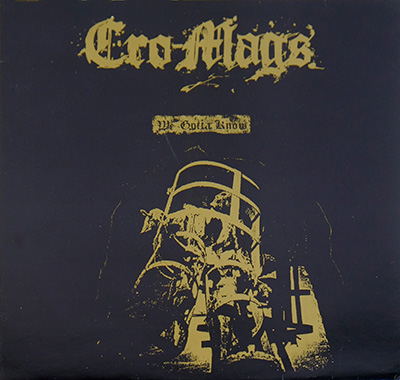
CRO-MAGS - We Gotta Know Unofficial album front cover vinyl LP album https://vinyl-records.nl

Beck's Records BR 001 , 1986 , USA

CRO-MAGS - We Gotta Know (Unofficial)

“We Gotta Know” is an unofficial early Cro-Mags LP documenting the band in their raw pre-album phase. Issued without authorization on Beck’s Records in 1986, this bootleg captures primitive New York hardcore energy with rough sound quality and minimal packaging. From a collector’s standpoint, it’s an underground artifact rather than an official release, valued for historical curiosity and scene documentation rather than production fidelity.