GIRLSCHOOL - HIT AND RUN 12" Vinyl LP Album

- Four leather backs, one Buick, and a neon typo with proper street attitude

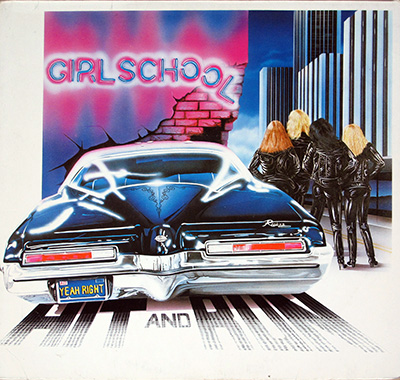
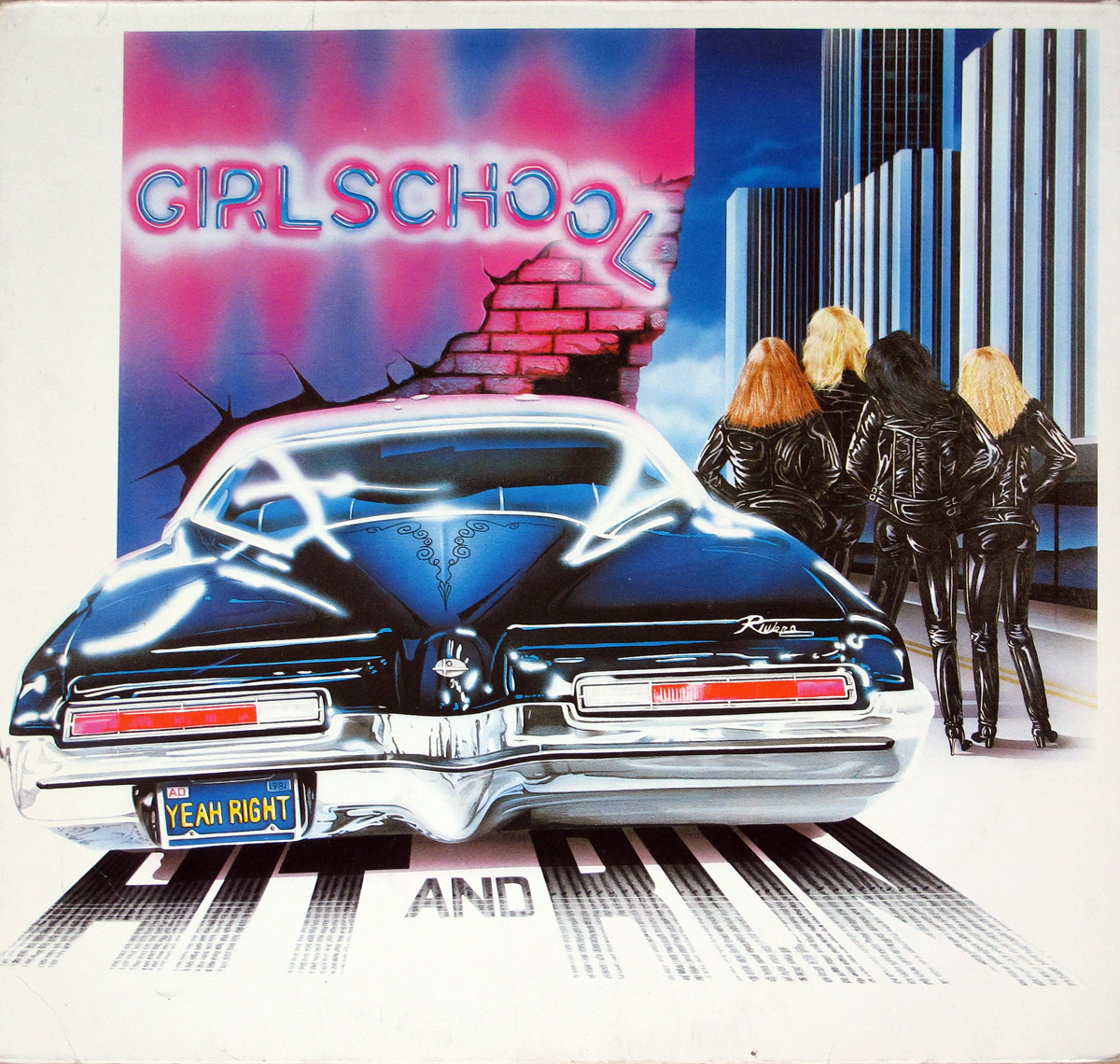
Album Front cover showing a glossy black Buick seen from the rear, four leather-clad band members walking away toward tall city blocks, and the Girlschool name sprayed in neon pink and blue above a cracked brick wall. The car plate reads YEAH RIGHT, the word AND sits partly hidden under the bumper, and the whole sleeve has that early-1980s airbrush flash: loud, cheeky, and just a bit ridiculous in the best record-rack way.

From this pulled-back view, the sleeve feels like a miniature city scene staged for maximum attitude: black car dominating the foreground, chrome bumper shining like it has something to prove, four leather-backed silhouettes heading into the blue city canyon, and that glowing GIRLSCHOOL sign burning over cracked brick. The composition is gloriously theatrical, almost comic-book slick, but the scuffed white border keeps it grounded as an actual handled LP, not some sterile gallery print.

"Hit and Run" is where Girlschool stopped sounding like promising NWOBHM troublemakers and started kicking the door clean off its hinges. Released in 1981, it became their breakthrough album and one of the sharpest fan favourites of the New Wave of British Heavy Metal: fast, lean, oily with guitar grit, and melodic enough to stick in your skull after one spin. "C'mon Let's Go" charges like a van with no brakes, "Hit And Run" has that perfect street-level punch, and "Tush" shows they could nick a classic and make it sweat. Vic Maile keeps it raw without letting it collapse into rubble. Even the German pressing has its little collector wink, including that notorious "GRILLSCHOOL" back-cover typo. Lovely chaos, really.

"Hit and Run" (1981) Album Description:

"Hit and Run" is Girlschool in April 1981 with the engine already hot, the tyres not exactly legal, and the early promise now making proper damage. This second studio album on Bronze Records has the classic line-up still locked in place: Kim McAuliffe on rhythm guitar and vocals, Kelly Johnson on lead guitar and vocals, Enid Williams on bass and vocals, and Denise Dufort on drums. It does not ask for a chair at the NWOBHM table. It kicks one out and sits down.

The obvious cuts are "C'mon Let's Go" and "Hit And Run", and fair enough, they do the job like a pair of boot heels on a sticky club floor. But the German Bronze pressing gives me the better kind of trouble: catalog number 203 556, the airbrushed Buick Riviera getaway sleeve by Alan Daniels, Vic Maile keeping the sound dry and useful, John Dent's mastering credit, and that silly back-cover "GRILLSCHOOL" typo sitting there like someone at the printers had been breathing glue. Lovely stuff. Wrong letter, right record.

Britain in 1981 did not smell of velvet trousers anymore. It smelled of rehearsal rooms, damp denim, van seats, chip fat, cheap badges, and amplifiers that had been carried up too many back stairs. The New Wave of British Heavy Metal was already splitting into tribes: some bands galloped, some polished, some posed, some sounded like lorries reversing through brickwork. Girlschool were better when they did not bother joining the parade. They came in short, sharp, and slightly impatient.

That impatience is the beauty of "Hit and Run". The guitars do not stand around admiring the wallpaper. They bite, shove, and leave. "C'mon Let's Go" has that clipped rush of a band already late for the next city, while the title track lands with a chorus that feels thrown rather than sung. "The Hunter" stalks with a bit more room in its shoulders, "Kick It Down" does exactly what the title promises, and "Tush" is not polished into reverence. The ZZ Top tune gets dragged into the Girlschool garage and told to earn its keep.

Bronze-era noise with its elbows showing

Vic Maile was the right man for this job because he did not make the band sound expensive. Thank heavens. Expensive would have killed half the charm. He gives the album shape, but he leaves the scrape in the guitars, the dry shove of Denise Dufort's drums, and the rough vocal edges that make the whole thing breathe. It sounds like a hard-working rock record, not a showroom demonstration for people who say "sonics" too often.

John 'The Don' Dent is credited with mastering, and the record has that practical physical bite I like in an early Bronze LP. It wants volume. Not ridiculous volume, just enough for the room to remember there is furniture in it. The songs have weight without turning into one grey lump, which is more than can be said for plenty of supposedly heavier records that came swaggering in later with bigger trousers and fewer ideas.

The line-up is the thing. McAuliffe keeps the rhythm tight and unfussy. Johnson cuts through with lead guitar and that voice full of smoke and wire. Williams pushes the bottom end along and takes her share of the vocal grit. Dufort drives the kit like someone has left the handbrake off. No keyboards. No creamy little studio cushion. No desperate wink at people who were never going to understand it anyway.

The sleeve: Buick, neon, and useful nonsense

Alan Daniels' cover is pure early-eighties record-rack theatre: the rear of a Buick Riviera, red tail lights, chrome glare, the "YEAH RIGHT" plate, four leather-clad backs heading toward the city, and the GIRLSCHOOL logo burning in pink and blue over cracked brick. Subtle? No. Nor should it be. Subtlety here would be like bringing cucumber sandwiches to a Motörhead aftershow.

The back cover is where the collector starts behaving badly. Track list on the left. LP and cassette numbers up top. Production notes lower down. German manufacturing detail doing its dull but useful work. Then the typo: "GRILLSCHOOL". Annoying? Yes. Funny? Also yes. Helpful? Absolutely. Clean copies tell you they survived. Mistakes tell you they lived somewhere.

I like this sort of evidence. The cream Bronze label, 203 556, LC 2313, GEMA box, and Side One detail are not glamorous. They are better than glamorous. They are the fingerprints. Late at night, sleeve beside the turntable, lamp catching the label, the record stops being an object and starts looking like paperwork from a small rock-and-roll accident.

The boys' club myth, still boring after all these years

The dullest way to talk about Girlschool is to treat them as a novelty because they were women in a metal scene that liked pretending its own gatekeeping was nature's law. That reading collapses as soon as the needle drops. They were not asking permission. They were not decorating the movement. They were in the room, plugged in, and already making the sort of noise that forces weaker arguments to leave early.

Another lazy take is that hooks mean softness. Rubbish. The hooks are the trap. "Hit and Run" remembers to be catchy without sanding down the attack, and that is harder than simply playing fast and hoping the racket hides the gaps. The album reached No. 5 on the UK Albums Chart, while the title single climbed to No. 32, but the numbers only explain the smoke after the bang. The record itself is the bang.

I do not hear "Hit and Run" as a perfect album, and I am glad of that. Perfect albums often behave like relatives who have read one good book and now want to explain dinner. This one has scuffed boots, bright choruses, a daft typo, a neon getaway sleeve, and enough Bronze-era grit to keep me leaning over the turntable longer than planned. That will do.

References

Album Key Details: Genre, Label, Format & Release Info

Music Genre:

NWOBHM New Wave Of British Heavy Metal

NWOBHM, or New Wave of British Heavy Metal, was the late-1970s and early-1980s British metal surge that dragged hard rock into sharper, faster, street-level territory. It had less patience for polish and more love for speed, denim, sweat, and guitars that sounded like they had been arguing in a pub car park.

Label & Catalognr:

BRONZE – Cat#: 203 556

Media Format:

Record Format: 12" LP Vinyl Stereo Gramophone Record
Total Weight: 230g

Release Details:

Release Date: 1981

Release Country: Germany

Production & Recording Information:

Producers:
  • Vic Maile – Producer, Sound Engineer

    Vic gave Motörhead and Girlschool enough shape to hit harder, not cleaner, which is exactly the point.

    Vic Maile — British producer and sound engineer, the sort of studio man I trust because he understood noise before trying to tidy it up. He began at Pye Studios in the mid-1960s, worked the mobile recording truck by the late 1960s, and had his fingerprints on rough, living rock rather than showroom polish. In the 1970s he engineered and produced for The Who, Dr. Feelgood, Eddie and the Hot Rods, The Pirates and other hard-working pub-rock bruisers. Then came the heavy-metal years: Motörhead's "Ace of Spades" in 1980 and "No Sleep 'til Hammersmith" in 1981, Girlschool's early Bronze-era punch in 1980-1981, and Twisted Sister's "Under the Blade" in 1982. He made bands sound awake, dangerous, and properly unwilling to behave.

Mastering Engineer & Location:
  • John 'The Don' Dent – Mastering Engineer

    The cutter who gives the final grooves their bite without shaving off the record’s street-corner muscle.

    John 'The Don' Dent, a British mastering engineer with a long trail through rock, new wave, punk, and pop vinyl, handled the final mastering stage for "Hit and Run". His job here was not to dress Girlschool up for polite company, thank heaven, but to lock Vic Maile’s punch into grooves that still kick from the speakers: sharp guitars, firm drums, and enough Bronze-era bite to keep the whole thing from turning soft at the last hurdle.

Album Cover Design & Artwork:
  • Alan Daniels – Artwork

    The sleeve hand behind the album’s visual punch, keeping the package direct, loud, and properly unfussy.

    Alan Daniels, credited here for artwork, supplied the visual side of "Hit and Run", where the cover has to do its job quickly from a record-shop rack. His contribution sits in that early-1980s Bronze Records world: no museum nonsense, no scented-paper vanity project, just a sleeve that tells the buyer this is Girlschool in full charge, loud enough on the eyes before the needle even lands.

Band Members / Musicians:

Band Line-up:
    Band-members, Musicians and Performers
  • Kim McAuliffe – Rhythm guitar, vocals

    The rhythm-guitar anchor who keeps this demolition job from turning into loose rubble.

    Kim McAuliffe, Girlschool co-founder, rhythm guitarist, vocalist, songwriter, and one of the band’s stubborn driving forces, gives "Demolition" its clipped street-level shove. Her guitar work keeps the songs tight and unglamorous, while her vocals on selected tracks add that sharp, no-pampering edge; less sweet chorus girl, more boot heel on the monitor.

  • Kelly Johnson – lead guitar, vocals

    Girlschool’s razor-edged guitarist with a voice full of grit, smoke, and no patience for soft-focus nonsense.

    Kelly Johnson was the sharp-edged lead guitarist and voice who gave Girlschool its early bite. I hear her in those first records as the band’s live wire: joining the Painted Lady/Girlschool camp in 1978, she drove “Demolition” (1980), “Hit and Run” (1981), “Screaming Blue Murder” (1982) and “Play Dirty” (1983) with a tone that did not ask permission. She left in 1984, tried the Los Angeles route, wrote demos, and played with World’s Cutest Killers / The Renegades around 1987–1989. Back with Girlschool from 1993 to 1999, she gave the old engine one more proper roar before illness forced her off the road. No frills, no dainty nonsense — just steel, nerve, and a guitar line that cut through the smoke.

  • Enid Williams – Bass, vocals

    The bass engine and one of the voices that gives the record its back-room electricity.

    Enid Williams, co-founder of Painted Lady and Girlschool bassist-vocalist, sits right in the machinery of "Demolition". Her bass does not wander around looking clever; it pushes, grinds, and keeps the songs moving with pub-floor force. Her vocals add rough character too, the sound of a band doing the job instead of posing for the brochure.

  • Denise Dufort – Drums

    The drummer who gives the whole thing its chase, clatter, and useful lack of good manners.

    Denise Dufort, Girlschool’s drummer from the classic early line-up onward, gives "Demolition" its forward motion and its glorious sense of danger. Her playing is tight enough to hold the songs together, but never so tidy that the record loses its teeth; the drums kick, rattle, and shove like the van is late for the gig again.

Complete Track-listing:

Tracklisting Side One:
  1. C'mon Let's Go (3:37) Single
    Written by McAuliffe / Johnson.
  2. The Hunter (3:15)
    Written by McAuliffe / Johnson.
  3. (I'm Your) Victim (2:42)
    Written by McAuliffe / Dufort.
  4. Kick It Down (3:03)
    Written by McAuliffe / Johnson.
  5. Following the Crowd (3:08)
    Written by Williams / McAuliffe / Johnson.
  6. Tush (2:16) Cover
    Cover of ZZ Top’s classic song, written by Gibbons / Hill / Beard.
Tracklisting Side Two:
  1. Hit And Run (3:08) Single
    Written by McAuliffe / Johnson.
  2. Watch Your Step (3:22)
    Written by Williams / McAuliffe / Johnson.
  3. Back to Start (3:32)
    Written by Johnson / Williams.
  4. Yeah Right (3:21)
    Written by McAuliffe / Johnson / Dufort.
  5. Future Flash (4:27)
    Written by Johnson / McAuliffe.

Disclaimer: Track durations shown are approximate and may vary slightly between different country editions or reissues. Variations can result from alternate masterings, pressing plant differences, or regional production adjustments.

This "Hit and Run" gallery is the sort of thing I like because it deals with the actual German Bronze LP, not some polished museum scan pretending vinyl never picked up dust. The front cover gets the first look, then the back cover starts doing the usual business of credits, track details, and small-print evidence. Best of all is the Bronze label close-up: catalog number 203 556, LC 2313, GEMA, and that useful ℗ 1981 Bronze Records Ltd line sitting there like a small bureaucratic blessing. Not glamorous, no confetti, but proper collector meat. Open the hidden part and the label ink, catalog details, and pressing clues start earning their keep.

Album Front Cover Photo
Front cover of Girlschool - Hit and Run showing a black Buick seen from the rear in the foreground, with chrome bumper, red tail lights, and YEAH RIGHT licence plate. Four leather-clad women stand at the right, backs turned, facing tall blue-and-white city buildings. At upper left, GIRLSCHOOL appears as pink and blue neon on a cracked brick wall. The word AND sits partly hidden in the white road surface below.

Front cover photo of "GIRLSCHOOL - Hit and Run", taken from the actual vinyl LP album in my collection. Seen from above, the sleeve lays out its little street-corner drama with the black Buick shoved right into the foreground, as if the car got there before the band and now refuses to move. The rear bumper is all chrome glare and airbrushed bravado, the tail lights burn red, and the licence plate says YEAH RIGHT, which is exactly the sort of wink an early-1980s rock sleeve thinks it has earned. Fair enough. It mostly has.

The eye goes first to that ridiculous, glossy car, then climbs up toward the cracked brick wall and the neon GIRLSCHOOL name sprayed across it in pink, blue, and white. The lettering is loud, slightly warped, and wonderfully cheeky; not elegant, thank heavens, but built to shout from a shop rack. The broken wall behind it gives the design its useful rough edge, though the whole thing is still very arranged. Nobody accidentally parks a Buick under a glowing band logo while four leather-clad backs walk toward skyscrapers. That is sleeve theatre, pure and simple.

On the right, the four band members are shown from behind in shiny black leather, heading away into a clean blue city canyon of tall striped buildings. It is a clever trick because it gives them attitude without asking them to pose like another tired press photo. Still, the sleeve is not exactly subtle. The high heels, the tight leather, the city-at-night fantasy, the car with decorative flourishes on the boot: somebody was definitely enjoying the airbrush a bit too much. But that excess is part of the charm. This album was never going to arrive wearing beige and apologising.

The lower part has one of my favourite bits of awkwardness: the word AND printed into the road, partly swallowed by the car and perspective, like the sleeve changed its mind halfway through the joke. Under the car, the street markings stretch downward in blocky grey and black patterns, more graphic than realistic. The white border around the artwork has the handled-LP feeling too, with small marks and age showing at the edges. That matters. It reminds me this is not a clean digital fantasy but a real sleeve that has sat in racks, sleeves, boxes, and probably under a few piles it did not deserve.

As a design concept, it sells collision, escape, neon, and bad decisions in one quick hit. The Buick blocks the road, the band walks away, the title hides under the wheels, and the city waits like trouble with better lighting. It is calculated, absolutely, but not fake in the dull modern sense. More like a record company gave the band a comic-book getaway car and said, “There, look dangerous.” Annoying? A little. Effective? Very. The thing still grabs the eye, and that is more than can be said for half the sleeves pretending to be tasteful.

Note: The images on this page are photos of the actual album. Slight differences in color may exist due to the use of the camera's flash. Images can be zoomed in/out, for example by pinching with your fingers on a tablet or smartphone.

Album Back Cover Photo
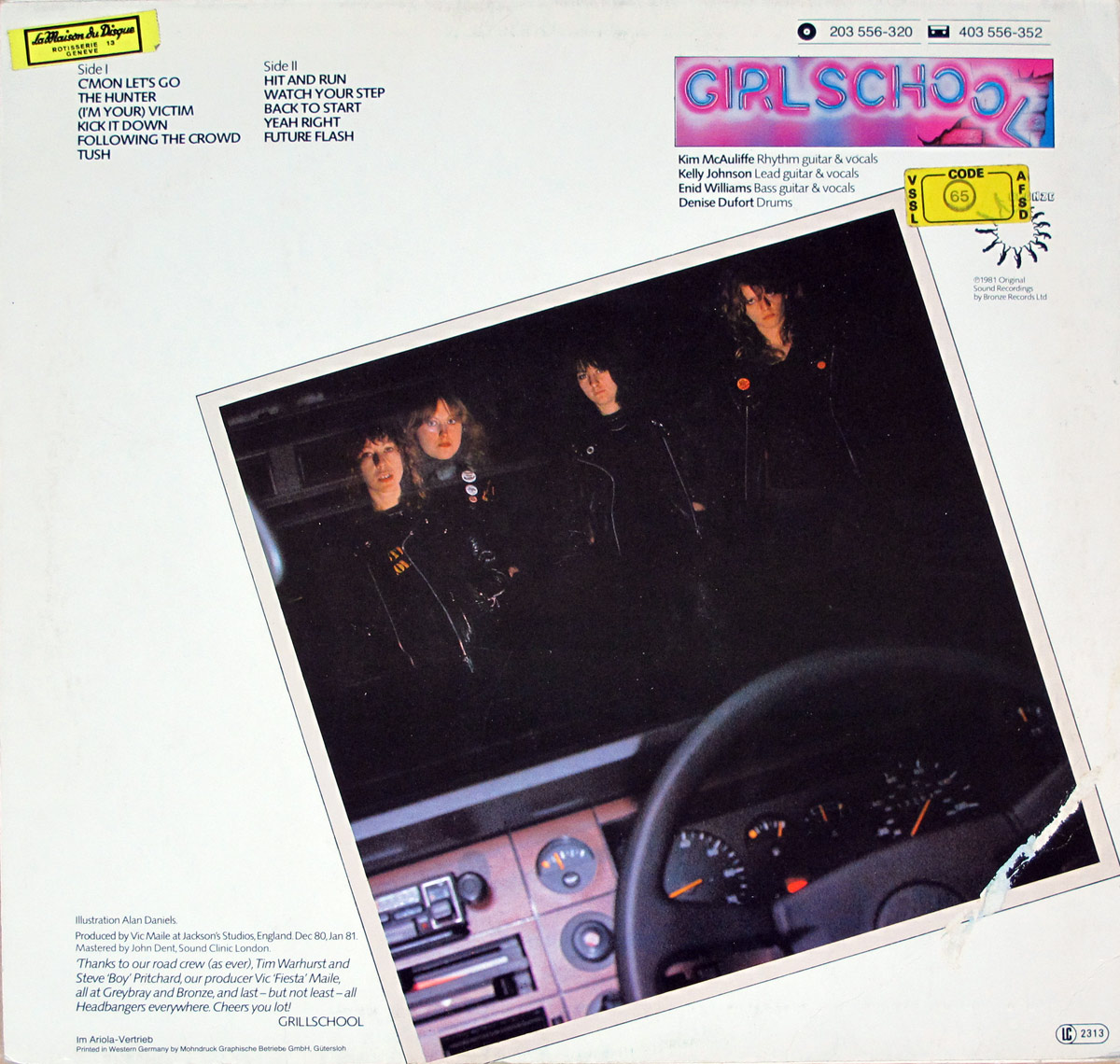
Back cover of Girlschool - Hit and Run showing a mostly white sleeve with track lists at upper left, catalog numbers 203 556-320 and 403 556-352 at upper right, and a neon GIRLSCHOOL logo strip. A tilted dark photo dominates the centre, showing the four band members in black leather seen from inside a car, with dashboard and steering wheel in the foreground. Credits and GRILLSCHOOL typo appear at lower left.

Back cover photo of "GIRLSCHOOL - Hit and Run", taken from the actual German Bronze Records vinyl LP album in my collection. From this bird's eye view, the rear sleeve looks almost too white at first, like someone left half the design budget in the photocopier tray. Then the eye catches the tilted central photograph, and the whole thing starts behaving less like a polite information panel and more like a badly parked getaway scene. The band are outside the car, dressed in black, half-swallowed by darkness, while the dashboard and steering wheel sit in the foreground as if the viewer has just slid into the driver’s seat. A neat little trick, that. Cheap? Maybe. Effective? Absolutely.

The top left is the collector’s working area: Side I and Side II track lists printed cleanly enough to read without inventing new glasses. COM ON LETS GO is printed without the apostrophes, which gives it that faintly rushed back-sleeve flavour I secretly enjoy, even while muttering at it. The yellow La Chanson du Disque import-style sticker at the upper left adds another bit of period retail noise, the sort of small mark that makes a copy feel handled rather than merely issued. Top right sits the catalog business, with 203 556-320 for the LP and 403 556-352 for the cassette, plus that narrow strip of neon GIRLSCHOOL artwork borrowed from the front. Reuse the art, save the money. Record companies have always been romantics like that.

The tilted photograph does most of the heavy lifting. Four band members stand ahead in the dark, leather jackets catching just enough light to stop them disappearing completely. Inside the car, the dashboard, radio, gauges, and steering wheel are visible, making the picture feel like a tense pause before the engine coughs into life. It is staged, of course it is staged, but at least it has a point of view. Too many back covers just line the band against a wall and call it a day. Here, the sleeve gives me a driver’s-eye setup: band outside, car inside, title implied by the whole awkward arrangement. Not graceful, but it has nerve.

Lower left is where the real discography meat starts turning up. There are credits for Alan Daniels, Vic Maile, Jackson's Studios, John Dent, and The Headboys, plus the German manufacturing line from Ariola-Vertrieb and Mohndruck Graphische Betriebe GmbH in Gütersloh. That is the kind of small-print archaeology collectors end up caring about more than is probably healthy. Then comes the notorious GRILLSCHOOL typo sitting near the bottom. There it is, plain as a bootprint. Annoying, funny, and useful all at once, because mistakes like that give a pressing its own little personality. A stupid typo can do more for identification than three paragraphs of marketing fog.

The sleeve has visible age and handling too: light grime in the white areas, softened corners, and a rough torn-looking patch along the lower right edge of the central photo area. That damage is not glamorous, but it tells the truth. This is not a fantasy object floating in perfect collector heaven; it is a real LP cover that has been pulled, stored, photographed, and inspected. As a back cover it works because it gives both attitude and evidence. Track list, credits, catalog numbers, label marks, band photo, typo. A bit cluttered, a bit cheap around the edges, and frankly better for it.

Close up of Side One record’s label
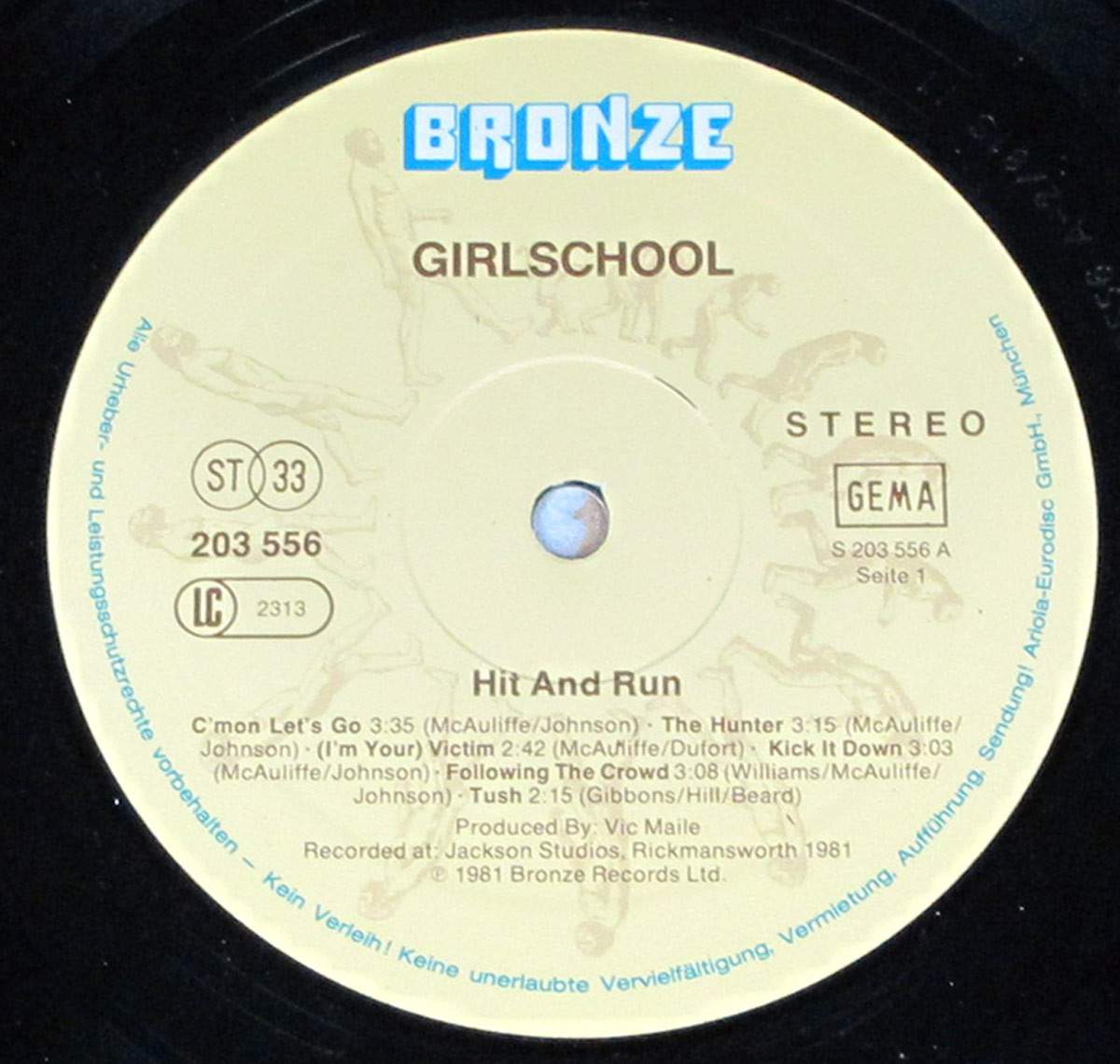
Close-up of the Side One record label for Girlschool - Hit and Run on a black vinyl LP. The cream label fills the centre, with large blue BRONZE logo at the top, GIRLSCHOOL beneath, catalog number 203 556, LC 2313, ST 33, GEMA, STEREO, and side marking S 203 556 A Seite 1. Track titles, credits to Vic Maile, and copyright text appear around the spindle hole and lower half.

This close-up of the Side One label from "Hit and Run" is where the sleeve nonsense stops and the record starts telling the truth. Seen from above, the cream-coloured Bronze label sits in the middle of the black vinyl like a circular office memo that somehow wandered into heavy metal. The big blue BRONZE block logo at the top does the usual label-branding job, blunt and impossible to miss, and underneath it the band name GIRLSCHOOL is printed with no drama at all. Good. By the time the needle gets here, drama is no longer required. Facts will do nicely.

The design itself is a bit odd in that very early-1980s way. Around the label’s outer area there is a ring of faint ghostlike little human forms, almost washed into the background, as if somebody in the art department wanted to make the paper look less bare but did not have the nerve to commit properly. It does not ruin anything, but it is the sort of decorative idea that makes me squint and ask who exactly this was for. The useful material is what counts: ST 33, catalog number 203 556, LC 2313, STEREO, GEMA, and the side identifier S 203 556 A / Seite 1. That is the meat. That is why collectors lean closer.

The lower half packs in the track listing for Side One: C'mon Let's Go, The Hunter, (I'm Your) Victim, Kick It Down, Following The Crowd, and Tush. Songwriters are printed in brackets in that compact, no-nonsense way labels tend to use when they want maximum information in minimum space. Then come the production lines: Produced By Vic Maile, Recorded at Jackson Studios, Rickmansworth 1981, and the © 1981 Bronze Records Ltd. notice. Nothing glamorous about any of this, and that is exactly the charm. A record label is not there to flirt. It is there to identify the disc before some later reissue muddies the water.

The spindle hole cuts through the centre, naturally, and in this photo it shows a little blue from whatever sits behind the record during the shot. The vinyl around the label is glossy black, with groove bands clearly visible near the outer edge. That contrast works well: dark vinyl, pale label, blue print around the rim in German legal text. Along the outer ring, the curved copyright warning runs in blue and reminds me again that this is a German pressing, with Ariola-Eurodisc manufacturing details circling the edge. It is practical, slightly bureaucratic, and far more interesting than people admit once they start chasing variants.

As a piece of design, the label is serviceable rather than thrilling, and frankly that suits the album. Too much visual cleverness here would only get in the way. What matters is that the information is legible, the Bronze identity is unmistakable, and the pressing clues are sitting right where they should be. A bit more contrast in the smaller black text would have helped older eyes, and those faded little background figures still feel like a half-baked flourish, but the label does its job. For anyone who keeps more than one copy around the room, this is the sort of close-up that earns its keep fast.

All images on this site are photographed directly from the original vinyl LP covers and record labels in my collection. Earlier blank sleeves were not archived due to past storage limits, and Side Two labels are often omitted when they contain no collector-relevant details. Photo quality varies because the images were taken over several decades with different cameras. You may use these images for personal or non-commercial purposes if you include a link to this site; commercial use requires my permission. Text on covers and labels has been transcribed using a free online OCR service.

Index of GIRLSCHOOL Vinyl Album Discography and Album Cover Gallery

GIRLSCHOOL - Demolition album front cover vinyl LP album https://vinyl-records.nl

The 1980 Bronze debut that kicked the boys’ club in the shins

GIRLSCHOOL - Demolition

I keep coming back to "Demolition" because it still feels like a record made with one eye on the clock and the other on the next cheap pint. No velvet rope nonsense here. Girlschool shove the 1980 Bronze debut straight into the NWOBHM traffic: Kim McAuliffe snaps, Denise Dufort hammers, and "Demolition Boys" still sounds as if it might nick your hubcaps on the way out.

References
GIRLSCHOOL - Hit and Run album front cover vinyl LP album https://vinyl-records.nl

The 1981 Bronze getaway job with riffs, leather, and that glorious GRILLSCHOOL typo

GIRLSCHOOL - Hit and Run

"Hit and Run" is where I stop calling Girlschool promising and start moving furniture out of the way. This 1981 Bronze LP, German cat# 203 556, tears through "C'mon Let's Go", the title track, and a grubby little "Tush" with Vic Maile keeping the grease on the gears. The Buick sleeve shouts first, the back-cover GRILLSCHOOL typo shouts second. Lovely mess.

References
GIRLSCHOOL - Nightmare at Maple Cross album front cover vinyl LP album https://vinyl-records.nl

The 1986 GWR bruiser that drags Girlschool back toward the rough stuff

GIRLSCHOOL - Nightmare at Maple Cross

"Nightmare At Maple Cross" has that 1986 feeling of a band wiping off some studio gloss and reaching for the heavier tools again. This Dutch GWR Records RR 9671 LP, produced by Vic Maile, does not beg for approval. It stomps, scowls, and throws in a Mud cover like a grin after a bar-room argument. Not their tidiest moment, thank heavens. Tidy is overrated.

References
GIRLSCHOOL - Play Dirty album front cover vinyl LP album https://vinyl-records.nl

Girlschool go louder, shinier, and still refuse to behave

GIRLSCHOOL - Play Dirty

"Play Dirty" is the one I file under suspicious polish, but I never skip it. Girlschool let Noddy Holder and Jim Lea drag a bigger 1983 shine across the riffs, and this German Bronze 205 855 pressing wears it like a slightly too-bright jacket. The choruses punch harder, the edges look cleaner, yet there is still enough NWOBHM dirt under the nails to stop the thing becoming respectable.

References
GIRLSCHOOL - Screaming Blue Murder album front cover vinyl LP album https://vinyl-records.nl

The 1982 Bronze siren: sharp hooks, bad temper, no velvet gloves

GIRLSCHOOL - Screaming Blue Murder

"Screaming Blue Murder" is Girlschool with the screws tightened but not polished smooth, which is exactly how I want them. Nigel Gray gives the 1982 Bronze LP a crisp shove, and the new bass weight changes the engine room without wrecking the ride. "Don’t Call It Love" comes on like a pub jukebox with an attitude problem. Subtle? No. Thankfully, neither is a siren.

References