PINK FLOYD - Relics 12" Vinyl LP Album

- UK Starline Records – The Strange Machine That Started It All

Album Front cover Photo of PINK FLOYD - Relics 12" Vinyl LP Album https://vinyl-records.nl/

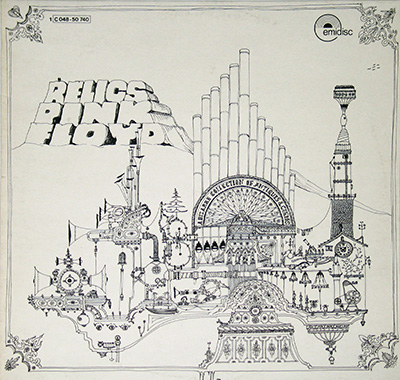
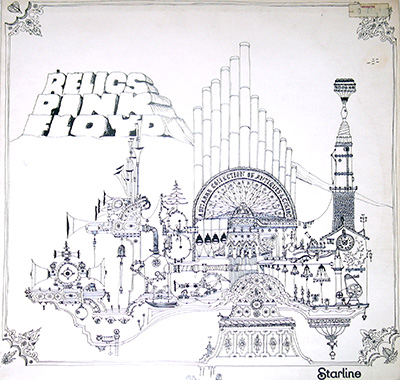
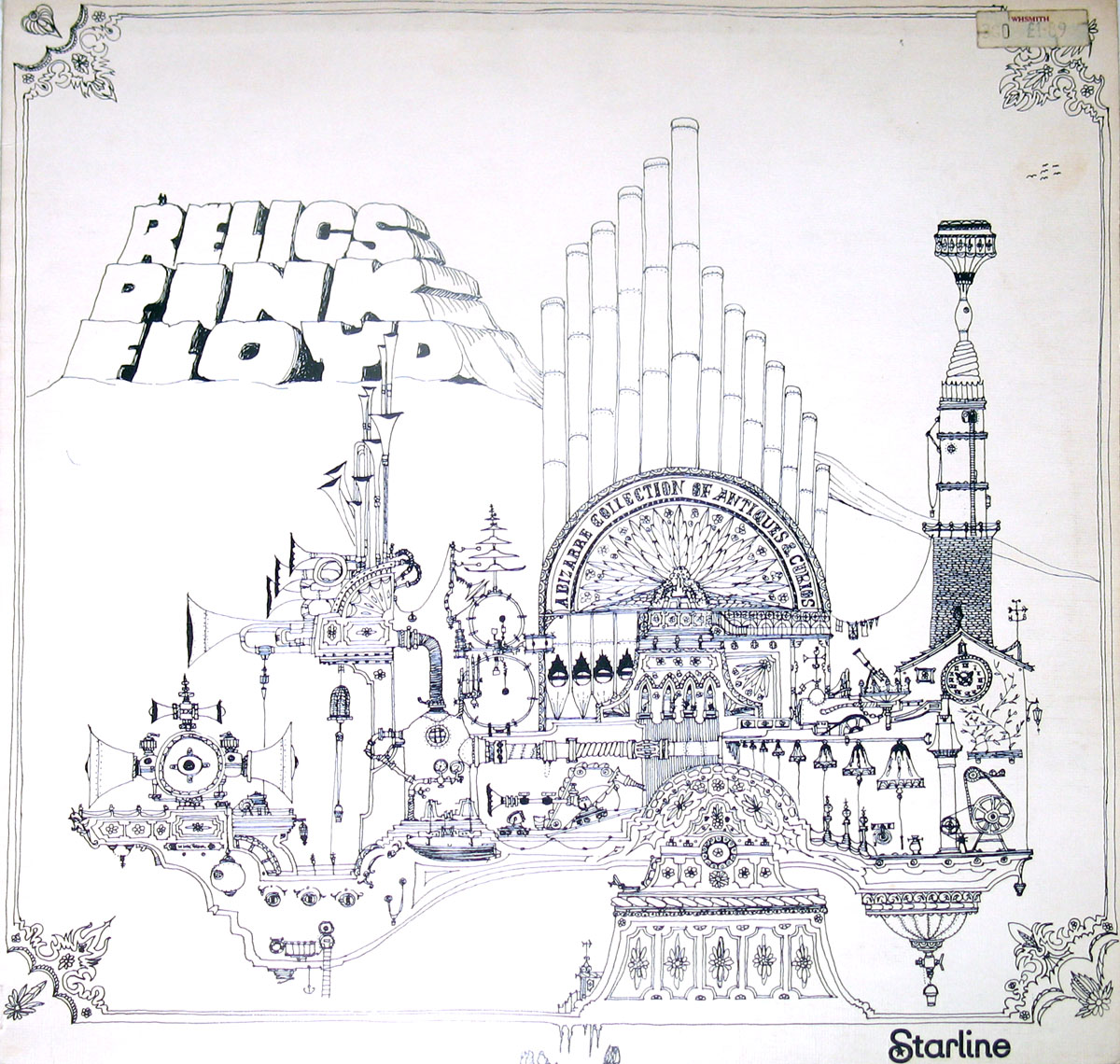
Bird’s-eye view of the UK Starline sleeve reveals Nick Mason’s intricate black-ink mechanical fantasy stretching across a stark white background. The band name looms in blocky stone-like letters at upper left, while a surreal assembly of pipes, horns, gears, clocks and cathedral-style organ tubes dominates the center. Fine ornamental borders decorate the corners, and the Starline logo sits modestly at bottom right, completing the minimalist yet hypnotic design.

Pink Floyd – Relics (1971) matters because it quietly bottled the late-60s UK psychedelic explosion just before progressive rock went arena-sized and serious. This wasn’t a chart-smashing blockbuster; it was the gateway drug. The mood drifts from the cheeky, off-kilter charm of “Arnold Layne” to the cosmic sprawl of “Interstellar Overdrive” and the slow-burn paranoia of “Careful With That Axe, Eugene.” The whole thing hums like a lava lamp in a dark room—thick, hazy, slightly dangerous. Produced by Norman Smith and dressed in Nick Mason’s strange mechanical artwork, it feels less like a compilation and more like a slightly warped time capsule. Even the old UK pressings seem to breathe differently, like the vinyl itself remembers the smoke.

"Relics" Album Description:

“Relics” (1971) is the moment early Pink Floyd got bottled up and put on a shelf with a budget price tag and a mischievous grin. Not a grand “history of” anything. More like a pocketful of Syd-era sparks and post-Syd shadows, dumped onto vinyl so new listeners could get hooked without doing the full archaeology dig.

That’s the trick: the big bait is obvious—“Arnold Layne” and “See Emily Play” still swagger like they’re too weird to be hits, yet somehow were. Then the record drifts sideways into longer, stranger weather. “Interstellar Overdrive” doesn’t “play,” it sprawls, like the room is slowly filling with smoke and nobody is volunteering to open a window. Good.

Musical gems from the messy years

Collectors love “Relics” because it refuses to behave like a tidy compilation. B-sides and album cuts show up like uninvited friends who turn out to be the best part of the night. The mood flips fast—Syd’s pop-psych wink, then the band’s darker, more physical grind as the late-60s optimism starts getting dents.

Unveiling unheard treasures

“Biding My Time” is the sly prize: a studio cut that wasn’t on the original run of albums and had mostly lived onstage inside “The Man/The Journey.” Seeing it printed on the sleeve still feels like finding a forgotten photo tucked inside a second-hand book—proof the band had more angles than the official story usually admits.

Behind the scenes: credits that actually matter

The production credits on this era aren’t just name-dropping. Joe Boyd and Norman Smith are in the mix across the track sources, and the labels/sleeve spell it out in that no-nonsense EMI way. Nick Mason’s artwork ties the whole thing together with that “mad antique machine” vibe—like the music needed a contraption to explain how it was made without ever being fully explained.

Identifying the pressing: the collector itch

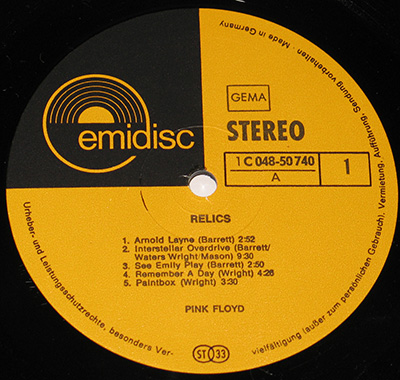
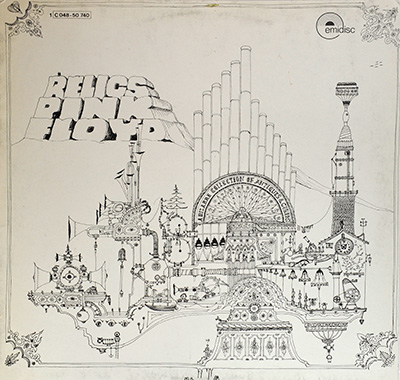
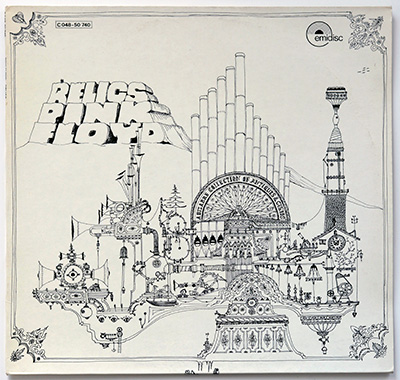
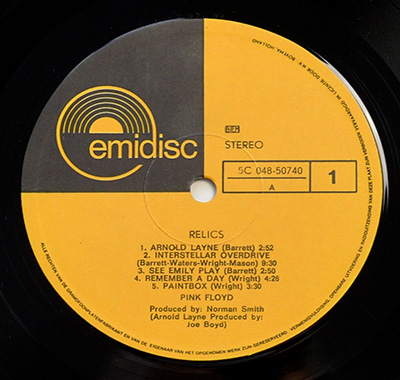
This write-up is about a specific European/EEC variant made for the German market—“Made in EEC” on the label rim, Emidisc branding, and the catalogue number 1C 048-50 740 sitting there like a little bureaucratic stamp on your hallucination. It’s still the same trip, just packaged by different hands, and those small differences are exactly how collectors end up squinting at rim text at midnight and calling it “research.”

References

“Relics” doesn’t pretend to be the definitive early Floyd document. It just hands you the keys, points at the fog, and lets you decide which corner of the past you want to get lost in. Some nights that’s exactly the point.
Album Key Details: Genre, Label, Format & Release Info

Music Genre:

Psych, Acid, Prog, Rock

A swirling blend of British psychedelia and early progressive rock experimentation, balancing Syd Barrett-era whimsy with darker, exploratory textures that helped define the late 1960s underground scene.

Label & Catalognr:

Starline – Cat#: SRS 5071

Media Format:

Record Format: 12" LP Vinyl Gramophone Record

Release Details:

Release Country: Made in Gt Britain (UK)

Production & Recording Information:

Producers:
  • Norman Smith – Producer, Sound Engineer

    The Beatles called him "Normal". Pink Floyd collectors call him the guy who made the chaos sound expensive.

    Norman Smith - the calm EMI wizard I still hear in the grooves whenever early Floyd turns the lights weird. He cut his teeth at Abbey Road, engineering The Beatles' EMI sessions from 1962 through autumn 1965 (yes, up to "Rubber Soul"), then stepped out from behind the glass as a producer. In 1967-1969 he steered Pink Floyd through "The Piper at the Gates of Dawn", "A Saucerful of Secrets" and "Ummagumma", keeping Syd's sparkle and the chaos on tape. In 1968 he produced The Pretty Things' "S. F. Sorrow", and in the early 1970s he shaped Barclay James Harvest (including "Once Again"). Later he even popped up as Hurricane Smith, because rock history loves a plot twist.

  • Joe Boyd – Producer

    Those Syd-era singles on "Relics" don’t just sparkle by accident.

    Joe Boyd, a sharp-eared London producer from the late-60s underground, had a gift for capturing strange bands without sanding off their edges. On this album his original 1967 work gives "Arnold Layne" and "See Emily Play" that tight, punchy snap and radio-ready shimmer, grounding "Relics" so the whole compilation doesn’t drift into pure cosmic fog.

  • Pink Floyd – Producer

    Self-produced Floyd is where the weird stops smiling and starts looming.

    Pink Floyd, the band that grew from clubland psychedelia into prog’s main architects, learned fast how to control the room from behind the desk. On "Relics" their producer credit matters on the darker, later cuts: "Careful With That Axe, Eugene", "The Nile Song" and "Biding My Time" hit with more weight and intention, like the band already sketching bigger worlds in the margins.

Album Cover Design & Artwork:
  • Nick Mason – Original Cover Concept & Artwork

    Drummer by trade, visual troublemaker by instinct.

    Nick Mason, Pink Floyd’s drummer with a quiet knack for turning band mythology into ink and odd machinery, designed the cover concept that keeps collectors up at night. For "Relics" his surreal drawing becomes the real rabbit hole: subtle print tones, layout tweaks, and country-to-country variations turn a “simple” sleeve into a comparison sport. The music is the bait; Mason’s artwork is the net.

Complete Track-listing:

Tracklisting Side One:
  1. Arnold Layne (2:56) Single
    Released as a single in 1967; Pink Floyd’s debut 45 and the beginning of the Syd Barrett era.
  2. Interstellar Overdrive (9:43)
    Early psychedelic epic from "The Piper at the Gates of Dawn", capturing the band’s improvisational underground club energy.
  3. See Emily Play (2:53) Single
    Released as a single in 1967; a whimsical Barrett classic that climbed the UK charts.
  4. Remember a Day (4:29)
    Rick Wright composition recorded during the 1967 sessions, later issued on "A Saucerful of Secrets".
  5. Paint Box (3:33)
    Originally the B-side to "Apples and Oranges"; Wright’s melancholic gem.
  6. Julia Dream (2:37)
    B-side to "It Would Be So Nice"; dreamy early Waters ballad.
Video: Pink Floyd - Arnold Layne (Official Music Video)
Tracklisting Side Two:
  1. Careful With That Axe, Eugene (7:11)
    Dark, tension-building live favorite first issued as the B-side of "Point Me at the Sky".
  2. Cirrus Minor (5:18)
    From the 1969 film soundtrack "More", blending pastoral mood with subtle menace.
  3. The Nile Song (3:25)
    Also from "More"; one of the band’s heaviest early studio recordings.
  4. Biding My Time (5:18) Previously Unreleased
    First official studio release here in 1971; previously performed live as part of "The Man/The Journey".
  5. Bike (3:21)
    Closing track from "The Piper at the Gates of Dawn"; Barrett’s eccentric farewell wink.
Video: PINK FLOYD Careful with that Axe, Eugene (studio version) The smoke in my head starts spinning

Disclaimer: Track durations shown are approximate and may vary slightly between different country editions or reissues. Variations can result from alternate masterings, pressing plant differences, or regional production adjustments.

Album Front Cover Photo
PINK FLOYD Relics UK Starline SRS 5071 front cover, matte white card sleeve with Nick Mason black line mechanical illustration, large RELICS PINK FLOYD block lettering top left, ornate corner borders, Starline logo bottom right, visible retail price sticker residue upper right and light edge wear typical of early 1970s UK EMI budget pressings.

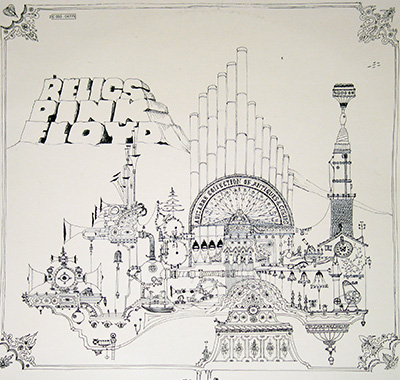
Front cover of the UK Starline pressing of “Relics” laid flat in front of me, matte white card already showing that faint early-70s cream shift that only comes from decades on a shelf. The drawing stretches wide across the surface like some Victorian science experiment that escaped the lab. At the top left, the title “RELICS PINK FLOYD” sits in chunky stone-block letters, shaded heavily enough to feel carved rather than printed. The ink is deep navy-black, not quite jet, and in certain areas it sinks slightly into the card, giving a soft halo along the lines if you tilt it under light.

Nick Mason’s mechanical fantasy dominates everything. A sprawl of pipes, organ tubes, horns, clock faces and little ornamental arches builds from left to right, like a surreal factory assembling sound instead of steel. The central arch reads “A Bizarre Collection of Antiques & Curios,” which feels both cheeky and honest; this isn’t a new statement, it’s a cabinet of early Floyd oddities. Some lines are razor sharp, others look fractionally lighter, suggesting plate wear or minor print inconsistency. That imperfection is part of the charm, though it does make later Music For Pleasure copies look slightly cleaner and, frankly, a bit sterile.

The card stock is thin by Harvest standards, typical EMI budget issue. Running a thumb along the spine reveals the usual micro-fractures near the center, tiny white stress lines where the glue has flexed over the years. Corners show soft rounding, especially lower right, and there’s a faint rectangular ghost at the upper right where a WHSmith price sticker once sat. The decorative corner flourishes feel almost excessive against the stark white field, like someone insisted on “classy framing” at the last minute. Bottom right, the Starline logo sits modestly, slightly off the main visual weight, reminding you this was marketed as affordable Floyd, not deluxe Floyd.

What works is the stubborn minimalism. No color splash, no psychedelic gradients, just black ink on white space and a mad inventor’s dream machine humming silently across the sleeve. It feels deliberate, almost defiant. Budget label or not, this cover doesn’t apologize. It dares you to lean in and trace every pipe and cog, and after all these years, that challenge still holds up better than some of the band’s more “serious” later packaging.

Album Back Cover Photo
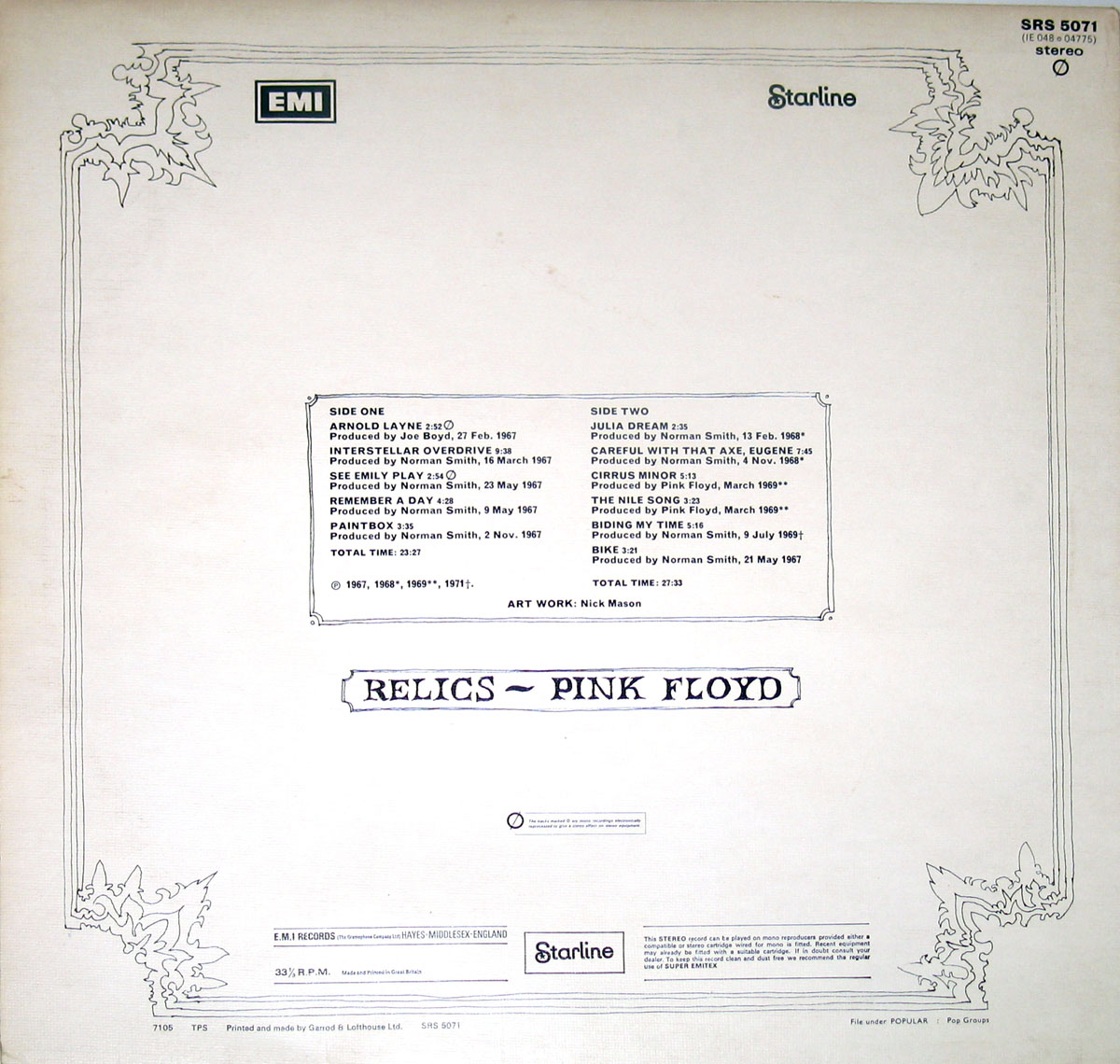
PINK FLOYD Relics UK Starline SRS 5071 back cover, matte off-white card with EMI and Starline logos at top, centered boxed track listing with production dates, RELICS – PINK FLOYD title panel, fine ornamental border lines, light foxing spots and mild edge wear typical of early 1970s UK EMI budget sleeves.

Back cover of the UK Starline “Relics” sitting flat under the lamp, and the first thing that hits is the emptiness. A wide field of off-white card with a faint cream shift from age, framed by thin ornamental corner lines that try very hard to look refined. The EMI logo sits top left, Starline top right, and SRS 5071 in the upper corner like a quiet reminder that this was sold as budget Floyd, not prestige Harvest Floyd.

At the center there’s a neatly boxed track listing, printed in small, disciplined type. Song titles, timings, and precise production dates—down to specific days in 1967, 1968, 1969—are laid out almost clinically. The ink is slightly lighter than the front illustration, and under close inspection it shows minor inconsistencies, tiny breaks in the fine lines of the box border. Nothing dramatic, just enough to confirm this wasn’t an expensive print job. The “RELICS – PINK FLOYD” panel below it feels almost pasted in as an afterthought, hovering in too much white space.

Handling the sleeve reveals the real story. A few faint foxing spots creep across the upper half, small brown freckles that only appear after decades in British air. The spine edge shows gentle compression near the center, likely from years of records leaning too tightly together. Lower corners are softened, especially bottom right, and there’s a whisper of ring wear beginning to show through the card when angled toward the light. The paper stock flexes more than early Harvest sleeves; this is thinner, functional board, not built for luxury.

What works is the honesty. No psychedelic overload, no attempt to disguise the compilation nature of the record. Just songs listed plainly, production credits visible, and “ART WORK: Nick Mason” printed with almost stubborn modesty. It feels practical, almost austere. Slightly dull at first glance, perhaps, but there’s something reassuring about a sleeve that doesn’t pretend to be more than it is.

Close up of Record Label
Close up of Side One record’s label
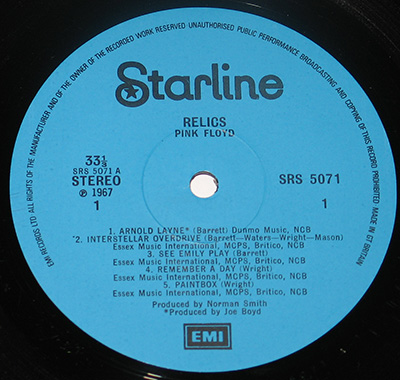
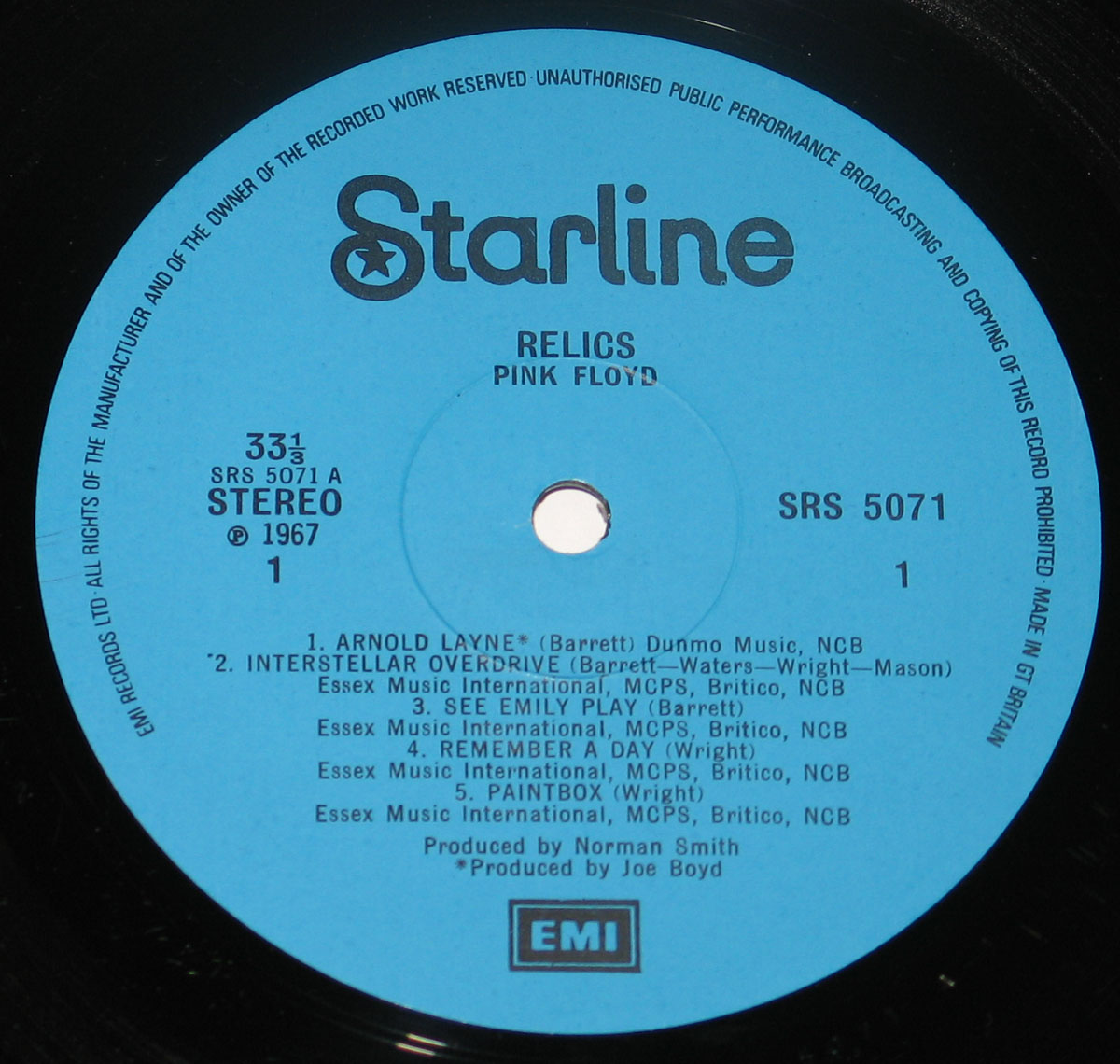
Close up of Side One label for PINK FLOYD Relics UK Starline SRS 5071, blue EMI Starline label with black print, 33 1/3 stereo marking, catalogue SRS 5071 A, publishing credits and EMI logo at bottom, UK pressing.

Side One of the UK Starline pressing sits there in that unmistakable light blue EMI wash, slightly matte, not glossy, with black print that has softened just a touch over the decades. The spindle hole shows faint circular stress marks from careful play, nothing abusive, just the normal history of a record that has been lifted and lowered a few hundred times.

At the top, the large “Starline” logo curves confidently across the label, the “S” containing a small five-pointed star inside its rounded bowl. It is not decorative fluff; this was EMI’s budget imprint, designed to reissue catalogue titles at a lower price point without redesigning them entirely. Around the outer rim runs the classic EMI legal text in a tight circular band, warning against unauthorised public performance and copying. The text is in English, confirming UK manufacture.

“RELICS” and “PINK FLOYD” sit centered beneath the logo in clean sans-serif type. To the left: 33 1/3 speed marking, “SRS 5071 A,” “STEREO,” and the 1967 date reference. To the right: “SRS 5071” and the side indicator “1.” Publishing credits list Dunmo Music and Essex Music International, alongside MCPS, Britico and NCB codes, clearly identifying the UK rights framework of the period. Production credits for Norman Smith and Joe Boyd are printed directly under the track list, with the small EMI box logo anchoring the bottom. No imagery, no background art—just flat colour. Functional, almost austere, and very much early-70s EMI discipline.

Starline (EMI), United Kingdom Label

EMI’s Starline imprint was introduced as a mid-price reissue series, offering established catalogue titles in simplified packaging. This blue label variant was used in the early 1970s for UK domestic pressings of back-catalogue releases including Pink Floyd titles.

Colours
Light blue background with black text and black EMI box logo.
Design & Layout
Minimalist circular layout with curved Starline logo at top, centered album title and artist, technical data left and right of spindle hole.
Record company logo
“Starline” wordmark with integrated star inside the initial “S,” indicating EMI’s budget reissue series.
Band/Performer logo
No separate band logo; artist name printed in standard uppercase sans-serif.
Unique features
SRS 5071 A matrix reference on label, dual producer credit lines, full publishing breakdown including MCPS, Britico and NCB societies.
Side designation
Side indicator “1” printed beneath catalogue reference on right side.
Rights society
MCPS, Britico, NCB.
Catalogue number
SRS 5071 (Side A: SRS 5071 A).
Rim text language
English, stating manufacturing and public performance restrictions, “Made in Gt Britain.”
Track list layout
Numbered track listing in compact block format, composer credits in parentheses.
Rights info placement
Publishing and rights societies printed directly beneath each track entry.
Pressing info
UK EMI pressing, catalogue and speed marking positioned left of spindle hole.
Background image
Solid light blue field without additional imagery.

All images on this site are photographed directly from the original vinyl LP covers and record labels in my collection. Earlier blank sleeves were not archived due to past storage limits, and Side Two labels are often omitted when they contain no collector-relevant details. Photo quality varies because the images were taken over several decades with different cameras. You may use these images for personal or non-commercial purposes if you include a link to this site; commercial use requires my permission. Text on covers and labels has been transcribed using a free online OCR service.

Index of PINK FLOYD's Relics Vinyl Album Discography and Album Cover Gallery

PINK FLOYD - Relics (Europe) 12" Vinyl LP
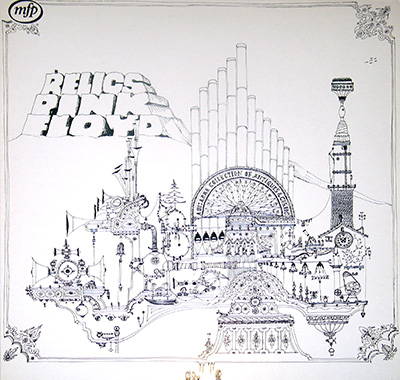
PINK FLOYD - Relics (Europe) album front cover
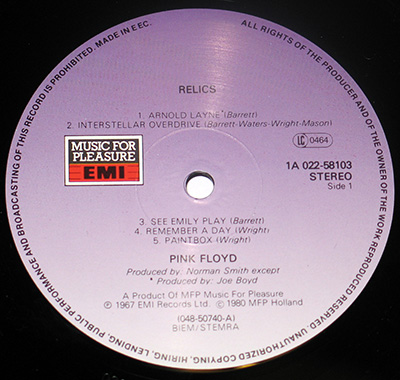
PINK FLOYD - Relics (Europe) record label

EMI 1A 022-58103  , 1980 , EEC

Pink Floyd's "Relics," a 1980 European release on the EMI "Music For Pleasure Record Label," encapsulates the band's early brilliance. Highlighting Syd Barrett-era hits like "Arnold Layne" and "See Emily Play," it unveils a previously-unreleased gem, "Biding My Time" by Roger Waters. Recognizable by the "MFP" logo, gradient purple background, and "MADE IN EEC" inscription, this vinyl LP, with Nick Mason's artwork, stands as a timeless relic, offering a sonic journey through Pink Floyd's formative years.

Learn more
PINK FLOYD - Relics (England) 12" Vinyl LP
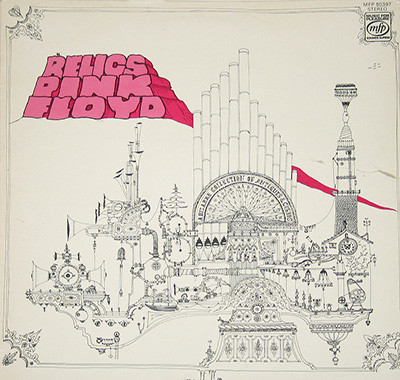
PINK FLOYD - Relics (England) album front cover
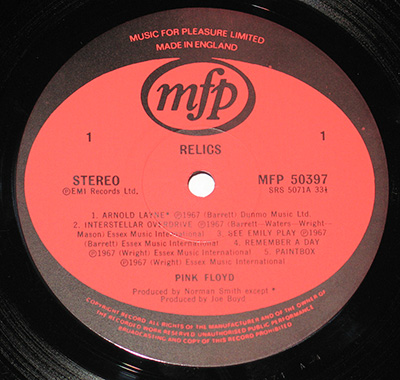
PINK FLOYD - Relics (England) record label

  Music For Pleasure MFP 50397 , 1971 , England

Pink Floyd's "Relics," a 1971 release from England, encapsulates the band's Syd Barrett era with hits like "Arnold Layne" and "See Emily Play." The album, adorned with distinctive purple typography, is a collector's gem. Noteworthy for its unreleased track, "Biding My Time," and identifiable by the Music For Pleasure label with red and black background, this vintage vinyl, cataloged as MFP 50397, is a sonic and visual journey through Pink Floyd's evolution.

Learn more
PINK FLOYD - Relics (France) 12" Vinyl LP
PINK FLOYD - Relics (France) album front cover
PINK FLOYD - Relics (France) record label

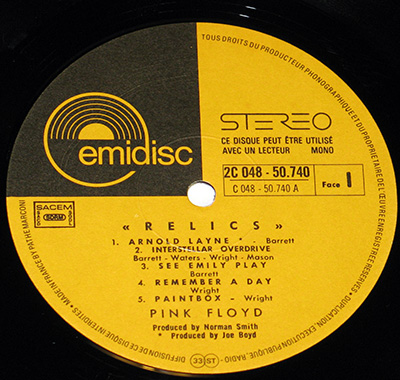
  Emidisc 2C 048-50.740 , 1971 , France

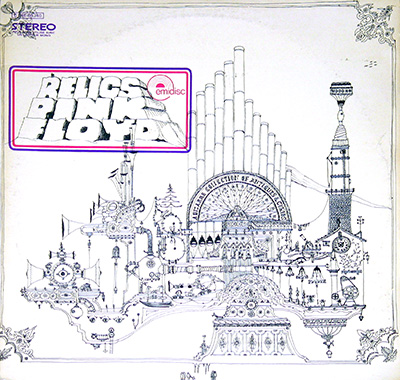
Pink Floyd's "Relics" French 2nd EMIDISC 12" Vinyl LP Album is a collector's gem, distinguished by its red and blue "Boxed" title and striking yellow-and-black EMIDISC label. Released in 1971, this compilation of iconic tracks encapsulates the band's evolution. With its unique design and historical context, this edition is a sought-after treasure, showcasing Pink Floyd's enduring influence on music and its timeless appeal to enthusiasts and collectors.

Learn more
PINK FLOYD - Relics (France Export) 12" Vinyl LP
PINK FLOYD - Relics (France Export) album front cover
PINK FLOYD - Relics (France Export) record label

 Emidisc – 1 C 048-50 740 L , 1971 , France Export Edition

Pink Floyd's "Relics," a 1971 compilation album, is a collector's gem made in France for German distribution. The album cover, adorned with the iconic band name and catalog number, exudes aesthetic charm. The back cover reveals unique features, including distribution details. The vinyl's label, a visual delight in Black/Yellow(Orangish), bears the GEMA rights society stamp. Matrix and run-out codes authenticate its origin, making "Relics" a timeless piece in the musical tapestry of the early 1970s.

Learn more
PINK FLOYD - Relics (Germany 1st Release) 12" Vinyl LP
PINK FLOYD - Relics (Germany 1st Release) album front cover
PINK FLOYD - Relics (Germany 1st Release) record label

Emidisc 1C 048-50 740 , 1971 , Germany

Pink Floyd's "Relics" 12" Vinyl LP, a genuine 1st German release, stands as a collector's gem. Marked by unique identifiers like catalog numbers and distinctive labels, it encapsulates the band's early years, featuring Syd Barrett-era hits and rare studio recordings. With iconic producers and Mason's artwork, "Relics" is a timeless testament to Pink Floyd's musical evolution, cherished by fans as a captivating relic from a pivotal period.

Learn more
PINK FLOYD - Relics (EEC Germany) 12" Vinyl LP
PINK FLOYD - Relics (EEC Germany) album front cover
PINK FLOYD - Relics (EEC Germany) record label

 Harvest 1C 048-50 740 , 1971 , EEC Export Edition

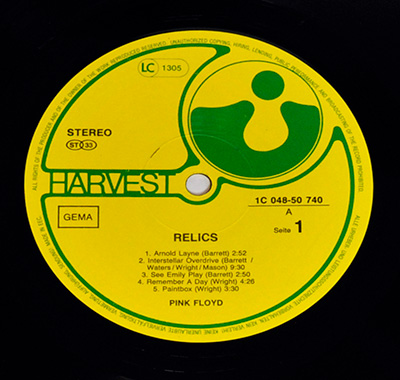
Pink Floyd's 1971 "Relics" 12" vinyl, crafted for distribution in Germany, compiles Syd Barrett-era hits like "Arnold Layne" and "See Emily Play," alongside rare B-sides. The album unveils a previously-unreleased studio recording of Roger Waters' "Biding My Time." Producers Joe Boyd and Norman Smith, along with Nick Mason's artwork, contribute to the album's allure. Collectors value specific identifiers, such as catalognr 1C 048-50 740 and the "MADE IN EEC" label, making it a prized piece in Pink Floyd's discography.

Learn more
PINK FLOYD - Relics (Gt Britain) 12" Vinyl LP
PINK FLOYD - Relics (Gt Britain) 
 album front cover
PINK FLOYD - Relics (Gt Britain) 
 record label

Starline SRS 5071 , , Gt Britain

Pink Floyd’s “Relics” on UK Starline SRS 5071 captures the raw Syd Barrett-era psyche just before prog went monumental. Produced by Norman Smith and Joe Boyd, with Nick Mason’s intricate mechanical cover art, it jumps from “Arnold Layne” to “Careful With That Axe, Eugene.” Blue EMI label, “Made in Gt Britain” rim text — a collector’s acid-soaked time capsule.

Learn more
PINK FLOYD - Relics (Netherlands) 12" Vinyl LP
PINK FLOYD - Relics (Netherlands)  album front cover
PINK FLOYD - Relics (Netherlands)  record label

Emidisc – 5C 048-5074 , 1971 , Netherlands

This album "Relics" is a compilation album of early "Pink Floyd" recordings and is most noted for its inclusion of Syd Barrett-era hit singles, "Arnold Layne" and "See Emily Play", as well as B-sides to three other singles. It also includes a previously-unreleased, studio recording of a Roger Waters composition, "Biding My Time", which had otherwise only been heard by live audiences as part of "The Man/The Journey" concert sequence.

Learn more
PINK FLOYD Main Index